



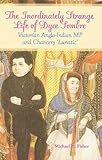
Michael Herbert Fisher. The Inordinately Strange Life of Dyce Sombre: Victorian Anglo Indian MP and Chancery "Lunatic". New York: Columbia University Press, 2010. xx + 396 pp. $27.50 (cloth), ISBN 978-0-231-70108-2.
Reviewed by Shrabani Basu (Historian and journalist)
Published on H-Asia (November, 2010)
Commissioned by Sumit Guha (The University of Texas at Austin)
Nowhere Man: Dyce Sombre in England
Victorian England always had its share of intriguing characters--empire and industrialization combined with poverty and deprivation providing a fertile milieu for them. While the Elephant Man and Jack the Ripper lay claim on London’s East End, there were others--less known--who also caused a stir in the heart of London and Westminster.
One of these was David Ochterlony Dyce Sombre, heir to the state of Sardhana in India, but labeled in England as a “Chancery lunatic.” The moment in Michael Fisher’s book, when he escapes from confinement and makes his way to France, has the makings of pure Victorian melodrama.
The year is 1843, when Victoria and Albert are taking Britain into the age of steam. Dyce Sombre, a fabulously wealthy, corpulent Anglo-Indian, former member of Parliament and certified “lunatic,” decides to escape. Leaving his elegant London home in Regent’s Park, Dyce Sombre heads north for Liverpool and checks into the fashionable Adelphi Hotel near Lime Street station. He even throws the locals off guard by feigning interest in buying a boat and sailing down the Mersey River. Instead, on September 21 at 4:00 a.m. he leaves his hotel room in the dead of night, quietly heads for the railway station, and boards a night express train from Liverpool to London. Four hours later he transfers to another fast train bound for Southampton port. With faultless timing, he books an overnight steam-packet to Le Havre, entering France without any identity papers and hardly any money. By the evening of September 22, only forty-four hours after leaving Liverpool, Dyce Sombre pawns a pocket watch, his diamond buttons, and a solid-gold pencil case and checks into the expensive Hotel du Rhin in Paris. The “lunatic” is ready to establish himself in Parisian society and take on the might of the East India Company.
Michael Fisher’s biography of the rich and rakish Anglo-Indian, David Ochterlony Dyce Sombre, makes fascinating reading. Dyce Sombre (as he preferred to be known in England) could have walked straight out of the pages of a Dickens novel, had he not been as tangible as the empire and, in fact, very much a product of it. Born in 1808 in the state of Sardhana near Delhi, Dyce Sombre was an Anglo-Indian of mixed French, German, Scottish, and Indian descent. He was adopted by Begum Farzana, a Muslim courtesan who became the ruler of the kingdom of Sardhana, a small kingdom near Delhi, at an early age. The mistress of a notorious German Catholic mercenary, Walter Reinhardt “Sombre,” Begum Farzana soon inherited his wealth and the little kingdom which had been given him to him as jagir by the Mughals. She gave herself the name of Begum Sumroo, became a Catholic, built impressive churches and palaces, and raised her own private army, ruling both from Sardhana and her palaces in Delhi’s Chandni Chowk area. She wooed both the Mughals and the British Raj and in defiance of Raj protocol, grandiosely awarded herself a 101-gun salute. The shrewd Begum chose David Ochterlony, great-grandson of Walter Reinhardt from his first wife, to be her sole heir. He took the full name of David Ochterlony Dyce Sombre from his father (George Dyce), his paternal grandfather (a Scottish Presbyterian subaltern named David Dyce), and his maternal great-grandfather Walter Reinhardt “Sombre.”
The first part of the book deals with David Ochterlony’s life in India, as heir to the kingdom of Sardhana. Hand-picked by Begum Sumroo, he displaced his own father, George Dyce, and became the colonel commandant of her army. The dazzling wealth of Sardhana gave him the freedom to maintain an extravagant lifestyle. The Begum had two palaces in Delhi, both used by David Ochterlony. He grew up speaking Persian, Urdu, and English and learned some Latin and Italian. Preferring to wear European clothes, he lived a life of disrepute: gambling, womanizing, and frequently contracting sexually transmitted diseases. He had two regular mistresses, Dominga, a Catholic with some European ancestry, and Hoosna Baae, a Muslim. When Begum Sumroo died in 1836, the British seized the kingdom of Sardhana and from this point David Ochterlony’s life became a battle with the East India Company.
The second part of the book covers David Ochterlony’s departure for England, where he used the name Dyce Sombre. He flaunted his wealth and married Mary Ann Jervis, a society celebrity and daughter of an aristocrat, a woman whose lovers included the Duke of Wellington.
In England, the corpulent and dark-complexioned Dyce Sombre was toasted for his wealth but sniffed at for his Oriental heritage. He in turn became irrationally jealous of his wife, accusing her of having several lovers and threatening to fight duels with all of them. He bribed his way to be elected a member of Parliament for Sudbury, becoming the first Anglo-Indian to sit in Parliament, but very quickly the glamour faded. His election was overturned and he was soon after declared a “Chancery lunatic.” His access to his own funds was blocked and he escaped to Paris to fight his case, later making an attempt to reach India through Russia.
Dyce Sombre gathered evidence from French and European doctors to prove his sanity; he fought at least six cases at the Chancery Court but all to no effect. Even at his death, he was considered “insane” and the legal battle with the East India Company continued. It took decades to settle the disposition of his inheritance, which finally went mostly to his brother-in-law as Dyce himself had no heirs. Dyce Sombre was buried in Kensal Rise cemetery though he had requested that he be taken to Sardhana for burial (and that his heart be embalmed and preserved).
Michael Fisher’s well-researched book also illustrates the thin line between sanity and insanity. Based on detailed newspaper reports and court papers, the book throws up several questions. Was Dyce Sombre considered a lunatic because of his Oriental background, which often led him to have a different perception of life in the West? Can Dyce Sombre actually go on record as the first Asian in the British parliament? He himself always discounted his Indian roots and preferred to project himself as European--of Scottish and German extraction. Yet he had Indian blood in his veins and wanted to be buried in Sardhana. The book ultimately reveals the tragic life of a rootless man, at home neither in India nor in the West, and the politics of wealth, race, and colonization that ultimately subsumed him.
If there is additional discussion of this review, you may access it through the network, at: https://networks.h-net.org/h-asia.
Citation:
Shrabani Basu. Review of Fisher, Michael Herbert, The Inordinately Strange Life of Dyce Sombre: Victorian Anglo Indian MP and Chancery "Lunatic".
H-Asia, H-Net Reviews.
November, 2010.
URL: http://www.h-net.org/reviews/showrev.php?id=31584
 | This work is licensed under a Creative Commons Attribution-Noncommercial-No Derivative Works 3.0 United States License. |

