



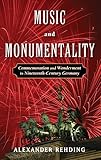
Alexander Rehding. Music and Monumentality: Commemoration and Wonderment in Nineteenth-Century Germany. Oxford: Oxford University Press, 2009. vii + 308 pp. $49.95 (cloth), ISBN 978-0-19-538538-0.
Reviewed by Lindsay Hansen (California State University - Northridge)
Published on H-German (November, 2010)
Commissioned by Benita Blessing (Oregon State University)
Grand Aspirations: German Composers’ Contributions to European History
What makes a piece of music monumental? When does a composer deserve a ceremony to commemorate his or her work? In his Music and Monumentality, Alexander Rehding discusses "musical monumentality" and attempts to answer these questions. He notes that the term is used frequently, but rarely defined. Indeed, the Grove Dictionary of Music, a fine starting point for any musical research, does not have an entry for monumentality; rather, it sprinkles the term freely throughout many articles.[1] Although there is a tendency for music historians to consider brash, noisy works, such as Peter Ilych Tchaikovsky's 1812 Overture, as monumental, Rehding suggests that monumentality may be subtler. He says that it is "better understood as the imaginary link between musical bigness and greatness" (p. 9), and that--as musicians and audience members--we need to recognize that quiet or thoughtful music may also be monumental. Consider, for example, the use of Samuel Barber's somber Adagio for Strings (1938) at funerals; it is a quiet and slow piece that is both moving and monumental. Rehding uses a clear writing style, but assumes his readers have enough musical knowledge to read the illustrative excerpts and follow intricate discussions of music theory.
Employing a variety of historical images to support his arguments, Rehding has taken advantage of the rich resources at Harvard's Loeb Music Library. The book includes roughly sixty pages of thorough footnotes and a bibliography that will prove useful for further investigation. Although he has translated all German quotations into English, he provides the original German in footnotes. In addition, the book's detailed index allows for in-depth browsing by subject.
Rehding only examines German music, arguing that Germany faced unique political-musical challenges in the nineteenth century. England had London, and France had Paris as cultural centers. Germany, with its nation-states, lacked a geographical center for musical output. Great composers could be honored in London's Westminster Abbey, for instance, but Germany had no similar place for physical monuments until Walhalla opened in 1842.[2] As is clear from this example, Rehding alternates between discussion of monumental music and musical monuments, considering both the artistic and physical ideas of monumentality and commemoration. In this way, he looks at what makes a musical work monumental, and how monuments or celebrations can in turn honor a composer.
Rehding divides his work into six chapters, considering compositions and efforts by familiar German composers: Richard Wagner, Franz Liszt, Johannes Brahms, and Anton Bruckner. Using these case studies, Rehding considers different kinds of musical magnitude, including "historical greatness" and "dramatic wonderment" (p. 27). In addressing these concepts, he notes that German philosophers have long grappled with the definition of monumentality. For example, Friedrich Nietzsche devised a mountain metaphor of musical peaks and valleys. Rehding argues that the majority of works that are deemed universally monumental are nationalist in some way. This link between nation and music facilitated the later association of certain German composers with Nazi ideology. To that end, Rehding offers a quote from Nietzsche that, "only German composers know how to lend expression to an excited mass of people" (p. 43).
These monumental German composers inspired later composers to create monuments. For example, Liszt funded a physical monument in Bonn to Ludwig von Beethoven, the first composer to be honored with a statue in Germany (p. 54). The story is one of the most compelling parts of this book: Liszt was not entirely altruistic, and focused the concert and celebration on his own monumental music and agenda. Liszt later worked on a celebration in Weimar, perhaps Germany's greatest cultural center and home to many commemorations, honoring Johann Wolfgang von Goethe's work. For the occasion, he penned a vocal piece with a dramatic sketch featuring heaven and hell. The illustration borders on kitsch, which Rehding addresses as a theme throughout his narrative (p. 55). That is, monumentality and celebration can easily turn into kitsch or parody. In a twist on locations of monumentality, the local newspaper offered a reprint of the music in a souvenir program, allowing individuals to perform and further commemorate the piece at home.
Continuing with this observation, Rehding establishes the importance of the piano, and piano editions of monumental works. This instrument, and the ability to reproduce musical arrangements that centered on the piano, allowed people to enjoy large-scale works at home. For example, Liszt arranged many Beethoven and Wagner works for piano; these pieces are still popular today. Rehding explains the importance of these arrangements that, "like the modern souvenir, then, which can substitute for the first-hand experience of a tourist destination, the piano arrangement can stand in for the experience of listening to a new operatic work" (p. 106). The piano arrangement is thus itself a monument for a monumental work.
A critical section of this work addresses the Denkmäler deutscher Tonkunst series, or the complete collected works of German composers, edited by Philipp Spitta.[3] Composers in this series included Johann Sebastian Bach and George Frideric Handel, but officially excluded Christoph Gluck. Born in Bohemia, but working in Vienna, Spitta considered Gluck Austrian and not German. The Denkmäler created an ongoing monument to German music; newer composers could be compared more easily to those already in the canon. As Spitta noted (in opposition to Nietzsche), these collected works meant that "musical monumentality would no longer fully reside in isolated peaks, the highlights of the musical canon, but in the full alpine landscape" (p. 165). The Denkmäler helped to tell a more complete story of German musical history.
Finally, Rehding addresses the unfortunate link between monumental music and extreme nationalism, demonstrating how the Nazi Party could not resist using works by Wagner and Bruckner to excite crowds and instill German pride in their nation's musical greatness. Unlike other scholarship on the general connection between Nazism and German nationalist appropriations of music, Rehding focuses on specific musical gestures, like tremolos. Rather than repeat accepted scholarship on Nazi associations with Romantic composers like Wagner, Rehding explains how these musical gestures, and not simply an abstract idea of music, excited the crowds. Rehding notes other uses of music monumentality in National Socialist ideology: During the Third Reich, Bruckner received a large monument in Walhalla, and was feted with a carefully choreographed celebration of more than three thousand participants. Rehding includes a powerful photograph that leaves no doubt as to the importance accorded music by Nazis: The image of Adolf Hitler placing wreaths on the Bruckner bust as part of the ceremony is one of the most effective illustrations in his book.
In his epilogue, Rehding discusses the ultimate musical monument: the use of Beethoven's Ninth Symphony to celebrate the fall of the Berlin Wall in 1989. Leonard Bernstein conducted the work on November 9, 1989, taking controversial liberties with the text to better match the occasion (substituting "freedom" for "joy" in the famous "Ode to Joy" melody) (p. 197). With such examples, Rehding's book offers a complex examination of German musical history and the resulting monuments, both musical and physical. He provides insight into little-known squabbles between composers, historians, musicologists, and conductors. This volume will be of interest to scholars of the Romantic period and, to a lesser extent, the development of music in Nazi Germany.
Notes
[1].Stanley Sadie, ed. The New Grove Dictionary of Music and Musicians (London: Oxford University Press, 2001).
[2]. http://www.walhalla-regensburg.de/ s.v. October 26, 2010.
[3]. Philipp Spitta et al., Denkmäler deutscher Tonkunst (Leipzig: Breitkopf and Haertel, 1891-present).
If there is additional discussion of this review, you may access it through the network, at: https://networks.h-net.org/h-german.
Citation:
Lindsay Hansen. Review of Rehding, Alexander, Music and Monumentality: Commemoration and Wonderment in Nineteenth-Century Germany.
H-German, H-Net Reviews.
November, 2010.
URL: http://www.h-net.org/reviews/showrev.php?id=31545
 | This work is licensed under a Creative Commons Attribution-Noncommercial-No Derivative Works 3.0 United States License. |

