



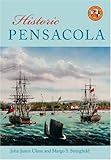
John J. Clune, Margo S. Stringfield. Historic Pensacola. Colonial Towns and Cities of the Atlantic World Series. Gainesville: University Press of Florida, 2009. Illustrations. xi + 185 pp. $27.00 (cloth), ISBN 978-0-8130-3256-6.
Reviewed by Lucy D. Jones (Florida History, LLC)
Published on H-Urban (June, 2011)
Commissioned by Robert C. Chidester (The Mannik & Smith Group, Inc.)
Colonial Pensacola in the Atlantic World: An Interdisciplinary Approach
Historic Pensacola is the first in a new series, Colonial Towns and Cities of the Atlantic World, published by the University Press of Florida. In a foreword, series editors John J. Clune Jr. and Gregory Waselkov explain that their intention is to examine local histories from a global perspective using an interdisciplinary approach, while making research accessible to a larger audience--a daunting task, but one that Historic Pensacola does accomplish. The book’s authors are Clune, a historian, and Margo S. Stringfield, an archaeologist, both of whom work at the University of West Florida, located in Pensacola. Historians and archaeologists are not often viewed as being succinct writers, so it is all the more impressive that the pair manages to cover 262 years of history in just 160 pages of text. Despite lengthy names, numerous dates, and a smattering of technical terminology, the narrative is quite readable. The book’s format contributes to its accessibility with well-spaced text, wide margins, glossy paper, and large full-color illustrations. Each chapter is followed by recipes for colonial dishes, such as cocido (Spanish stew) and British punch.
The authors tell Pensacola’s story using both written and archaeological records to describe the colonists’ diets, entertainment, spiritual life, and mortality. Historical records are used to outline the global political forces that led to successive settlement efforts at Pensacola Bay, particularly competition between Spain, France, and England. They discuss tenets of Spanish and British town planning and military engineering and their expression in successive settlements at Pensacola. While the physical shape of the early Spanish settlements at Pensacola are visible primarily through archaeological excavation, the town plan created by British surveyor Elias Durnford is still embodied in the Seville Historic District of today. Urban planners will also find interesting the discussion of the early nineteenth-century Pensacola Tivoli House, a public gathering place.
The impact of the environment on the colonists was dramatic, as it affected their food supplies every day and threatened their existence when hurricanes struck. Conversely, the colonists had an impact on the environment, introducing new diseases, crops, and pests. As an example of the latter, excavation of sixteenth-century Spanish shipwrecks associated with the founding of Pensacola has yielded some of the earliest documented instances of Old World cockroaches and black rats in the New World. Obviously, archaeology can provide information not found in written records. Other unwritten histories pursued by archaeologists in Pensacola include those of women, children, and servants or slaves. Artifacts recovered in excavations also suggest that the trade between Spanish Pensacola and French Mobile was far more extensive than officially reported.
Historic Pensacola traces the political, cultural, and landscape history of the city from the repeated attempts of the Spanish to establish a permanent settlement beginning in 1559 to the British presence and subsequent reoccupation by the Spanish, and ending with the United States’ acquisition of Florida in 1821. The book is well researched, with fairly sparse endnotes avoiding unwarranted interruptions to the flow of the text, and an eight-page bibliography for those who wish to explore the topic more deeply. By being interdisciplinary and academic yet appealing to a general audience, the authors run the risk of trying to be all things to all people. Who is most likely to use this book? Historic Pensacola should appeal to an educated layperson with an interest in history or someone inspired to learn more following a visit to Pensacola; given the increasing opportunities for heritage tourism in Pensacola, this could be a growing market. The book will also appeal to scholars in the fields of history, archaeology, or urban studies who may not be familiar with the area or time period and would appreciate a general introduction. As a historian who works with archaeologists every day, I appreciate this book as an example of how the two professions have much to offer each other and much to gain from an interdisciplinary approach to studying urban and colonial history.
If there is additional discussion of this review, you may access it through the network, at: https://networks.h-net.org/h-urban.
Citation:
Lucy D. Jones. Review of Clune, John J.; Stringfield, Margo S., Historic Pensacola.
H-Urban, H-Net Reviews.
June, 2011.
URL: http://www.h-net.org/reviews/showrev.php?id=31472
 | This work is licensed under a Creative Commons Attribution-Noncommercial-No Derivative Works 3.0 United States License. |

