



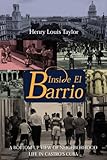
Henry Louis Taylor. Inside El Barrio: A Bottom-Up View of Neighborhood Life in Castro's Cuba. Sterling: Kumarian Press, 2009. xviii + 217 pp. $24.95 (paper), ISBN 978-1-56549-281-3; $69.95 (cloth), ISBN 978-1-56549-282-0.
Reviewed by Frank Argote-Freyre (Kean University)
Published on H-LatAm (March, 2012)
Commissioned by Dennis R. Hidalgo (Virginia Tech)
Inside El Barrio: Where Does the Individual End and the Neighborhood Begin?
Inside El Barrio raises several philosophical questions: How much personal, political, and economic freedom should be sacrificed at the altar of creating social justice and equality? Can these high-minded ideals be achieved voluntarily or is some degree of coercion required? How is social justice measured and defined?
Henry Louis Taylor argues in his work that the Cuban Revolution has been exploring these questions for fifty years and has achieved a measure of success in promoting social justice at the neighborhood level. The “social-function model” is central to the Cuban concept of neighborhood development and land use. “Undergirding the model is the belief that residents are bio-psycho-social beings who have an interactive relationship with their neighborhood,” writes Taylor, an urban planner by training (p. 72). In keeping with this model, the Cuban government seeks to embed vital community services, such as healthcare, schools, food distribution centers, culture, and recreation, into each community so that they interact with each other rather than operate independently.
A case in point, Taylor notes, is the doctor-nurse program, established in the 1980s, which seeks to operate a clinic in every neighborhood staffed by a doctor and nurse. The first floor serves as the treatment area, while the second and third floors serve as housing for the medical team, thus making the doctor and nurse members of the community they serve. In addition to providing care at the clinic, the medical team is expected to offer educational programs at the local school, as well as make house calls to the sick and elderly. The same concept applies to education, where teachers are expected to visit parents and students at their homes on a periodic basis.
The book, based on a seven-year study from 1999 to 2006 that includes almost four hundred interviews of residents, is strongest when it focuses on local land use issues in San Isidro, a neighborhood in old Havana (Habana Vieja). As solid as the neighborhood study is, it would be difficult to make inferences about the entire island, perhaps even all of Havana, from it, a point the author readily admits. There is a chapter in the work that provides a broad overview of all of Havana’s neighborhoods and a useful map accompanies the section. The photographs of the neighborhood sprinkled throughout chapter 5 also enhance the narrative of the text.
The statistical data compiled from the interviews coupled with the anecdotes about the neighborhood bring San Isidro to life so that one can almost smell the Cuban coffee brewing and feel the heat rising from the narrow streets. The neighborhood consists of 22 blocks that includes 1,384 dwellings with over 11,000 residents. It is a relatively young community (60 percent are under the age of 32) and there is an average of 8 persons to a housing unit. “This nexus between dwellings and streets creates an intimate environment that transforms the street into a living room, an extension of the home and a comfortable setting that encourages social interaction” (p. 150).
In his work, Taylor provides great insight into how community land-use issues are resolved. During the course of his study of San Isidro, a dispute arose over a corner vacant lot used by neighborhood children to play sports. The teenagers wanted a recreational center built on the lot, but some of the community elders objected. A ceiba tree, of particular religious significance to practitioners of Santeria, grew in the middle of the vacant lot and so it was turned into a “meditative park.” The displeasure voiced over that decision spurred a “community-driven process” to find alternative sites for recreational use which ultimately led to the construction of a community gymnasium (p. 161).
The Committees for the Defense of the Revolution (CDR--Comités de Defensa de la Revolución) are the “social glue that holds Cuban neighborhoods together and the engine that drives neighborhood life” (p. 81). Taylor notes that everyone must register with their local CDR, and the “organization maintains records on all residents, including a person’s friends, visitors, family members, work history, day-to-day activities, and participation in neighborhood life” (p. 84). It is this detailed information that allows the government to respond to problems that arise in the community before they reach a crisis point. As an example of a response to a simmering problem, Taylor writes about the dispatch of teams of social workers to troubled neighborhoods when a precipitous economic decline in the late 1990s led to a dramatic increase in crime.
While these scholarly contributions are invaluable to an understanding of Havana’s neighborhoods, Inside El Barrio is a deeply flawed work. As Taylor chronicles efforts by the Cuban Revolution to turn the “monumental city” of 1950s Havana, with its racially and economically segregated neighborhoods, into a city for the “popular classes,” there is scarcely a mention of the negative side of Cuba’s social experiment. In his discussion of the CDRs, Taylor makes no effort to address concerns regarding their coercive nature or to raise the possibility that they serve as a social control mechanism to clamp down on dissent. He never addresses the sacrifices of personal freedom Cubans are required to make to create these neighborhoods of relative equality. In discussing the stability of many neighborhoods, Taylor observes: “When the incomes of residents improve, they typically remain in the same neighborhood rather than move to a new location. This is a social asset that imbues the community with a strong culture of work” (p. 77). This may be so, but at no time does the author ask the next logical question: why do residents not move when their incomes increase? Is it simply that they are happy staying in the same neighborhood? Or is it possible they have few relocation options available given the nature of the Cuban system? Asking those questions would open up a series of issues about the nature of the Cuban state and its control over its citizens that Taylor has no interest in addressing.
This failure to engage in a debate over the Cuban social experiment is a weakness that runs throughout the book. The author does not address the voluminous body of research and scholarship documenting the systematic repression that has been a hallmark of the Cuban political system. He vaguely alludes to these criticisms in his epilogue and dismisses them as “ideological biases” that make it difficult to assess “Cuba through an objective lens” (p. 178).
In discussing the current Cuban government, Taylor notes that “it recognizes the importance of creating a forum where people can voice their opposition to governmental policies and programs that concern them. This openness appears to be an important feature of the Raúl Castro regime” (p. 177). Yet, the same year Inside El Barrio was published (2009), Human Rights Watch released a scathing report, entitled New Castro, Same Cuba, that documents in great detail political repression in today’s Cuba. It is impossible to justify the omission of these critical issues in a work of scholarship.
In the closing paragraphs of his book, Taylor makes a brief attempt, via a quotation from former United Nations Secretary General Kofi Annan, to address the concept of “freedom.” As has often been done in the past as a defense of the Cuban Revolution, it suggests the emptiness of a political democracy that permits such gross inequalities that the life and dreams of many, if not most, are stifled. This is an underlying theme of the entire work. Personal freedoms have been sacrificed at the national and neighborhood level, and for Taylor, the benefits outweigh the sacrifices.
Do not expect a well-rounded debate or exploration of the tensions between individual and community rights while reading Inside El Barrio.
If there is additional discussion of this review, you may access it through the network, at: https://networks.h-net.org/h-latam.
Citation:
Frank Argote-Freyre. Review of Taylor, Henry Louis, Inside El Barrio: A Bottom-Up View of Neighborhood Life in Castro's Cuba.
H-LatAm, H-Net Reviews.
March, 2012.
URL: http://www.h-net.org/reviews/showrev.php?id=31444
 | This work is licensed under a Creative Commons Attribution-Noncommercial-No Derivative Works 3.0 United States License. |

