



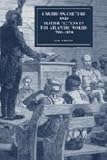
Tim Watson. Caribbean Culture and British Fiction in the Atlantic World, 1780-1870. Cambridge: Cambridge University Press, 2008. xv + 263 pp. $90.00 (cloth), ISBN 978-0-521-87626-1.
Reviewed by Susan Hall (Cameron University)
Published on H-Atlantic (July, 2011)
Commissioned by W. Douglas Catterall (Cameron University of Oklahoma)
Caribbean Space: Networks of Influence in British Literature and Politics
Tim Watson’s Caribbean Culture and British Fiction in the Atlantic World, 1780-1870 follows in the tradition of postcolonial scholarship about this region through its dislodging of the Eurocentric--or in this case, Anglocentric--interpretative lens that once dominated Western accounts of events and people living in Jamaica during the ninety years that the book examines. Watson’s approach might also be characterized as postmodern; that is, he focuses on lesser-known individuals, such as Simon Taylor and Samuel Ringgold Ward, to open up discussions about the sugar plantations prior to abolition and the 1865 Morant Bay Rebellion, respectively. Instead of singular narratives about the Caribbean or Britain, Watson traces connections and networks of influence between economics, religion, politics, science, and literature in the Caribbean, Britain, and the United States. Watson admirably negotiates between historical methodologies and literary criticism, and even though his book primarily analyzes events and people in southeastern Jamaica, his work offers claims that are relevant to the broader field of postcolonial Caribbean studies and critiques of British imperialism. Literary scholars who work on Maria Edgeworth’s Belinda (1801) and George Eliot’s Felix Holt, the Radical (1866) will be interested in Watson’s astute readings, which highlight the influence of colonial politics on these novels. Hamel, the Obeah Man (1827), published anonymously but presumably authored by Charles White Williams, and Ward’s Autobiography of a Fugitive Negro (1855) are two fascinating texts that are beginning to receive the attention that they deserve, and Watson’s book makes an impressive contribution to scholarship on these works.
Watson’s first two chapters focus on the genres of realism and romance and their deployment with respect to politics and economics in Jamaica and Britain. As he develops arguments about the entanglement of realism and romance in writing about Jamaica, his impressive archival work is evident in his analysis of newspapers, letters, journals, missionary accounts, and British administrative records (to name a few of the types of material under consideration) concerning Jamaica. Watson begins by defining “creole realism” as “the attempt to narrate the story of the British colonies from the point of view of a planter class defined by their qualities of reasonableness and enterprise” (p. 17). Developing this concept from the first chapter, Watson takes the personal and business writings of Taylor, a wealthy master of a large sugar plantation and creole politician, as the focus of his analysis to establish the Caribbean as a crucial site for the exchange of commodities and people. Taylor recorded the numbers of slaves, names of ships, and kinds of goods that crossed the Atlantic. One of the most important claims in this chapter concerns the United States as an emerging “counter-metropole to England” (p. 33), as Watson puts it, and in later chapters, Watson continues to explore the theme of shifting power relations in the Atlantic world. Taylor railed against antislavery missionaries and activists, like William Wilberforce, and, as he felt that his dominant position in Jamaica was growing increasingly untenable, he contemplated the possibility of relocating to the United States, where he felt that the economic conditions were more conducive to his interests. The rest of Watson’s first chapter mainly considers the various editions and politically significant revisions, especially with respect to the role of West Indian characters, of Edgeworth’s Belinda.
In his discussion of genre and the politics of representation in chapters 1 and 2, Watson poses a compelling question: why do romantic as opposed to realistic modes often allow for more radical representations of racial inequality and conflict? One of Watson’s moves is to argue that shortly before emancipation African Jamaicans began to write in the mode of creole realism because they were drawn to its emphasis on respectability and industriousness as a means to promote their own position in Jamaica. Conversely, he asserts that the gothic and romance were the refuge of white Jamaican creoles who sensed that their way of life was on the brink of extinction. Watson identifies a white creole owner of an estate in St. Thomas-in-the-East, Williams, as the author of Tour through the Island of Jamaica (1826) and Hamel, the Obeah Man. While it is true that romances written by whites about colonial regions often idealize the relations between masters and slaves, Watson offers another way of understanding how historical events are portrayed in romance. In Watson’s interpretation, Hamel promotes the interests of white planters against abolitionist and missionary fervor on the novel’s surface, yet conveys a more challenging sub-narrative about slavery through its depiction of the slave Hamel and the narrative space devoted to his efforts to lead a rebellion. While this reader wished that Watson would have offered a more thorough interrogation of the genre of realism and its claims to verifiability and objectivity, Watson’s discussion of the romance genre is more fleshed out, and he makes a persuasive argument about the possibility of representing the enslaved as agents not objects through his analysis of Williams’s complex portrait of Hamel.
Watson frequently cites Dipesh Chakrabarty, who discusses the tension between subaltern modes of structuring reality and Eurocentric modes of historical narration, and Watson is aware of the difficulties of attempting to uncover the perspectives and daily details of the lives of those who were largely denied access to the means of recording their own stories. Although Watson is certainly attentive to the lives of African Jamaicans in the first two chapters, the materials that he works with contain inherent limitations in terms of their potential to represent accurately and fully the lives of this group of people. The third chapter may well be the strongest one as it grapples with the difficulty of placing Ward within the parameters of national histories and with the legacy of Ward’s controversial support for Governor Edward Eyre’s suppression of the 1865 Morant Bay Rebellion. Starting life as a slave in Maryland, Ward went on to lead a public life as an abolitionist, minister, and writer that took him to New York, Canada, Britain, and then Jamaica. In addition to his Autobiography of a Fugitive Negro, Ward wrote articles and pamphlets, which provide rich materials for Watson’s study. As this brief summary of Ward’s life and accomplishments suggests, he was an exceptional rather than a typical figure, and Watson might have engaged more fully with the work of other postcolonial and African American critics who analyze the impact of competing demands and the ways that these demands were negotiated by persons of color who navigated their way through oppressed and dominant cultures. One might reasonably expect that Ward’s abolitionist activities in the United States and Britain would have led him to oppose Governor Eyre’s reaction to the Morant Bay Rebellion, but Ward also supported the values of respectability and capitalism that he associated with the British Empire. Watson usefully builds on Brent Edwards’s work on the diaspora and black internationalism to show that Ward believed that “intra-imperial black entrepreneurship” would lead to economic advancement for blacks in the British Empire (p. 135). All in all, Watson’s treatment of Ward offers an overdue reassessment of Ward’s complicated and perhaps even conflicting commitments.
Watson’s study moves outward in the final chapter and in the epilogue. Tracing the contemporary debates in Britain concerning blood, race, class, citizenship, and inheritance, Watson illustrates how these debates were fueled by the crisis in Jamaica in the 1860s. In addition to well-known figures, such as Charles Darwin, Watson also examines the influence of James Hunt and Paul Broca to show how views on race shifted back to polygenism, a position associated with pro-slavery factions that claimed each race had a separate origin, as anxieties about both British imperialism and enfranchisement of the working class came to a head in Britain. Watson then grounds his reading of Eliot’s Felix Holt in the historical and cultural context described above; as Watson and others have remarked, Felix Holt is known for its inheritance plot with its overwhelming details, and he presents a convincing account of the role that Caribbean politics and British discussions of citizenship rights played in Eliot’s obsession with inheritance in her novel. In a move that nicely foregrounds the transatlantic dimension of his study, Watson concludes with an epilogue describing the transitional power relations in the Caribbean during the late nineteenth century. Frederick Douglass, one of America’s most prominent abolitionists and spokesmen for the rights of African Americans, visited Jamaica in 1871 while he was serving on the Santo Domingo Commission, which was appointed by President Ulysses S. Grant to explore the possibility of annexing the Dominican Republic. While drawing some provocative comparisons and contrasts between Ward and Douglass, Watson ends his fine study with a reminder of the crucial role that Jamaica played in the politics of the Caribbean, Britain, and even the United States during the period examined in his book.
If there is additional discussion of this review, you may access it through the network, at: https://networks.h-net.org/h-atlantic.
Citation:
Susan Hall. Review of Watson, Tim, Caribbean Culture and British Fiction in the Atlantic World, 1780-1870.
H-Atlantic, H-Net Reviews.
July, 2011.
URL: http://www.h-net.org/reviews/showrev.php?id=31389
 | This work is licensed under a Creative Commons Attribution-Noncommercial-No Derivative Works 3.0 United States License. |

