



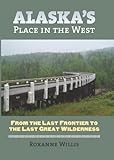
Roxanne Willis. Alaska's Place in the West: From the Last Frontier to the Last Great Wilderness. Lawrence: University Press of Kansas, 2010. xi + 186 pp. $34.95 (cloth), ISBN 978-0-7006-1748-7.
Reviewed by David Arnold (Columbia Basin College)
Published on H-Environment (May, 2011)
Commissioned by David T. Benac (Western Michigan University)
Grand Ambitions: A History to Match the Great Alaskan Landscape?
This book shows that the old adage “life is stranger than fiction” is true, especially in Alaska. Imagine this: a Presbyterian missionary named Sheldon Jackson decides that the best way to bring Alaskan Natives into the modern age is to make them into nomadic reindeer herders. In 1891, he crosses the Bering Strait with Captain Michael Healy, “the son of an Irish immigrant and his African slave,” on the first of many voyages to bring both Siberian reindeer and Chukchi herders to western Alaska and transform Alaskan Eskimos into self-sufficient herdsmen (p. 24). Jackson’s improbable scheme turns into a lifelong obsession, beset by folly and unintended consequences that range from tragic to comic. Jackson’s Chukchi herders prove less than worthy as moral exemplars for their Eskimo apprentices: they feasted heartily on reindeer lice and enjoyed wrestling the animals to the ground and gulping warm milk directly from their teats. Worse still, from the shocked perspective of a Victorian-era missionary, was their use of human urine to guide the herd. “The reindeer loved to drink human urine, and the Chukchi could effectively guide the herds in certain directions using urine streams as their beacons” (p. 29). Such savagery did not augur well for reindeer herding as a vehicle of cultural assimilation and moral uplift. Jackson sent the Chukchi on their way and raised over one hundred thousand dollars to import Saami reindeer herders from Lapland who were Christians. To no lasting effect: Inupiat Eskimos in Alaska never fully embraced the nomadic lifestyle required to become successful herders. The reindeer project was doomed by cultural conflicts, clashes between public and private interests, poor policy, and environmental collapse. The reindeer population peaked in 1930 at nearly 640,000 but had fallen to 25,000 by 1950. Jackson’s audacious vision of a northern wonderland populated by happy, self-sufficient Christian Eskimo reindeer herders was never to be fulfilled.
The woeful tale of the “Reindeer Game” comprises chapter 1 of Alaska’s Place in the West and it underscores Roxanne Willis’s primary thesis: outsiders like Jackson have continually tired to shape and transform the Alaskan environment (and in this case Alaska’s Native culture) according to their own conceptions of the place rather than the reality on the ground, and the result has most often been disastrous. According to Willis, “Alaska development proponents believed so powerfully in their ideas of what Alaskan geography should be that they continued to support large projects that made no sense environmentally. America’s changing cultural ideas of nature and place led developers down a path of continued ecological and economic destruction in Alaska” (p. 15).
Chapter 2 continues this theme of grandiose and unrealistic visions thwarted by the test of experience. In the 1930s, New Deal planners conceptualized Alaska as a twentieth-century agricultural frontier, believing that a far northern frontier, like previous nineteenth-century frontiers, would serve as the proverbial “safety-valve,” easing anxiety and offering hope to despairing Americans trapped in the quagmire of the Great Depression. Toward that end, in 1933 Congress allocated money to relocate 150 hard-luck midwestern families (some of whom had no farming experience) to Alaska’s Matanuska Valley, where, under the direction of the Alaska Rural Rehabilitation Corporation, they attempted to build an agricultural community in the midst of Alaska’s forbidding northern environment. It was not altogether a failure: by 1943 there were 250 farms in the valley, proving, according to Willis, “that Alaskan Agriculture was possible” even if it was not “environmentally desirable or economically profitable” (p. 68). By 1948, “only 63 of the original 201 families remained” and, despite the famous giant vegetables that are still produced during those short Alaska summers, the author argues that the Matanuska experiment, like the other development schemes she chronicles, was an epic misadventure whose tragic flaw was rooted in the fact that, once again, outsiders tried to impose their unrealistic expectations on an Alaskan landscape that refused to yield to their ill-conceived desires (p. 69).
All told, this book contains five vignettes in five chapters: added to the story of reindeer and the failed agricultural colony are short essays on the building of the Alaska Highway, the Rampart Dam controversy, and the Trans-Alaska Pipeline. The material is rich--at times tragicomic and filled with grandiose ambition and unintended consequences as large as Alaska itself. The first chapter, published previously in the Western Historical Quarterly, is the strongest and best supports her thesis that the ambitious plans of Alaska developers most often led to “ecological and economic destruction.” After that, however, Willis’s thesis loses some of its kick. The Rampart Dam--a Grand Coulee-plus-sized project to be built in a region with no one to use the power (a bridge to nowhere writ larger)--was never built. The Alaska Highway and the Trans-Alaska Pipeline (the latter “literally tore the Alaskan landscape apart,” according to the author) are much harder to dramatize, because, even if they were beset by poor planning and unintended consequences (and what construction projects, from small to large, are not?), these projects actually “succeeded,” at least in being built, and therefore lack the quixotic element of tragic failure surrounding the reindeer scheme or even the boosterish overreach of the proposed Rampart Dam (p. 112). Did the Alaska Highway, which she describes as “a collision course of waste and destruction,” really end up, in the long term, “doing irreparable harm to local peoples and the natural environment” (pp. 89, 93)? Her argument is not convincing. Perhaps a discussion of the more environmentally destructive and consequential fishing, logging, or mining industries in Alaska--all topics neglected in what the dust jacket misleadingly claims is “the first comprehensive examination of Alaska development schemes from 1890 to the present”--would have better supported her argument about the unintended consequences and environmental, economic, and cultural costs of development.
When it fails, Alaska’s Place in the West fails because of overreach, much like the topics it chronicles. Like the grandiose pronouncements of Alaska developers, the book boasts plenty of imagination but not enough substance to make its ideas into something lasting--five chapters totaling 139 pages scarcely makes a “comprehensive” treatment of Alaskan development schemes since 1890. Further, the book does not quite know what it wants to be: Willis’s fleeting references to Sarah Palin, Tina Fey, Grizzly Man, and Into the Wild, as well as her cursory attempt in the epilogue to redefine Alaska as “America’s frontier of climate change,” all suggest an effort to appeal to a larger audience beyond academia, which is certainly a praiseworthy goal (p. 138). But the balance of the book--including her title and thesis--is clearly framed in reference to recent academic scholarship on the history of the American West and environmental history.
In the introduction, Willis explains that previous historians and scholars have usually either presented Alaska as “exceptional” or tried to fit the state into the familiar story line of the American West. Willis, for her part, rejects both narratives as too simplistic while at the same time embracing aspects of both. Alaska is exceptional, she argues, because it “cycles differently”--“Its days and nights, its weather and seasons, its natural migrations and cultural celebrations, are all in one way or another unique within the spectrum of American experience” (p. 4). She also argues that “Alaska does share many traits with parts of the continental American West, including a great distance from the centers of power, a concentrated urban population, and a large amount of federally controlled land” (p. 5).
Willis contends that both approaches (“exceptional” or “another chapter” of western settlement) essentially miss the point that “dominant geographic frameworks” like the “American West” or “Alaska” are not objectively self-evident “givens” but rather socially constructed “spaces” and “places” that are imagined, categorized, defined, and shaped by outsiders who over time attach meanings to them--“frontier” or “wilderness,” for example--and then attempt to transform and shape them accordingly. “In Alaska,” Willis writes, “we learn that places are not fixed in one objective geographic space. No, indeed--places move” (p. 5). Fortunately, for those rough hewn Alaska frontier types who do not take kindly to meddling outsiders theorizing widely about Alaska’s rugged environment, Willis’s argument essentially boils down to this: “How we define a place determines both how we want the landscape to look and what we expect the place to do for us” (p. 10).
Willis also employs the concept of “scale” to examine Alaskan history. She urges us to be aware of scale so that “we can recognize the ongoing contestation of spaces” and “see how people and nature are spatially defined as well as how our historical narratives can come to redefine the spaces they inhabit.” By this, she simply means that Alaska can be looked at from different perspectives and through different lenses: “Alaska can be viewed as a group of local communities, a politically fixed region, a nation’s last frontier, or part of a transnational circumpolar north” (p. 20).
Willis makes an important contribution by attempting to connect Alaska into the cultural imagination of the larger nation, but the author’s propensity to underemphasize previous scholarship on Alaska--or use it simplistically to bolster her own argument--is problematic in a book that makes special claims of moving beyond conventional story lines and traditional histories. From page 1, where Willis writes that her mission is to “shed light on the fact that Alaska had a history that was not only interesting, but important,” to the rear fold of the dust jacket, which claims that her book transcends “the typical regional histories of the state,” Willis’s narrative often appears deliberately neglectful of the raft of modern scholarship on Alaska, much of it residing in her own footnotes and bibliography, that similarly transcends “typical regional histories of the state.” Works like Robert Campbell’s In Darkest Alaska: Travel and Empire along the Inside Passage (2007), or Kathryn Morse’s The Nature of Gold: An Environmental History of the Klondike Gold Rush (2003), or Theodore Catton’s Inhabited Wilderness: Indians, Eskimos, and National Parks in Alaska (1997), or Peter Coate’s Trans-Alaska Pipeline Controversy: Technology, Conservation, and the Frontier (1991), to name a few, all transcend “typical regional histories” and connect Alaska to broader trends, themes, and ideas. But Willis does not explicitly weave such contributions into her own narrative, leaving the reader with the impression that she is the first to cover such ground.
In the end, this is an outsized topic that is not fully managed by Willis in this undersized book. To her credit, Willis gamely sets herself up for such criticism by raising expectations with her ambitious claims--something that many historians are too timid to do. In this respect, Willis deserves credit for beginning (or rather entering into) an important conversation about Alaska and Alaskan history and its connection to the nation as a whole.
But perhaps Alaska’s place in our nation’s history is not so buried or distorted or ignored or misunderstood as Willis suggests, or at least no more than any other state. In fact, from John Muir to John McPhee to Douglas Brinkley, Alaska has attracted many nationally regarded writers and scholars who have placed the state’s history, wilderness, and natural resources in a broader context. Willis’s fear that “in many American history textbooks, Alaska disappears after the Klondike gold rush, never again to be mentioned in any significant way,” is the norm for most states except perhaps California, New York, and Massachusetts (p. 2). Does anyone (except those in the Mt. Rushmore State) get worked up over the fact that South Dakota fades from the national narrative after Wounded Knee in 1890 (only to reappear again in 1973), or that Oklahoma fades from U.S. history after the “Sooner” land rush of the 1880s (only to reappear again in 1995 with the Oklahoma City bombing), or that Tennessee disappears from the limelight after the Scopes trial and the Tennessee Valley Authority (TVA)?
In spite of its remoteness, or perhaps because of it, Alaska has always made a disproportionate claim on the national consciousness, even if it only appears episodically in our national narrative. This is why the state is important and why anyone interested how and where Alaska fits into our national story should read this provocative new book which is a welcome attempt to add some spark to a conversation that deserves broader attention.
If there is additional discussion of this review, you may access it through the network, at: https://networks.h-net.org/h-environment.
Citation:
David Arnold. Review of Willis, Roxanne, Alaska's Place in the West: From the Last Frontier to the Last Great Wilderness.
H-Environment, H-Net Reviews.
May, 2011.
URL: http://www.h-net.org/reviews/showrev.php?id=31322
 | This work is licensed under a Creative Commons Attribution-Noncommercial-No Derivative Works 3.0 United States License. |

