



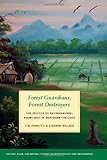
Tim Forsyth, Andrew Walker. Forest Guardians, Forest Destroyers: The Politics of Environmental Knowledge in Northern Thailand. Culture, Place, and Nature: Studies in Anthropology and Environment Series. Seattle: University of Washington Press, 2008. 302 pp. $65.00 (cloth), ISBN 978-0-295-98792-7.
Reviewed by David Biggs
Published on H-Environment (March, 2011)
Commissioned by Dolly Jørgensen (University of Stavanger)
Revising Environmental Narratives in Northeast Thailand
The tropical hills of Southeast Asia present many environmental and political challenges to the lowland states that have tried to govern them for centuries. As Jim Scott (The Art of Not Being Governed [2009]) and others have shown, the highlands of Southeast Asia are filled with a complex patchwork of different ethnic groups who have endured a tense, conflict-ridden existence over many centuries with their lowland neighbors. These highland areas are also some of the most bio-diverse regions of the world, and they contain many endemic species that are severely threatened today. Finally, the hills of Thailand as well as Cambodia, Laos, Myanmar, and Vietnam have been plagued by wave after wave of warfare since long before the European colonial conquests of the 1880s. Tim Forsyth and Andrew Walker contribute to a growing literature on environmental and social problems in the highlands with this study on environmental knowledge and environmental narratives in northern Thailand.
Forsyth and Walker set out to critique a number of powerful environmentalist stories about the hill country concerning deforestation, hill people, water conservation, soil erosion, agrochemicals, and biodiversity. In each chapter, they take on the familiar environmentalist assumptions; they then proceed to poke holes in commonly assumed elements of these stories. For example, in discussing community forestry practices, they point to a tendency to distinguish between lowland agricultural landscapes (muang) and upland wilderness areas (pa). These two different eco-zones tend to be populated with the ethnic majority Thai in the lowlands and different groups (Hmong, Karen, etc.) in the highlands. Where minority groups with claims in the highlands adopt subsistence practices that conserve trees, their settlements are protected; however, where upland groups have engaged in terraced agriculture, especially irrigated agriculture, the Thai state and conservationists have often interceded. In some cases, lowland, ethnic Thai groups use local police to forcibly remove uplanders from farm plots on contested slopes. Forest Guardians, Forest Destroyers succeeds in its primary mission to destabilize commonly held assumptions about upland agriculture, especially perceived effects downslope, such as erosion, pollution, or water shortages.
Repeatedly throughout the book, the authors point to important contradictions and conflicts within long-established conservation narratives in Thailand. In their chapter on erosion, for example, they argue that such crops as cabbage that were introduced in the 1960s to replace opium production may have stabilized the economy, but they have also worsened soil erosion because they leave more soil exposed for longer periods of time. They quote a Bangkok Post article published in 1990 stating that "cabbage is worse than opium," and they then proceed to raise a number of important questions about perceived environmental effects of such truck farming enterprises in the hills (p. 144).
Environmentalists and environmentally minded academics will likely raise many pointed responses to what, on the surface, appear as revisionist histories of conservation in Thailand. I am reminded of American historian Richard White's essay "Are You an Environmentalist or Do You Work for a Living? Work and Nature" in William Cronon's edited volume Uncommon Ground: Toward Reinventing Nature (1995) where he makes the case that partisans of environmentalism and conservation have become too separated from or opposed to those who labor in it, especially those working in agriculture and forestry. Forsyth and Walker are making a similar point here in the hills of Thailand. Nevertheless such a work is important for ultimately improving our understanding of the complex, intertwined social and ecological dimensions of agriculture, forestry, and conservation.
There is a growing literature, especially on hill people in Southeast Asia, to which Forest Guardians, Forest Destroyers is a useful addition. Besides Scott's book mentioned above, there is Andrew Hardy's study of hill settlement in Vietnam, Red Hills: Migrants and the State in Vietnam (2003), and Edmund R. Leach's classic Political Systems of Highland Burma: A Study of Kachin Social Structure (1954). As with these other works, Forsyth and Walker point to the many ways that past lowland-upland conflicts insert themselves into almost every aspect of state management of resources today. For the book's effort to bring dated conservationist ideas about upland people into the twenty-first century, it shares a place with Anna L. Tsing's work on Indonesian uplanders in Friction: An Ethnography of Global Connection (2004) and Tania M. Li's The Will to Improve: Governmentality, Development and the Practice of Politics (2007).
For environmental historians who may be interested in adding a unit on Southeast Asian forests, Forest Guardians, Forest Destroyers and the other works cited above present a problem: a general lack of historical research on these environmental topics. Environmental histories of Southeast Asian forests are still rare. This is not a shortcoming of Forest Guardians, Forest Destroyers, nor of the other works, but it points to an interesting difference in scholarship between Southeast Asian and North American or European forested areas. This extensive involvement of anthropologists and political scientists in Southeast Asia's upland forests means that foreign scholars perhaps more than foresters and local officials play a prominent role in the region's environmental history. Forsyth and Walker spend much of their time critiquing previous work, especially that conducted in the 1960s and 70s, so the book also offers glimpses into a critical history of upland anthropology in Southeast Asia. Forsyth and Walker suggest that ethnographers and anthropologists have played an important role reinforcing environmental narratives that, in their opinion, have warped public understanding about environmental changes in these remote areas.
Forest Guardians, Forest Destroyers is well written, and it provides engaging, revisionist critiques that will surely generate a lot of response--especially among the many environmentalist groups active in this region.
If there is additional discussion of this review, you may access it through the network, at: https://networks.h-net.org/h-environment.
Citation:
David Biggs. Review of Forsyth, Tim; Walker, Andrew, Forest Guardians, Forest Destroyers: The Politics of Environmental Knowledge in Northern Thailand.
H-Environment, H-Net Reviews.
March, 2011.
URL: http://www.h-net.org/reviews/showrev.php?id=31261
 | This work is licensed under a Creative Commons Attribution-Noncommercial-No Derivative Works 3.0 United States License. |

