



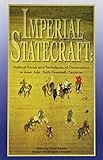
David Sneath, ed. Imperial Statecraft: Political Forms and Techniques of Governance in Inner Asia, Sixth-Twentieth Centuries. Bellingham: Western Washington University Center for East Asian Studies, 2006. 279 pp. $45.00 (paper), ISBN 978-0-914584-27-8.
Reviewed by Thomas J. Barfield (Boston University)
Published on H-Asia (October, 2010)
Commissioned by Sumit Guha (The University of Texas at Austin)
States in Central Asia
Imperial Statecraft presents the results of a conference held to look at indigenous varieties of governance that developed largely among nomadic pastoral peoples who inhabited the lands north of China. The contributors are primarily historians joined by a few anthropologists, and they have produced a work of high quality that covers a range of subjects. The chapters can be divided into three sets by the themes they address: conceptions of power, rank, and authority rooted in close analyses of indigenous terminologies; strategies of imperial rule employed by Inner Asian conquerors; and the social and political organization of Inner Asian societies. The introduction to the work not only highlights the contributions but also attempts to correct perceived defects in publications of earlier scholars and gives Inner Asia credit for unique developments it can call its own. The success of this latter project may not be greeted with unanimous acclaim because it often appears that the theoretical baby comes out no cleaner from this bath than earlier ones.
The focus on a close understanding of indigenous linguistic concepts demonstrates that circumstances (historical and cultural) are key to their interpretation. One of the best examples in the volume is, on the surface, rather simple. Tatyana D. Skrynnikova looks at the uses of terms commonly glossed as slave (bo’ol) and commoner (qarachu) during the Mongol period to remind us that such appellations were not fixed but context driven. That is, a bo’ol could be a lowly slave charged with sweeping up the sheep dung and starting a fire in the morning, but those who appear in Mongolian histories are more often powerful members of the ruling elite whose “slave” status is derived from their “servile” ties to the family of the ruler, not an inferior and unfree form of bondage. By similar extension, the emergence of qarachu leaders among the subordinate ranks of rulers did not represent the upward mobility of ordinary commoners but was instead used to distinguish those aristocratic lineages who descended from Chinggis Khan and those that did not. They were “common” only in comparison with the charmed circle of Chinggisids who placed themselves at the top of the Mongol hierarchy, but in other respects, particularly in regard to their own people, they were also members of the aristocracy. Such situations of course were hardly unique to the Mongols, but British historians do not regularly need to remind their readers that a member of the royal “Order of the Bath” does not soap the monarch down and make sure her towels are warm. By contrast, the tendency in Mongol history has been to be so literal minded that it is still necessary to point this out. During the Soviet period, for example, the appearance of the term bo’ol was cited as evidence that the Mongols ran a slave society and thus Skrynnikova’s point has theoretical implications for those coming out of the older Marxist tradition.
Christopher P. Atwood continues this line of inquiry in a detailed exegesis on the status and origin of qarachu begs (“commoner commanders”) in Crimea that he traces back to the ranks of keshig elders, originally leaders within Chinggis Khan’s imperial bodyguard. Overtime such ranks evolved into political offices of quite different status and power within Mongol successor states and many became hereditary. Atwood therefore notes that the influence of men holding such ranks could vary significantly, some serving the ruler in a subordinate status, and some holding a subordinate rank but actually wielding more power than their nominal sovereigns. A more complicated question is tackled in Caroline Humphrey and A. Hűrelbaatar’s chapter on the concept of tőrű in Mongolia. A sacred concept embodying legitimate government in the widest sense at the time of Chinggis Khan in the thirteenth century, it later comes to embody the actual state administration while retaining some of its spiritual connotations. Humphrey and Hűrelbaatar argue that this spiritual connotation that links government and people embodied in tőrű still resonates in the modern Mongol state and provides an unusually strong identification between people and state. Grappling with high concepts of this type does present problems of interpretation however. As the authors themselves admit, tőrű is an ephemeral concept in its earliest uses and it is hard to draw a clear picture of exactly how the Mongols originally conceived of it. I admit that even at the end of their discussion I was still groping to get at both what was meant by it and why the concept remains so evocative in Mongol political culture today. Of course if idioms were easily translatable they would not be idioms.
While all of the other contributors take Mongolian uses as their starting point, Peter B. Golden focuses on the Tűrk imperial tradition from the sixth to eighth century on the Mongolian steppe. His analysis includes a discussion of tőrű at this much earlier period as well as such other cultural beliefs as qut (luck, heavenly good fortune) that legitimated rulers. Golden is one of the few contributors who is hesitant about assuming that such concepts and terms are indigenous to the Mongolian steppe. His work on the Turkish titles in particular shows that many of them had Iranian origins, perhaps not surprising since at earlier periods the steppe nomads from southern Russia to the Altai spoke Iranian languages and the Turks had close connections to Sogdian traders. He is more open to the possibility that titles, concepts, and institutions could have entered the Inner Asian repertoire from China, Manchuria, or the Iranian world through adoption and adaptation rather than invention. If true this should not reduce their political importance or cultural validity, although one gets the uneasy sense from the other chapters in the book that any hint of cross-cultural importation needs to be rejected out of hand as demeaning. This defensiveness is surprising and does not seem to have been shared by the peoples of Inner Asia under examination. The leaders of empires founded by the steppe nomads were, on the contrary, keen to seek out the new on their own terms. Their elites voluntarily adopted many outside religions (Manichaeism for the Uighurs, Buddhism for the Mongols, Judaism for the Khazars, and Islam in the Golden Horde and Il-Khanate, to name just a few) that had deep and lasting impacts on their culture.
Despite the title, only a few of the contributors actually deal specifically with imperial statecraft, the running of empires, but these are very informative. Thomas T. Allsen’s “Technologies of Governance” examines the very different structures the Mongols employed when dealing with their northern frontier (the sparsely populated forest zone of foragers and dispersed farming communities, such as Siberia and Russia) and its southern frontier (highly populated agricultural regions, such as China, Central Asia, and Iran, supporting large cities). The rule of the northern area was indirect, employing indigenous leaders who owed tribute and fealty to the Mongols but were otherwise left alone. It was based on earlier nomad relations with the forest hunters to the North from whom they sought furs but was extended to other peoples along the steppe-forest borderland, such as the Russian princes. They came to depend on Mongol appointments to maintain power locally and maintain their own political networks. The rule of the southern area employed a type of dual organization in which the Mongols recruited skilled officials drawn from the sedentary societies they conquered to handle bureaucratic administration and taxation systems needed to govern effectively. He notes that they were the beneficiaries of the earlier waves of conquerors similar to themselves who had first devised these systems: the Manchurian Khitan Liao dynasty in northern China and a series of Turkish dynasties in Central and Southwest Asia. People like the Turks and Khitans made particularly good intermediaries because they shared, at a distance, similar traditions with the Mongols but were also familiar with the sedentary societies they had dominated for two centuries before the arrival of the Mongols. Michal Biran provides an account of another of these hybrid systems, the Qara Khitai Western Liao dynasty, which was the immediate predecessor to the Mongols in eastern Turkistan. Founded by a refugee Khitan prince who fled the overthrow of the Liao dynasty by the Jurchen Jin, it was a multiethnic polity that effectively employed Khitan and Chinese styles of organization to rule over a series of oasis kingdoms in the West. Biran argues that its basic political structure was Inner Asian but that it retained many Chinese trappings because these were a source of high prestige in the western borderlands. Of particular interest was the dynasty’s refusal to adopt Islamic practices or convert to Islam even though they were ruling a region where the majority of their subjects were Muslims.
Continuing with the institutions of rulership, Isabelle Charleux examines the longstanding debate over whether the nomads of Mongolia needed to establish cities to rule large polities. One problem here is the need to distinguish between nomads who conquered mixed populations and established (or occupied) cities to rule them, and those who remained on the steppe where urbanization was more problematic. Most of the evidence of urbanism on the steppe, where it exists at all (Xiongnu, Uighur, Mongol), appears after political centralization was achieved, not before. Even then, over the course of two thousand years there are remarkably few examples of cities in Mongolia, even when city is defined generously since many so designated are little more than walled forts. Charleux’s examples are those established by Altan Khan, which are Chinese in design but were built when Mongolia was no longer the site of a unified state. It is surprising that she does not analyze the Uighur capital of Qarabalghasun, the largest city built in Mongolia that appears to be of Central Asian design. In a book devoted to Inner Asian statecraft it would have been more interesting to take a closer look at how political leaders mobilized peoples and handled affairs in the absence of cities. Charleux is not unaware of this and describes the significance of the large mobile camps (orda) used by nomadic rulers in Mongolia (also a tradition employed by Turkish dynasties in Iran and northern India for many centuries as well). These are well attested to in historical sources but we do not know how they operated or to what extent they served as the functional equivalent of cities, a form of peripatetic urbanism if you will. Similarly she notes that later monastery complexes in Mongolia served urban functions without being cities in the classic sense, but begs off an analysis of both of these forms because of a lack of information. This is true enough but the result is unsatisfying; we may be omitting what was truly unique about Inner Asian statecraft, the ability to carry out sophisticated government in a highly mobile fashion without having to concentrate people permanently in a single location.
A third set of contributors looks more closely at the internal dynamics of Inner Asian social and political organization when it came to ruling themselves. Nicola Di Cosmo compares the different strategies used by the Mongol Ligdan Khan and the early Manchu emperors to win over the eastern Mongol tribes in the early seventeenth century. Although Ligdan had the better Mongol pedigree and Buddhist backing, those tribes failed to unite behind him and eventually joined with the Manchus. Ligdan asserted a political superiority based on Chinggisid lineage and Buddhist conceptions justifying his centralization policy but relied largely on force to bring rival tribes under his control. By contrast, the Manchus offered a junior partnership in a new multiethnic empire that promised great future wealth and status if they were successful. Game, set, and match for the Manchus! This set in train social and economic changes in Mongolia that had an impact on political organization into the twentieth century. As Jigjidiin Boldbaatar and David Sneath document, Mongolia was transformed and remodeled by the Qing Empire in ways that tied people permanently to places and political leaders and produced a rigid class structure. Under the Qing, ordinary nomads were assigned to specific princely banners or monastic organizations and forbidden to move. Nobles could and did exploit this situation to the detriment of ordinary nomads. I believe this produced an exceptional situation on the steppe, one made possible only because the Qing Empire eventually encapsulated Mongolia politically and economically, destroying rivals from without and suppressing rebels from within. Many of the contributors see it as normative, however, and are willing to project the social structure of late eighteenth- and nineteenth-century Mongolia onto past epochs.
This is apparent in the arguments that both Sneath and Atwood make directly, arguing that our theoretical framework for understanding the politics of Inner Asia is deficient. Their targets are many. Atwood attacks what he sees as theories of “ecological determinism” that attribute all political organization among nomadic peoples to “a direct and unmediated response to the ecological necessity of dispersed livestock breeding,” even though recent work on the Khazars and Qipchaqs “has shown these people had fundamentally different political structures, despite speaking the same language and exploiting roughly the same area of the steppe with a similar nomadic way of life” (p 207). He is of course correct, and I would praise the observation were I not listed as one of the prime ecological determinists whose theories need to be rejected. I find this odd if only because I spent an entire book (The Nomadic Alternative [1992]) insisting that a comparison of pastoral societies from Africa to Mongolia demonstrated that their strikingly different levels of political organizations and centralization could be explained only by their relations to the outside world, not to their livestock economy. Where we do disagree is on his insistence that a class of ruling aristocrats dominated Mongol politics to the exclusion of ordinary nomads who appear to be reduced to a serf-like status of slavish obedience. Steppe aristocracies and the divisions between noble and common clans have had a long history on the Mongolian steppe, a tradition of hierarchy at least two millennia long. It is quite distinct of the egalitarian lineages found among the Bedouin of Arabia or even the neighboring pastoralists on the Manchurian steppe (Xianbi, Khitan) that rotated leadership among various clans. But the belief that these hierarchical distinctions constituted class divisions in a Marxist sense is a projection of a late Qing political and social structure (as noted above) into the past where it did not exist.
Sneath takes to task the many scholars who see state formation among nomads as a secondary phenomenon, claiming that states in Mongolia arose independently and indigenously. He and other contributors argue that Inner Asia had its own types of governing institutions that developed internally and were not the product of borrowing or interactions with neighboring imperial polities, like China. In many cases, their critiques are a useful corrective to previous interpretations but some of the arguments appear stretched. There is a particular reluctance to even consider the possibility that many imperial institutions of power there might be products of interactions with China rather than generated internally and in isolation on the steppes of Mongolia or the forests of Manchuria. Such secondary state formation processes are implicitly viewed as inferior to pristine state building rather than simply different but no less complex. It would be as if some distant future historians of Japan felt compelled to find the origins of the Industrial Revolution there rather than explaining how Japan adapted itself so well to a technology it first imported from the West and then made its own. Particularly in conquest situations, Inner Asian rulers often found it more effective to modify the ruling institutions they encountered and meld them with their own rather than build anew. Sneath’s other bugaboo is the use of the term “tribe,” which he asserts is a colonial fiction. But societies that organized themselves primarily through kinship and descent groups have a different political structure than those that organize themselves by locality, economic class, or other factors. Besides, none of the replacements used in this volume (ethnie, nation, bone, etc.) appear any clearer. I prefer to define what I mean by tribe and then use the term in the absence of better alternatives. Also the people we are writing about have historically explained their social organizations in terms of descent groups and kinship. Their fixations on genealogies, clans, marriage alliances, and (dare I say) tribes that we see in such detail in Paul Kahn’s Secret History of the Mongols: The Origin of Chingis Khan: An Adaptation of the Yuan chʼao pi shih, Based Primarily on the English Translation by Francis Woodman Cleave (1998) long predates the advent of European colonialism and (if a fiction) was a system of their own making.
If there is additional discussion of this review, you may access it through the network, at: https://networks.h-net.org/h-asia.
Citation:
Thomas J. Barfield. Review of Sneath, David, ed., Imperial Statecraft: Political Forms and Techniques of Governance in Inner Asia, Sixth-Twentieth Centuries.
H-Asia, H-Net Reviews.
October, 2010.
URL: http://www.h-net.org/reviews/showrev.php?id=31246
 | This work is licensed under a Creative Commons Attribution-Noncommercial-No Derivative Works 3.0 United States License. |

