



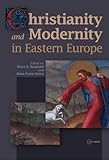
Bruce R. Berglund, Brian Porter, eds. Christianity and Modernity in Eastern Europe. Budapest: Central European University Press, 2010. 380 pp. $55.00 (cloth), ISBN 978-963-9776-65-4.
Reviewed by Patrick Houlihan (University of Chicago)
Published on HABSBURG (January, 2011)
Commissioned by Jonathan Kwan (University of Nottingham)
Secularization and Its Discontents
In the past three decades, the religious history of modern Europe has made remarkable strides, moving outside of older modes of confessional history and into the mainstream of the historical profession. As seen through large-scale multivolume works on the history of Christianity, top-down narratives of church politics have been replaced by sophisticated studies of social and cultural history.[1] Similarly, histories of Eastern Europe since the fall of communism have utilized new archival materials, and new climates of public opinion, to go beyond the Manichean moralistic assessments of societies as they existed in the atmosphere of the Cold War. Yet, when it comes to the history of Eastern Europe, there remains a dearth of high-caliber work on modern religiosity that goes beyond simplified notions of church-state relations.
Influential conceptual histories of Eastern Europe have rightly argued that an integral part of Western European self-identification since the Enlightenment was the notion of Eastern Europe as Other. In contrast to a progressive, rational, and secular society, Eastern Europe supposedly represented a backward, chaotic, and superstitious foil to Western self-projections.[2] An essential component of these debates is a notion of religiosity and a thesis of advancing collective secularization as a key component of modernity. Despite numerous objections and refinements, the secularization thesis remains part of the discourse of modern society.[3] This is especially so because, as Jeffrey Cox has written, secularization is a convenient master narrative that has yet to be displaced by a competing narrative of comparable explanatory power.[4] As the current volume under review makes clear, besides the accumulated weight of historical stereotypes, current discourses in the media and by pointed political factions demonstrate that reductive notions of religiosity continue because they advance contemporary special interests. These interest groups often have no desire for complicated analyses of religion as a component of pluralistic identity formation. Thus, simplistic generalizations about religiosity in Eastern Europe persist.
The editors write that they seek two audiences: “area specialists in Eastern European studies” and “scholars of religion and the history of Christianity” (p. xiv). While a few of the essays in the volume come from the disciplinary background of contemporary religious anthropology, the majority of the contributions are methodologically closer to archival-based historical studies. Taken as a whole, the thirteen essays of the volume represent an international and interdisciplinary effort of cutting-edge scholarship. The resulting published essays retain a degree of cohesion beyond the usual publication of conference proceedings.[5] The best intentions of the editors and authors aside, however, many of the individual contributions tend to read as case studies of countries, organized by a theme of nationality. More explicitly transnational and comparative studies would have given a more nuanced portrait beyond the national case studies, and thus more in line with the fundamental reappraisals claimed in the introduction. Nevertheless, on the whole, the current volume under review is a thorough, sensitive, and judicious appraisal that seeks to go beyond morally charged stereotypes and conventional dichotomies about the topic of Christianity in modern Eastern Europe.
Brian Porter-Szűcs’s introductory essay, “Christianity, Christians, and the Story of Modernity in Eastern Europe,” is a tour-de-force piece that offers both a brilliant theoretical overview and a methodological background of the entire project. It also sets an appropriate tone of critical, even-handed, reflective scholarship that nonetheless respects the content of religious faith as lived experience. In a deft handling of the issue of structure vs. agency and the definition of religion, he writes, “we approach religions as flexible conceptual frameworks that are formed and re-formed while necessarily and simultaneously establishing the parameters of and potentials for such re-formation.... In each of the essays that follow, we see how religious people in Eastern Europe worked with the beliefs, institutions, theologies, ideologies, and cultural frames that were accessible to them, subtly altering each in turn” (p. 13).The essay is remarkably forthright about major assumptions that guided the project, such as a “caution towards an overly sharp dichotomy between Western (Catholic and Protestant) and Eastern (Orthodox) Christianity” (p. 17). Naturally, some readers will dispute these assumptions, but it is refreshing to have the editors write about such issues directly.
As scholars of religion have long theorized, a fundamental component of religious studies is the drawing of boundaries and notions of inclusion/exclusion. Especially in such a wide-ranging and ambitious volume on a sensitive topic, therefore, issues of bracketing and conscious omission will no doubt cause vigorous debate among scholars, and it is worthwhile to take up these issues at length. Porter-Szűcs does well to explain the volume’s choices behind conceptual boundary-drawing of such terms as “Christianity,” “Modernity,” and “Eastern Europe,” to name only the three broadest categories from the title.
The focus on Christianity deliberately excludes Judaism and Islam from direct comparison, though this is promised as a temporary bracketing, and indirect references to Jews and Muslims are found in some of the essays. Acknowledging the “categories of ethnicity, nationality, and class” intertwined in the three Abrahamic faiths, Porter-Szűcs writes that, “Perhaps the easiest response to our heightened sensitivity about the delicate nature of comparative religious history is to tighten our focus, confining our research to a particular tradition or community while offering only the most tentative and qualified claims about religion writ large.... Once we sketch out the questions that animate historians of Christianity in Eastern Europe, we can move forward in the future to see how our agendas overlap those of Islamic or Judaic studies” (pp. 7-8). Given the relative lack of high-quality research about Christianity in the region of modern Eastern Europe, as well as the tantalizing hint of future work, the volume’s explicit focus on Christianity is more defensible than it might first appear.
The volume’s geographic and temporal selections will likely prove more controversial. Porter-Szűcs writes that the project “focused on the eastern part of the European continent, an area where nearly all residents consider themselves European but where the social, economic, and political processes that have characterized the continent's modernity were experienced belatedly, if at all.” This approach to a supposed belated experience of modernity, however, seems to rely too much on a notion of Weberian disenchantment that the volume claims to reexamine. The selective focus proceeds further to exclude Russia and the Soviet Union: “we focused on those areas where communist regimes held power from the 1940s to the 1980s--a time long enough to shape the patters of popular religiosity and the institutional history of the churches, but short enough to ensure that communism did not entirely define the experience of faith in the modern world” (p. 16). Thus, in elaborating an area between Germanophones and Russophones, he argues that this “somewhat arbitrary territorial demarcation” grants the area a “uniquely liminal position” (pp. 17-18). Since two of the essays explicitly focus on events in Germany, however, one wonders if Russia and the Baltic states should have received more focus in a volume on Eastern Europe.
More problematic, at least to this reviewer, was the concentration on mostly post-1945 developments in individual national frameworks with the resulting overly narrow definition of modernity. Indeed, eight of the eleven essays focus on post-1945 developments. More explicitly comparative or transnational views would have helped to go beyond these limits. In many ways, Andreas Kossert’s essay, “Religion in Urban Everyday Life: Shaping Modernity in Łódź and Manchester, 1820-1914,” throws this dilemma into sharp relief with a pronounced comparative focus on the pre-1914 era. Without minimizing the changes that urban industrialization posed for Christian churches in the nineteenth century, and taking a cue from earlier work on urban religion by Hugh McLeod (who also wrote a foreword to the present volume), Kossert argues that cities like Łódź and Manchester were “ ‘half-secular’ societies in which few people had a wholly secular view of the world” (p. 51). Given the importance of McLeod’s work on urban religion, further work on Eastern European urbanisms and urban-rural divides, and their comparison to Western European forms, seems especially warranted.
Of the eleven essays that form the core of the book, however, Kossert’s essay introduces explicit international comparison as a methodological approach that is not taken up again until Katharine Kunter’s essay, “Human Rights as a Theological and Political Controversy among East German and Czech Protestants.” Given the conventional wisdom about Catholic groups in Eastern Europe as focal points of resistance movements to communism, especially in Poland during the pontificate of Pope John Paul II, Kunter’s essay demonstrates that Protestant believers, too, could organize their activism in complex ways between accommodation and resistance. Additionally, Patrick Hyder Patterson’s essay near the end of the volume, “On the Ruin of Christendom: Religious Politics and the Challenge of Islam in the New West,” is a piece that highlights the advantages of overarching transnational thematic comparison, focusing on notions of European identity more broadly construed.
Thus, a major interpretive gap is the era of the world wars and their implications as a moment of modernity for Eastern Europe--particularly an assessment of the pre-1914 world and the changes wrought by the First World War. There are provocative individual contributions regarding this time period, as Porter-Szűcs’s essay hints at the need to “provide critical interpretations of Christian politics that go beyond denunciation or exposé” (p. 19) of an inflammatory topic that has generated a library of polemics. Indeed, the endnote attached to this statement occupies over one page of text with suggested readings. In broaching this heated topic, Paul Hanebrink’s essay, “Christianity, Nation, State: The Case of Christian Hungary,” shows that despite their differences, Hungarian Catholics and Protestants could often unite in a religious nationalism that excluded non-Christians as not fully Hungarian. Thus, in this context, the latent anti-Semitism of the nineteenth century could transition smoothly into the genocidal complicity of the Nazi era. Similarly, Martin C. Putna’s chapter, “Searching for a ‘Fourth Path’: Czech Catholicism between Liberalism, Communism, and Nazism,” touches on a “complicated and not very glorious chapter in the history of Catholic political thought” that historicizes a collective Czech Catholic critique that “seems absurd today” but had widespread importance at the time. Putna argues that in a negative sense, this sociopolitical critique was a response to “real flaws” of the fledgling capitalist system of liberal democracy but also contained a positive suggestion of socioeconomic reform (p. 106).
Through no fault of the individual authors of the essays, however, the volume as a whole does not adequately address the era of the world wars for Eastern Europe outside of the particular cases of Hungary and Czechoslovakia. A more transnational focus on the continuities and changes that the wars brought to Christian sensibilities in Eastern Europe seems necessary. This is especially so given the magnitude of the First World War as a decisive moment in the shaping of the modern world, as well as the role of regimes of occupation in restructuring modern states.[6]
Moving to the series of post-1945 essays, James Ramon Felak’s contribution, “The Roman Catholic Church Navigates the New Slovakia, 1945-1948,” highlights the importance of a forward-looking Slovakian episcopate who had a burdened past. Tarnished by association with the Tiso regime, in the postwar elections the Slovakian bishops refused to support the Slovak People’s Party founded by Father Andrej Hlinka, instead endorsing the Democratic Party. Thus, in Felak’s words, by endorsing the Democratic Party, the “Catholic bishops rejected both opposition to the new regime and resignation to a communist-dominated future” (p. 124).
Through its skeptical deconstruction of inherent assumptions of the nature of Polish Catholicism, James Bjork’s essay, “Bulwark or Patchwork? Religious Exceptionalism and Regional Diversity in Postwar Poland,” addresses several of the key analytical issues of the volume. Bjork argues that, “If we are to see the making of Catholic Poland as a genuinely suspenseful, delicate, and open-ended process, it is necessary to pay closer attention to the various fissures within the Polish-Catholic edifice” (p. 152). Through detailed archival examination and probing of contemporary publications, Bjork demonstrates that regional ascriptions of Catholic religiosity within Poland varied tremendously. In many cases, this involved “daunting trade-offs and implausible balancing acts” on the part of bishops, clergy, and laity (pp. 130-31).
Natalia Shlikhta’s chapter, “Competing Concepts of ‘Reunification’ behind the Liquidation of the Ukrainian Greek Catholic Church,” focuses on the notion of a “Church within a Church” as a form of resistance to assimilation into Soviet society through conversion to the Russian Orthodox Church. Shlikhta shows the effectiveness of James C. Scott’s idea of false compliance as a mode of resistance used by subordinate groups to undermine the power of dominant authorities. Though full of “compromise and accommodation” Western Ukrainian Greek Catholic forms of resistance retained a localized ascription of religious life that preserved a sense of “distinct religious-national identity” that resisted “Moscow’s antireligious and assimilatory policies” (p. 182). Further pursuing the theme of resistance, David Doellinger’s essay, “Constructing Peace in the GDR: Conscientious Objection and Compromise among East German Christians, 1962-1989,” argues that Christian conscientious objectors could draw on their religious beliefs to inform their ethical behavior, but in Doellinger’s view, the actions of Christian conscientious objectors were motivated “more by a rejection of the state’s mobilization policies than a defense of the faith against secularization or communism” (p. 269).
In one of the volume’s most original pieces, Galia Valtchinova’s essay, “State Management of the Seer Vanga: Power, Medicine, and the ‘Remaking’ of Religion in Socialist Bulgaria,” provides perhaps the most unexpected results to those whose perception of communist religious policies is dominated by assumptions about militant atheism. Through an anthropological examination of the life of Vanga (Evangelia) Pandeva Gushterova, a religious visionary prophet and healer, Valtchinova shows a remarkable amount of religious appropriation by the Bulgarian state. For Valtchinova, the “remaking of religion under socialism amounted to taking it outside ecclesiastic institutions, giving it a rational face, and putting it into a ‘scientific’ mold, thereby dissolving ‘religiosity’ into the blurred ‘magical-religious-medical field,’” thus demonstrating a “popular religiosity that was denigrated in the dominant discourses but de facto tolerated.” In the post-socialist religious revival, Valtchinova argues that Vanga became more akin to a “religious entrepreneur” (pp. 261-262).
With a similar anthropological approach that involved many personal interviews with Romanian clerics and lay believers, Anca Şincan’s essay, “From Bottom to the Top and Back: On How to Build a Church in Communist Romania,” offers another example of local particularities and individual agency creating a nuanced portrait of church-state relations. In the Romanian case, a hard-line fervently atheistic regime pursued a deft and complicated policy of accommodation and repression of religious groups. The government, however, did not treat all religious believers equally. Instead, Şincan shows that the regime was able to play the loyalties of religious groups against each other. Roman Catholic priests, for example, found it easier to receive authorization from the regime for church-building activities than did their Protestant counterparts, precisely because the regime more desperately needed Catholic supporters. This chapter is an apt illustration of the tensions between the theory and practice of authoritarian governments, a theme that runs constantly throughout the volume’s essays.
Bruce R. Berglund’s final essay, “Drafting a Historical Geography of East European Christianity,” is a fitting end to the volume. Thoughtful, sensitive, and balanced in its unpacking of the conceptual geographies of Christianity in Eastern Europe, it strikes the right tone as not a definitive conclusion but rather a stimulus to further inquiry. Berglund gives an impassioned and apt overview of the volume’s guiding impulses based on ascribed notions of place and belief.
Taken as a whole and as individual pieces, the book’s essays are impressive; they make thought-provoking contributions to the modern religious history of Eastern Europe. The editors and sponsors are to be commended for coordinating the project and bringing it to the attention of English-speaking audiences in a well-edited and engaging collection. This book deserves a wide readership; it will benefit advanced undergraduates as well as specialists in the field. Anyone interested in approaching the complex, intertwined history of Christianity, modernity, and Eastern Europe should read this volume.
Notes
[1]. To witness the effect of this shift, compare the older, yet still useful, Gabriel Adriányi, ed., Die Weltkirche im 20. Jahrhundert, vol. 7, Handbuch der Kirchengeschichte, ed. Hubert Jedin (Freiburg: Herder, 1985) with the recent Hugh McLeod, ed., World Christianities, c. 1914-c. 2000, vol. 9, Cambridge History of Christianity (Cambridge: Cambridge University Press, 2006). For an overview that synthesized as well as foreshadowed many emergent trends in Western European religious history, see Hugh McLeod, Religion and the People of Western Europe, 1789-1989, 2d ed. (Oxford: Oxford University Press, 1997).
[2]. For two of the most prominent works, see Maria Todorova, Imagining the Balkans, updated ed. (Oxford: Oxford University Press, 2009); and Larry Wolff, Inventing Eastern Europe: The Map of Civilization on the Mind of the Enlightenment (Stanford: Stanford University Press, 1994). See also Larry Wolff, The Idea of Galicia: History and Fantasy in Habsburg Political Culture (Stanford: Stanford University Press, 2010) currently under review for HABSBURG by Daniel Unowsky.
[3]. There have been libraries of material written on the secularization thesis. One of the most influential treatments remains David Martin, A General Theory of Secularization (Oxford: Blackwell, 1978). For a few recent reappraisals, see Steve Bruce, ed., Religion and Modernization: Sociologists and Historians Debate the Secularization Thesis (Oxford: Clarendon Press, 1992); Timothy A. Byrnes and Peter J. Katzenstein, eds., Religion in an Expanding Europe (Cambridge: Cambridge University Press, 2006); and Michael Saler, “Modernity and Enchantment: A Historiographic Review,” American Historical Review 111, no. 3 (2006): 692-716.
[4]. Jeffrey Cox, “Master Narratives of Religious Change,” in The Decline of Christendom in Western Europe, 1750-2000, ed. Hugh McLeod and Werner Ustorf (Cambridge: Cambridge University Press, 2003), 201-17.
[5]. As explained in the book’s preface, an array of scholars from various disciplines met in 2005 at Calvin College in Grand Rapids, Michigan, and in 2006 at the German Historical Institute in Warsaw, not merely to present papers but to discuss and critique essays touching on common themes distributed in advance. An exchange of contributors’ essays then followed.
[6]. For a current provocative statement about the war as a decisive moment of modernity, see Modris Eksteins, Rites of Spring: The Great War and the Birth of the Modern Age (Boston: Houghton Mifflin, 1989). The subject of the Great War’s practical and ideological impact on Eastern Europe has been explored in Vejas Gabriel Liulevicius, War Land on the Eastern Front: Culture, National Identity, and German Occupation in World War I (Cambridge: Cambridge University Press, 2000); and Mark Von Hagen, War in a European Borderland: Occupations and Occupation Plans in Galicia and Ukraine, 1914-1918 (Seattle: University of Washington Press, 2007).
If there is additional discussion of this review, you may access it through the network, at: https://networks.h-net.org/habsburg.
Citation:
Patrick Houlihan. Review of Berglund, Bruce R.; Porter, Brian, eds., Christianity and Modernity in Eastern Europe.
HABSBURG, H-Net Reviews.
January, 2011.
URL: http://www.h-net.org/reviews/showrev.php?id=31233
 | This work is licensed under a Creative Commons Attribution-Noncommercial-No Derivative Works 3.0 United States License. |

