

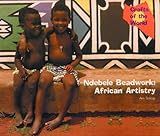
Ann Stalcup. Ndebele Beadwork: African Artistry. New York: Rosen Publishing Group, 1999. 24 pp. $18.00 (cloth), ISBN 978-0-8239-5336-3.
Reviewed by Robyn Sassen (Department of History of Art, University of South Africa)
Published on H-AfrTeach (May, 1999)
Tradition - It's Alive!
This is an excellent book, highly recommended for readers who are beginning to show an interest in the world around them--as well as the ways in which different cultures have lifestyles and practices which differ from their own. It presents a thorough introduction to the Ndebele and their traditions in a way which is pleasing to the eye, the creative sensibilities, and the inquiring mind.
The content of the book is divided up into various different approaches to the study of the Ndebele and their traditions. This comprises an introduction to the people, their way of life, their traditional costumes, the medium of beading, and the ways in which this beading contributes towards their culture. It gives a sense of immediacy and potency to the Ndebele and highlights the qualities for which the beadwork is most well known. The words in the text which are perceived as being possibly more difficult for the young reader (be they indigenous African or longer English words) are phoneticised, which would enable the reader to manage alone with this book. These words appear again in the glossary, at the end.
Each page spread is different, and most are filled with brightly coloured, clearly focused photographic images which are appropriate to both the age group of the recommended reader as well as to the Ndebele culture itself. The images are distributed across the pages in different ways, either filling the whole of one page or being presented as a cut out image, thus creating a different visual approach when each page is turned. The effect of this is to encourage the reader to look and not just glib over similarly adorned pages.
Physically, the book is both small and large enough for little hands, and the font size is big enough for the beginner reader. The book is presented on a landscape format, opening the double spreads to a fair width. The overall design of the book has been rendered to comply with a sense of Africa--from the bold and geometric choice of the type used for headings, to the repeat designs on each page. It is evident that care has been taken to make each page significant and interesting for the reader, as well as of value for the text as a whole.
The approach of the text is not patronising to the limited comprehension of the beginner reader. This is most clearly exemplified in the overall use of language and the way in which longer words and more difficult concepts are explained in a concise and clear, rather than childish, manner. Also, the doll making project (pp. 20-21) is handled in a one-to-one tone: the text is not addressing an adult assisting the child, nor is it speaking down towards the child, but the language is simple and easy to understand. Although neither the project nor the text surrounding it address the profoundly different roles played by Ndebele and western dolls respectively, it is presented in a manner which is not impossible for small hands to deal with, alone.
There are, however, areas where the Ndebele's home life is contextualised that may have been simplified to such a great degree that certain aspects of it become meaningless or difficult to make sense of. For instance, the comment on the Ndebele way of life "... TVs are often painted on the walls of homes, along with lightbulbs and airplanes!" (p. 22) becomes rather obscure with regard to an understanding of the primitive living conditions of the rural Ndebele in contemporary times. Perhaps this point would have been easier to understand with a photographic image of the inside of a rural Ndebele home.
In a palatable and sensible way, this book breaches very broad areas of debate and discussion which are currently being addressed in the field, such as the role of gender in the distribution of media, the ways in which tradition has adjusted to fit economic and political problems which have given rise to a smaller availability of materials, traditional rituals within the life cycle, and the ways in which the economy has prevailed to render transitional art objects necessary in the greater evolution of the South African art/craft debate. Dealing with these issues and more, albeit on a level simple enough for the child to digest easily, will present the young North American reader with tools of awareness and a basic understanding for the breadth of the problematics, in a way that is coloured with the excitement of creating and the pleasure of looking at the aesthetically bright and geometrically pleasing.
The people in this book are, on the whole, represented dressed traditionally. This is of significance because the traditional costumes are central to the discussion. It is pointed out, however, that these people are normal, everyday South Africans, working in the mainstream of society and contributing to the economy and the way of life in a regular fashion. This is further evidenced by the image of the child on page 11, who wears a synthetic factory made t-shirt over her ghabi, as well as the woman in the centre of the image on page 12, who wears a conventional dress--alongside her peers in traditional garb.
There is considerably less material on the male members of the Ndebele than on the female. It must be borne in mind, however, that the medium of beadworking is largely a female based one, and given the spectrum of this book and its intended readers, a small focus is necessary.
Overall, this is a very successful piece of non-fiction work for young children, addressing a number of important themes and concepts for an understanding of South Africa and its complexities in an unbiased and interesting manner.
Copyright (c) 1999 by H-Net, all rights reserved. This work may be copied for non-profit educational use if proper credit is given to the author and the list. For other permission, please contact H-Net@h-net.msu.edu.
If there is additional discussion of this review, you may access it through the network, at: https://networks.h-net.org/h-afrteach.
Citation:
Robyn Sassen. Review of Stalcup, Ann, Ndebele Beadwork: African Artistry.
H-AfrTeach, H-Net Reviews.
May, 1999.
URL: http://www.h-net.org/reviews/showrev.php?id=3120
Copyright © 1999 by H-Net, all rights reserved. H-Net permits the redistribution and reprinting of this work for nonprofit, educational purposes, with full and accurate attribution to the author, web location, date of publication, originating list, and H-Net: Humanities & Social Sciences Online. For any other proposed use, contact the Reviews editorial staff at hbooks@mail.h-net.org.

