



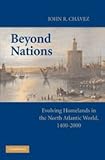
John R. Chávez. Beyond Nations: Evolving Homelands in the North Atlantic World, 1400-2000. New York: Cambridge University Press, 2009. xv + 292 pp. $85.00 (cloth), ISBN 978-0-521-51667-9; $24.99 (paper), ISBN 978-0-521-73633-6.
Reviewed by Catherine Styer (University of Pennsylvania)
Published on H-Albion (March, 2011)
Commissioned by Thomas Hajkowski (Misericordia University)
Six Centuries of Imperialism and Confederation
This ambitious book seeks to do no less than track the histories of the “homelands and communities that made the North Atlantic World coherent historically” from their “sociopolitical positions prior to transoceanic contact to their current standing” in the modern world order (pp. xiii, xiv). In doing so, the author states that he will “de-emphasize” the usual subjects of Atlantic histories--the main European players and the United States--to focus on the people and places of the Atlantic’s “ethnic regions” on the borders of these central states and on the “edges of the mainstream” of historical scholarship (p. xiv). Furthermore, unusually for a project focusing on comparative political, cultural, and institutional development, John R. Chávez presents his analysis in a narrative format and hopes to “clarify and elaborate colonial theory ... setting the stage geographically and then following the processes and events chronologically” (p. xv).
Chávez’s geographical scope is wide. He describes the evolution of peoples and places as diverse as the Micmacs of a land successively termed Megumaage, Acadia, and Nova Scotia; the Irish; the people of the Basque region; the Tejanos of South West Texas; and the various inhabitants of Sierra Leone. Some of these people and places make brief appearances to illustrate larger phenomenon; for instance, a four-page trip to Sierra Leone is used to depict “renewed” colonialism in Africa at the end of the eighteenth century (p. 120). Others, such as Ireland and the Basque region, are tracked throughout the book. Chávez’s chronological span is also long. Beginning in the fifteenth century, he works his way around the Atlantic and through time to the formation of the European Union (EU) and the contemporary struggles of the United States with what the author terms “resurgent ethnic homelands.”
In describing the evolution of these “homelands,” Chávez shapes his narrative into several analytical periods. Beyond Nations opens with a survey of the wide variety of political and social institutions to be found around the Atlantic basin in 1400 before tracking what the author describes as the “first great wave” of transatlantic empire as the Spanish, Dutch, French, and English crossed into the Caribbean and the Americas (p. 246). His focus in these chapters is not solely on European imperialism, however. Chávez also demonstrates the ways in which European migration both limited and encouraged imperial tendencies among different native groups in the Americas themselves. Moving into the eighteenth century, Chávez considers the manner in which new empires arose between 1750 and 1880 modeled on former empires, a process he terms “internal colonialism” (p. 246). For instance, he sees the United States as the heir to English imperialism as settlers moved West. The years between 1880 and 1945 then witnessed, according to Chávez, the “second great wave of overseas empire and formal colonialism” (p. 246). Finally, Chávez argues that World War II delegitimized ideas of formal empire, although he maintains that the Cold War period nonetheless saw persistent imperial tendencies from both the United States and the Soviet Union.
While he focuses much of his work on the evolution of homelands through the rise and fall of successive empires loosely defined as both formal and informal, Chávez is also interested in how these regions, nations, states, and homelands have sought to work together in a voluntary and cooperative fashion. He terms such actions “federation” and “confederation.” Chávez finds examples of federation and confederation throughout the centuries he covers, moving from the Iroquois League to the United Nations, and from the Economic Community of Western African States to the EU--the EU being the institution he deems the most successful among these.
There is much to admire in Chávez’s work. The sheer breadth of scholarship is impressive: he writes cogently on a wide variety of people and places, moving easily between discussions of Algonquian homeland myths, the nineteenth-century struggles over Texas, the intricacies of Irish politics, and the creation of the EU. His attempt to remove the main European and American players from center stage is also refreshing. Chávez offers a new view of the Atlantic world, one of many peoples struggling to define their home and identity within regions, nation-states, and empires that changed considerably over time. Instead of writing a historical narrative that describes and explains the development of nation-states, Chávez offers a narrative that tracks the fortunes of imperialism and federation as forces which have shaped the Atlantic world.
Scholarship of this scope is, however, difficult to contain, and Chávez does not entirely escape many of the associated problems. The central characters in his book, if they may be so termed, are the forces of imperialism and confederation. As a result, both individuals and causation are often lost. Although he sometimes defines “homelands” or “ethnic regions” as places to which peoples have emotional ties, such ties are asserted rather than examined, and the reader is often left wondering where actual people fit into this story. Only briefly, at the start and finish of the book, does the messiness of humanity impinge on this history of impersonal forces. Similarly, causation is also sometimes lacking. Chávez verges on producing a modern history of progress, one in which the self-evident virtues of confederation/federation are inexorably revealed. The book is full of such statements as “the utility of federalism gradually became more evident as the modern era unfolded down to our time,” but how, and to whom, and whether there was disagreement on this point is unclear from his narrative (p. 11).
Chávez’s main focus on imperialism and confederation/federation also makes it difficult for him to find the boundaries of his subject. Although he aims to write a history of the North Atlantic world, there is nothing about imperialism or confederation that is specifically and only pertinent to the Atlantic world. Whereas most Atlantic history now focuses on a particular set of peoples, places, migrations, and systems that form a coherent and meaningful whole, this work struggles to force together the history of the Atlantic and the history of the two sociopolitical forms in which Chávez is interested. While examples of imperialism and confederation can, of course, be found in the Atlantic world, they are not unique to it, and at times his narrative threatens to move beyond its stated bounds with references to imperial Japan or the United Nations. Although conceived as a work of Atlantic history, Chávez’s scholarship sometimes seems uncomfortable within its purported Atlantic bounds.
Finally, this reviewer would have found a little more clarity in terminology helpful. Chávez has a tendency to use such terms as “nation,” “ethnic region,” or “homeland” interchangeably, and it is not always clear in what ways they are, or are not, different. Similarly, greater discussion of what is meant by imperialism (formal or informal) and confederation or federation would have been useful. In Beyond Nations these terms cover a range of institutions and actions and seem, at times, to obscure their important differences or to oversimplify their nature. Many Europeans, for instance, would struggle to recognize the EU Chávez describes. Nonetheless, this is an important and provocative book that offers students of the Atlantic world much to consider.
If there is additional discussion of this review, you may access it through the network, at: https://networks.h-net.org/h-albion.
Citation:
Catherine Styer. Review of Chávez, John R., Beyond Nations: Evolving Homelands in the North Atlantic World, 1400-2000.
H-Albion, H-Net Reviews.
March, 2011.
URL: http://www.h-net.org/reviews/showrev.php?id=31044
 | This work is licensed under a Creative Commons Attribution-Noncommercial-No Derivative Works 3.0 United States License. |

