



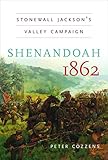
Peter Cozzens. Shenandoah 1862: Stonewall Jackson's Valley Campaign. Civil War America Series. Chapel Hill: University of North Carolina Press, 2008. 640 pp. Maps. $35.00 (cloth), ISBN 978-0-8078-3200-4.
Reviewed by Matthew Hulbert (University of Georgia)
Published on H-CivWar (November, 2010)
Commissioned by Martin P. Johnson (Miami University Hamilton)
Jackson in the Shenandoah: Remodeling the Stonewall?
Even before the famed Valley Campaign began in March of 1862, General Thomas J. Jackson had already earned his “Stonewall” moniker at First Manassas--where visitors will still find his colossal likeness keeping stern watch over the Henry House Hill. Jackson’s activity in the Shenandoah that spring, which began with defeat at Kernstown and concluded victoriously at Port Republic, violently commanded the attention of valley residents, Union commanders, and even President Lincoln. In doing so, Jackson’s brief, four-month tenure in the valley played a critical role in determining the trajectory of the war and, in turn, the fate of the floundering Confederacy. Ultimately, various stories of Stonewall Jackson and “his” Valley Campaign helped morph the one-time Virginia Military Institute instructor into a national sensation and postmortem Lost Cause icon.
To date, Confederate-oriented explanations of the Valley Campaign have mostly dominated historical accounts--thanks in great part to the long arm of Lost Cause mythology and its infiltration of popular culture. With Shenandoah 1862: Stonewall Jackson’s Valley Campaign, Peter Cozzens succeeds at recounting a version of this story which offers a much more balanced, if not more complete, narrative of the campaign: its gamut of characters, its political underside, and its physical environment. Throughout the book, Cozzens overtly grapples with popular perceptions of Jackson’s religiosity, tactical intellect, and broader importance within the Confederate war effort. As a critic of battlefield tactic and the internal workings of both Union and Confederate headquarters, Cozzens wields his pen sharply but fairly. As a storyteller, peeling back the fog of war to reveal a complicated, often dysfunctional matrix of fierce personalities, military engagements, and scenic landscapes, Cozzens is at his best.
As the title of the book would indicate, Thomas “Stonewall” Jackson resides squarely at the center of Cozzens’ narrative. His rendering of Jackson is multifaceted and acutely personal--a necessary framework given the erratic nature of the Major General’s personality and behavior. Cozzens piece together a portrait of Jackson as deeply secretive, often hermetic, and motivated in great part by his religious devotions; a portrait of Jackson that directly addresses his popularity in the ranks (which included the original “Stonewall Brigade”), his relationships--often contentious--with other officers, his tactical prowess, and at times, his grasp on reality. Jackson, Cozzens informs, “deplored war” but upon receiving the call to serve, conducted himself as if “on religious crusade” (pp. 35-36). The common notion of Jackson as one of the harshest proponents of discipline and drill, Cozzens assures readers, rests on solid ground. In the process, however, Cozzens also exposes other, less flattering aspects of Jackson’s personality. A disciplinarian to be sure, Shenandoah 1862 also highlights how Jackson failed, miserably at times, to comprehend how problems of transportation, starvation, fatigue, and accouterment could impede his command. “Jackson,” Cozzens writes, “expected too much of both officers and men,” continuing later that “he [Jackson] expected his men to go into battle in freezing weather on empty stomachs” (pp. 70-71). And, Cozzens notes, while Jackson occasionally angered his subordinate commanders for taking little interest in their generally horrid camp accommodations, hypocrisy often ruled the day as Jackson lived in town and was frequently visited by his wife, Anna.
At the same time the book accentuates discontent among the ranks, it also emphasizes a more personal, albeit erratic, side of Jackson. Early in the campaign, as he sent his exhausted troopers into freezing river waters to raze Dam #5, “Jackson himself served out a cupful of whiskey to each man from a barrel brought forward for the occasion, along with the admonition to ‘pitch in the dam and tear [it] down’” (pp. 61-62). Later in the campaign, Jackson surprised an aspiring artist in his command. The young soldier found Jackson asleep under a tree and sketched a picture of the odd scene. Somewhat to his surprise, Jackson did not berate the soldier in question, but actually seemed to appreciate the gesture. As the Valley Campaign continued, Cozzens contends, the man who “stood like a stone wall” at Manassas gradually succumbed to stress and fatigue. Highly erratic behavior marked Jackson’s--already known for his “fetish for secrecy”--record as the spring of ’62 dragged on (p. 73). In an almost comedic incident, Jackson ordered one “dim-witted cavalry lieutenant” arrested as a Federal spy for asking a string of pestering questions about troop movement (p. 402). In this dialectic fashion, then, Cozzens captures figurative lightning in a bottle in the form of Jackson’s own ultra-complex personality.
In contrast, Cozzens tackles the issue of his famed religiosity head on--often allowing primary voices to analyze the general. As a Federal approach indicated imminent violence, Cozzens writes, the prospects of fighting that day “stirred Jackson to a reckless spiritual ecstasy. He was God’s instrument and as such must prevail” (p. 138). As an overseer of his army’s piety, Jackson took seriously the task of providing worship services and a capable reverend for the men. In short, piety, as far as Jackson was concerned, constituted a critical pillar of any fighting force. This sort of religious motivation, which bordered on the fatalistic, underpins Cozzens’ broader assessment of Jackson as a commanding officer. One of his subordinates, Colonel Albert Rust, verified Jackson’s fervor by requesting a unit transfer because Rust “wanted nothing more to do with ‘that crazy preacher who marched us up and down the icy mountains for no purpose’” (p. 100). As for victory and responsibility, Cozzens maintains, Jackson tended to credit the Almighty for his victories and, when defeated, subordinate officers like Brigadier General Richard Garnett usually shouldered the bulk of culpability--and were often subjected to unjust arrests for neglect or failure. On the whole, Cozzens is not dismissive of Jackson’s religious sentiment; rather, his interpretation of the general is keenly informed as to how religiosity altered the course of the Valley Campaign--for better and worse.
While his analytic and narrative frameworks admittedly revolve around Jackson’s figure, Shenandoah 1862 urges readers, at the very least, to recognize that the Valley Campaign’s vast array of other characters is what makes it both an exceptional story and historically important. From the cavalier Turner Ashby, whose well-armed men, according to a Union cavalry counterpart “leap fences like deer” (p. 237), to the estranged interactions of Edwin Stanton, George McClellan, John Fremont, Nathaniel Banks, James Shields, and even Lincoln, Cozzens blends strategic issues critical to the overall war with outright good storytelling. With almost painful precision, the book follows the long trail of correspondence that flowed out of the White House to Federal commanders. Readers find General McClellan habitually planning to move on Richmond, Fremont never quite in the right place at the right time, and Lincoln’s frustration mounting with slowly moving armies and drastically inaccurate estimates of enemy troop strength. That said, Cozzens is fair in his critique. While somewhat sympathetic of Lincoln’s difficult decisions--mainly what to do with an increasingly problematic George B. McClellan--Cozzens also takes Brigadier General James Shields to task for his renowned mendacity. While the book does identify genuine logistical impediments that slowed down Fremont, it also provides primary evidence to suggest that the Pathfinder lacked the desire to control his marauding men--with specific regard to the legendary thievery of Brigadier General Louis Blenker’s division. Perhaps most critical to the greater story of the Valley Campaign, Cozzens strongly asserts that while Jackson clearly benefited from the dysfunction of the Federal command (hampered by men such as Brigadier General George Steuart “who was incompetent beyond belief”), Jackson did not march through the Shenandoah unopposed by any capable commanders (p. 422). Cozzens rescues the reputation of Major General Nathaniel Banks to some extent by describing him as ready and willing to engage Jackson while most commanders crippled themselves with faulty intelligence, hesitation, and outright inability.
As mentioned, in addition to the Union side of the story, Shenandoah 1862 brings several anecdotal gems to the forefront of the Valley Campaign narrative. Along with cavalry officer Turner Ashby, who Cozzens depicts as fearless, if not overly reckless, other characters like Belle Boyd, Wheat’s Louisiana Tigers, and the fantastically inept General Geary make for excellent reading when met by Cozzens’ literary flare and wit. Boyd, a well-known seductress of officers in the valley and the rowdy Tigers, who, when ordered to charge with bayonets, shed their muskets in favor of Bowie knives, are at once entertaining and indicative of the humanistic, random, often bizarre nature of the Civil War. Geary, who constantly found himself surrounded by a growing mass of imaginary belligerents, casts less doubt on Jackson’s opposition in the valley than he serves to characterize the confusing, frustrating, and occasionally comedic side of the war. These subplots along with numerous others serve Cozzens well in his quest to present a version of the Valley Campaign in its relative totality.
Peter Cozzens’ Shenandoah 1862: Stonewall Jackson’s Valley Campaign utilizes a commendable assemblage of primary documents and voices to put forth an aggressive, religious, hypocritical, victorious, and subsequently revered Stonewall Jackson. In turn, the book ultimately concludes that the campaign afforded the struggling Confederacy a “new lease on life,” that Federal command issues aided Jackson’s overall victory as opposed to unbridled dominance, and ironically, that Jackson’s greatest fault likely surfaced in his capacity as a tactician (pp. 508-509). The same Jackson who aggressively pressed his foes, Cozzens deduces, often sacrificed unnecessary lives by engaging his troops in slow, piecemeal fashion. This generally overlooked point is perhaps best reified by Rev. Robert Dabney, who offered at the campaign’s end: “His [Jackson’s] victories are as fatal to his own armies as to his enemies” (p. 510). Collectively, Cozzens’ conclusions are well bolstered, his prose is clever and accessible to any public or academic audience, and common sense would dictate that Shenandoah 1862 will remain a relevant, if not definitive, look at Jackson and the Valley Campaign for years to come.
If there is additional discussion of this review, you may access it through the network, at: https://networks.h-net.org/h-civwar.
Citation:
Matthew Hulbert. Review of Cozzens, Peter, Shenandoah 1862: Stonewall Jackson's Valley Campaign.
H-CivWar, H-Net Reviews.
November, 2010.
URL: http://www.h-net.org/reviews/showrev.php?id=31027
 | This work is licensed under a Creative Commons Attribution-Noncommercial-No Derivative Works 3.0 United States License. |

