



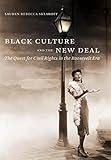
Lauren Rebecca Sklaroff. Black Culture and the New Deal: The Quest for Civil Rights in the Roosevelt Era. Chapel Hill: University of North Carolina Press, 2009. 328 pp. $35.00 (cloth), ISBN 978-0-8078-3312-4.
Reviewed by Matthew L. Downs
Published on H-Law (November, 2010)
Commissioned by Christopher R. Waldrep (San Francisco State University)
Staging Civil Rights
As scholars outline the long history of the African American civil rights struggle, the New Deal has become a historiographic battleground, centered on the objectives and limits of federal legislation. For some historians, Franklin D. Roosevelt’s failure to address directly the needs of black communities demonstrates the government’s unwillingness to challenge racial inequality (see, for example, Harvard Sitkoff’s A New Deal for Blacks: The Emergence of Civil Rights as a National Issue: The Depression Decade [1978]). For others (including William Leuchtenburg in his The White House Looks South: Franklin D. Roosevelt, Harry S. Truman, Lyndon B. Johnson [ 2005] and Patricia Sullivan in her Days of Hope: Race and Democracy in the New Deal Era [1996]), the inclusion of African Americans in larger programs, albeit as secondary beneficiaries, suggests a growing concern for the effects of segregation and an important first step in the fight for civil equality. In Black Culture and the New Deal, Lauren Rebecca Sklaroff forgoes legislation in favor of the larger cultural effects of black participation in the New Deal, providing a refreshing new perspective on the ways in which African Americans carved out spaces for civil rights activism in public life.
Sklaroff focuses on the numerous cultural programs enacted during the New Deal and World War II, a period in which the federal government actively encouraged and shaped cultural expression. Stricken by economic depression and determined to boost public morale, the Roosevelt administration funded artistic production, both as a source of direct economic relief and as a means of creating and selling an “authentic American culture” that “championed national values and traditions by celebrating regional and racial diversity” (p. 28). African Americans played a central role in the production of this “authentic” culture, though as Sklaroff carefully documents, the work and influence of black actors, directors, writers, and musicians changed as the national discussion of “black Americanness” shifted to address the demands of wartime participation (p. 9). Tracing the development of government-sponsored black culture during the New Deal and World War II, Sklaroff presents a complicated portrait of the fight for racial equality.
Sklaroff proceeds topically and chronologically, with chapters on the Federal Theater Project (FTP), the Federal Writers’ Project, wartime publicity (centered on the “character” of boxer Joe Louis), the Armed Forces Radio Service, and the Office of Wartime Information’s Bureau of Motion Pictures (BMP). With each chapter, Sklaroff notes the growing “inclusion” of African Americans into government-sponsored portrayals of “American culture.” As black performers played larger roles in the construction of cultural images, such as plays, radio programs, travel guides, and films, their actions served to make a strong political statement about the continued existence of racial inequality.
Beginning with the New Deal, federally funded and organized cultural programs sought to portray African American life more “authentically”; yet by privileging black participation in American culture, administrators provided a unique opportunity for black performers to challenge negative portrayals. At the outset, the FTP formed “Negro Units” to select and produce plays that highlighted black culture. Overseen by mostly white administrators seeking a specific presentation of black culture, the FTP nevertheless provided a unique opportunity for black performers to move beyond stereotypical “minstrelsy” toward a more realistic portrayal of African American life. In fact, even when the agency “blackened” traditionally white performances, black actors found space for autonomy. In the Swing Mikado (1938), for instance, the FTP “swung” aspects of Gilbert and Sullivan’s iconic musical, replacing Japanese robes and makeup with African headdresses and sarongs and adding several new songs and dances to reflect the changed mood and setting. Sklaroff argues that the performance gave black actors and actresses the opportunity to demonstrate “serious” skills, faithfully reproducing much of the original score, while “blackening” the traditional musical and giving it a “distinct racial meaning” (p. 69). While fueling white audiences’ desires to see black performers in “the comfort of a recognizable artistic format,” the FTP’s productions also demonstrated growing space for a black culture separate from the “minstrel stereotypes” that dominated much of mainstream American culture (p. 78).
Even as Roosevelt’s administration shifted from the New Deal to World War II, cultural production remained an important aspect of the government’s domestic program. With the advent of the “Double-V” campaign and growing discontent among African Americans, federal support for black performance offered administrators a way to increase patriotism and participation in the defense effort while forestalling more direct discussions of continued inequality. Government programs supported publicity that portrayed prominent African Americans, such as boxer Joe Louis, as valuable additions to a patriotic cause. In particular, Louis’s victories over “enemy combatants” became symbols of the superiority of American ideals, and his willingness to volunteer for the army suggested that racial animosity had no place in a society at war. Yet again, Sklaroff shows the complicated nature of such publicity. Even as Louis represented cooperative black patriotism, his presence and participation in a government program demonstrated a growing sense that black support for the war effort was essential to eventual success; Louis’s performance “produc[ed] a narrative both sanitized and racially charged” (p. 156).
For Sklaroff, these efforts at cultural inclusion culminated in the BMP, a federal agency tasked with enforcing patriotic principles in Hollywood films. As with the “performance” of Louis, the BMP sought to portray African Americans as important contributors to the war effort without broaching sensitive issues, particularly social integration. Yet unlike the carefully guided productions of the New Deal and early war effort, black performance in wartime films pushed the boundaries of what was “acceptable,” both for the administration and for mainstream black civil rights organizations. This was most notable in Cabin in the Sky (1943), an all-black musical starring Ethel Waters and Lena Horne as women fighting for the heart of a lottery winner. In contrast to the success of another black musical, the Swing Mikado, Cabin in the Sky received serious criticism. The all-black production did not fit with the wartime imperative to show African Americans as participants in a larger American culture, and for the National Association for the Advancement of Colored People (NAACP), the “vulgar” portrayal of urban life threatened the organization’s “bourgeois sensibilities” (p. 218). Yet despite the criticisms, by the end of the war effort, such portrayals of African American life had become an essential aspect of American culture. As Sklaroff notes, Hollywood films conscientiously sought to attract African Americans to theaters, black music found an increasingly interracial audience, and white audiences came to appreciate the “serious” talents of black performers.
Black Culture and the New Deal is a valuable addition to the growing history of the “long” civil rights movement. As historians uncover the numerous actions of resistance that marked the black response to inequality, the lines between political performance and cultural performance necessarily blur. Hoping to build and maintain black support for economic recovery and the American defense effort, the Roosevelt administration’s support for cultural production provided an opportunity for African Americans to challenge popular conceptions about black culture and life. Working within an admittedly limited system, performers forced American audiences, white and black, to reconsider long-held prejudices; in doing so, black actors and actresses, directors, singers, musicians, and writers became foot soldiers in the struggle for civil rights.
If there is additional discussion of this review, you may access it through the network, at: https://networks.h-net.org/h-law.
Citation:
Matthew L. Downs. Review of Sklaroff, Lauren Rebecca, Black Culture and the New Deal: The Quest for Civil Rights in the Roosevelt Era.
H-Law, H-Net Reviews.
November, 2010.
URL: http://www.h-net.org/reviews/showrev.php?id=31007
 | This work is licensed under a Creative Commons Attribution-Noncommercial-No Derivative Works 3.0 United States License. |

