



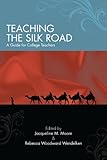
Jacqueline M. Moore, Rebecca Woodward Wendelken, eds. Teaching the Silk Road: A Guide for College Teachers. Albany: SUNY Press, 2010. ix + 238 pp. $75.00 (cloth), ISBN 978-1-4384-3103-1; $24.95 (paper), ISBN 978-1-4384-3102-4.
Reviewed by Stewart Gordon (Center for South and Southeast Asian Studies, University of Michigan)
Published on H-Asia (January, 2011)
Commissioned by Sumit Guha (The University of Texas at Austin)
The Silk Road in Teaching: Twenty Years On
Teaching the Silk Road assembles the revised papers of a seminar held at the East-West Center of the University of Hawaii. The seminar considered both formal pedagogy of the Silk Road and personal experience, such as taking students there for overseas study. The book’s opening section presents six chapters showcasing how the authors use the Silk Road in various disciplinary courses: they broaden world history surveys, add breadth to European history, address the emergence of a Chinese identity, add historical depth to globalization in political science, complicate exchange and development in comparative politics, and examine the complex interplay of symbols and motifs in art. The next two chapters concern thematic courses using the Silk Road, specifically on nomads and national identity. Part 3 offers four specific curricular approaches tried by the authors--the Silk Road through maps, primary sources, overseas study for students, and the Silk Road as a region of student service. The book ends with a chapter of reminiscences by a Han woman whose family was sent away from their urban life to Khotan during the 1960s.
In the last two decades, interest in the Silk Road has grown, both inside and outside the academy. There are currently more than eight hundred books in print on aspects of the Silk Road. More than seventy-five books on the Silk Road were published in 2010. They include books on empires, cities, music, cuisine, literature, textiles, Islam, European archaeologists, older travel accounts, caravan life, Altaic religions, Buddhism, Jews, site preservation, abandoned cities, climate change, current travel guides and memoirs, and novels set on the Silk Road.
There is also a plethora of teaching materials on the Silk Road. A casual review of a few hundred of the 170,000 sites from an Internet search “Silk Road plus teaching materials” yielded curriculum materials assembled by PBS, National Geographic, The Smithsonian, the Freer/Sackler Gallery, the Boston Museum of Fine Arts, the China Institute, the Metropolitan Museum, the International Dunhuang Project, the Silkroad Foundation, and the Asia Society. In addition, available online are dozens of courses by individual college professors in the United States, Europe, and Asia, as well as curricula developed by various area studies centers.
In spite of this flood of material on the Silk Road, Teaching the Silk Road has much to offer. Most of the contributors have considerable experience in teaching the Silk Road and have arrived at what might be termed a “second generation” perspective. Stand-alone courses on the Silk Road are rarely manageable. There are just too many empires, too many cities, too long a history, too many religions, and too many artifacts. It is easy for a course to slide into “one thing after another.” The authors of Teaching the Silk Road suggest two alternate strategies. The first is to mainstream the Silk Road into a variety of courses, as a comparative, complicated case. This strategy seems productive. Enough translated primary documents and memoirs, images, and good secondary studies of the Silk Road are available for the Silk Road area to take its place in historical or theoretical studies of the spread of religions, trade, language use, political systems, or the exchange of material culture. The second strategy, equally viable, is to take one aspect, such as the ecology of the Silk Road or the movement of Buddhism, and build a course around it.
Although research on the regions of Central Asia and western China has flourished, few academic articles use the term “Silk Road” in their titles. This omission suggests that some fundamental thinking about the term “Silk Road” remains to be done. First, the term is of relatively recent origin and has a freighted history of association with Chinese irredentist claims. Second, the term focuses attention on the two ends of the road, China and Europe, at the expense of the welter of peoples and activities along it. This perspective rests on the dubious assumption that the route rose or fell depending on the strength of the dynasty in China. Current research suggests, in contrast, that the route was always segmented, with a multiplicity of commodities and supply, processing, and demand centers. The flow of information from demand centers back to producers was a crucial part of the trading networks. Third, for trade and exchange in ideas, fashion, cuisine, and kingly customs in a broad region of across Eurasia, it is likely that other routes were as important as the Silk Road, such as the caravan route from the Caspian Sea into Rus, the horse trade from the steppe into India, the tea route from southern China to Tibet, and the Buddhist route from Sri Lanka and Tibet to eastern India.
It is an exciting time in studies of the lands of the Silk Road. Based on years of experience, the authors of Teaching the Silk Road offer sound strategies for both stand-alone courses on aspects of the route and mainstreaming what has been uncovered in three decades of research into existing courses in a variety of disciplines.
If there is additional discussion of this review, you may access it through the network, at: https://networks.h-net.org/h-asia.
Citation:
Stewart Gordon. Review of Moore, Jacqueline M.; Wendelken, Rebecca Woodward, eds., Teaching the Silk Road: A Guide for College Teachers.
H-Asia, H-Net Reviews.
January, 2011.
URL: http://www.h-net.org/reviews/showrev.php?id=30941
 | This work is licensed under a Creative Commons Attribution-Noncommercial-No Derivative Works 3.0 United States License. |

