



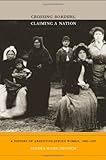
Sandra McGee Deutsch. Crossing Borders, Claiming a Nation: A History of Argentine Jewish Women, 1880–1955. Durham: Duke University Press, 2010. 368 pp. $84.95 (cloth), ISBN 978-0-8223-4657-9; $23.95 (paper), ISBN 978-0-8223-4649-4.
Reviewed by Donna Guy (Ohio State University)
Published on H-Judaic (June, 2011)
Commissioned by Jason Kalman (Hebrew Union College - Jewish Institute of Religion)
Liberating Argentine Jewish Women’s History
The publication of Sandra McGee Deutsch’s Crossing Borders, Claiming a Nation marks a major contribution to the history of Jews in Argentina as well as to women’s history. Her nuanced and engaging stories of women from the right, the left, and the center of the Argentine Jewish community and their efforts to distinguish themselves beyond the realm of hearth and home represents the first major monograph on Jewish women in the Southern Hemisphere. It covers women who grew up in the Jewish agricultural communities as well as those who lived in urban areas from 1880 to 1955. From women who told of their daily existence in families to those who portrayed Jewish themes in the theater and in music, to socialists and Zionists, women appear in the records of the Jewish community, even though they often had little power outside the home within the religious community. Equally important, Deutsch has paid careful attention to German, eastern European, and Moroccan Jewish women.
Often prosopography can be weighed down by the biographical unsubstantiated by personal recollections, but Deutsch has relied on a combination of statistics, memoirs, and personal interviews to bring life to the many women discussed. Furthermore their lives become more than anecdotal through the skillful use of the concepts denoted in the book title: the efforts of women to transit communal, geographic, political, and familial boundaries. Together they form part of a transnational diasporic community bounded by gender, religious, and ideological expectations that women challenged as well as celebrated in many ways.
Each chapter deals with a different group of women, beginning with those in the Jewish agricultural colonies who were often ignored or expected to remain at home by the Jewish Colonization Association officials. Although the common recollections of these communities are often nostalgic, the Ashkenazi and Sephardic women who went to the interior sometimes had to support the family by moving to Buenos Aires to work, and widows became the only women entitled to plots of land without their husbands to help out. Furthermore Jewish girls received less education than their male counterparts, partly due to poverty, but also to the emphasis on male education. One solution became boarding schools in more urban areas, with the girls living with relatives, and women became active in founding and supporting libraries. Communist-supported libraries also introduced Jewish women to new ideas. They also supported activities extolling the Argentine state on its public holidays as part of the process of both assimilation and patriotism long before women gained voting rights in 1947.
In Buenos Aires, as well as in other urban diasporic cities, poor Jewish women helped support the family through menial tasks such as laundering clothing. Educated women became involved in cultural centers and philanthropic activities. Although Jewish women lived in neighborhoods more segregated than others in immigrant communities, that did not mean they had no opportunities to reach out and engage in activities that transcended their own streets and families. They also received more education, often through religious organizations, than in the countryside, and teaching offered an acceptable occupation for educated women both inside and outside the Jewish community. Once again the presence of strong ideological movements such as anarchism, socialism, and, after 1918, communism, meant that women proved their usefulness ideologically by engaging in strikes, maintaining solidarity with those imprisoned on political charges, and both publishing and teaching these ideologies.
The narratives and analysis become the strongest as the research approaches the mid twentieth century due to the possibility of interviewing women who participated in these processes. Furthermore the coverage of both antifascist and Zionist Jewish women shows that women could cross international borders as well as work closely with groups of other Argentine women, particularly with the Junta de la Victoria in the case of the antifascist women.
Rather than tell just the stories of the most famous Jewish women Deutsch truly tries to integrate the unknown, the infamous (in the case of Jewish prostitutes), and the more well-known political activists. Thus while we learn more about the socialist Chertkoff sisters, we also learn of Elisa, a seamstress from Romania. We now know much more about the entertainers Cipe Lincofsky and Golda Fleme. What remains untold, however, is the interaction of these women with formal Jewish associations controlled by men. Indeed, the emphasis in this book, other than looking at the Zionists, is on women who generally worked outside the framework of “appropriate” roles for Jewish women in Argentina. Equally important, it is very difficult to tell whether the patriarchal nature of the formal Jewish community or husbands actually impeded women “crossing borders.” For example, there are no studies on divorces among the religious and their impact on Jewish women, nor of community ostracism of women who transgressed boundaries other than commercial sex.
Since it would be impossible to quantify the number of women who became notable within the Jewish community over time, it is even more difficult to gauge whether they are principally with the Left or the Zionists. In more recent times, estimates of Jews in Argentina who do not practice their faith well outnumber those who do, and given the fact that before the 1960s no Jewish seminaries operated in Argentina, one might surmise that non-practicing Jews also outnumbered those who belonged to the formal Jewish community. Thus the issue of patriarchy and religious control is a particularly important question for the Jewish women of Argentina, as the Jewish community itself solidified its fragmentation between the Left and the religious during the Peronist era and thus muddied these waters. Despite these thorny questions, there can be no doubt that few have gone as far as McGee Deutsch to reveal the history of Jewish women in Argentina. In fact, it ranks as the first major publication on women in an immigrant community anywhere in Latin America. And that is quite an achievement.
If there is additional discussion of this review, you may access it through the network, at: https://networks.h-net.org/h-judaic.
Citation:
Donna Guy. Review of Deutsch, Sandra McGee, Crossing Borders, Claiming a Nation: A History of Argentine Jewish Women, 1880–1955.
H-Judaic, H-Net Reviews.
June, 2011.
URL: http://www.h-net.org/reviews/showrev.php?id=30927
 | This work is licensed under a Creative Commons Attribution-Noncommercial-No Derivative Works 3.0 United States License. |

