



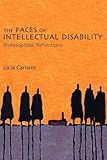
Licia Carlson. The Faces of Intellectual Disability: Philosophical Reflections. Bloomington: Indiana University Press, 2010. xiii + 266 pp. $65.00 (cloth), ISBN 978-0-253-35421-1; $24.95 (paper), ISBN 978-0-253-22157-5.
Reviewed by Elizabeth DePoy (University of Maine)
Published on H-Disability (December, 2010)
Commissioned by Iain C. Hutchison (University of Glasgow)
Analysis of Intellectual Disability: Past History and Contemporary Viewpoints
Licia Carlson’s book is about “worldmaking” or what she refers to as “finding and making.” She travels between institutional history and contemporary philosophy to analyze intellectual disability as knowledge both “found and made.” To guide this ambitious project, Carlson promises an intricate philosophical analysis of intellectual disability. Initially, she creates a multidimensional rubric that organizes the remainder of the book. The first dimension comprises three models of disability (medical, social, and postmodern), the second contains two categories of philosophical analysis (traditional and critical), and the third imposes three Foucauldian axes (knowledge, power, and ethics) on the historical and philosophical analysis of intellectual disability.
Because of her conviction that history must be invoked to provide the foundation for the philosophical analytic table to be set and visualized, Carlson then devotes part 1 to look back to eighteenth-century chronology to inform the present. Of particular note are her borrowed analyses from the Foucauldian emphasis on the institution and Young’s feminism. And so part 1 is devoted to looking backwards, albeit through a revisionist lens, asserted by Carlson as analytically purposive. This section illuminates binaries that locate intellectual disability as alter and as a group that is at the bottom of the power totem. Moving forward in time in the intermission between history and contemporary philosophy, Carlson takes on the vagueness of social construction, distinguishing an entity as natural, named, and/or experienced. Explicating her own healthy doubts armed with history, Carlson proposes yet another framework superimposed on the initial rubric, to analyze intellectual disability as a classification in which heterogeneity, instability, prototype effects, and power relations are inherent and complex.
In part 2, she analyzes intellectual disability as four faces or appearances aided by the labyrinthine analytic scaffolds that she proposes as potent in part 1. Each face illuminates a philosophical project in itself as Carlson converses with other scholars who have fashioned varied portraits of intellectual disability.
Carlson’s project is indeed Herculean as she attempts to provide the musculature for what she considers to be a skeletal treatment of intellectual disability within philosophy. Through her linguistic skill, Carlson renders complex ideas ascertainable. Indeed, an ongoing critical approach to the analysis of human intellectual performance is warranted and Carlson has entered that arena.
Several discussions are missing from Carlson’s analysis, as she does not cite works that have previously engaged with such topics. First, Carlson places her work within disability studies literature, but attends primarily to three models of disability: medical, social and postmodern. Several issues are problematic with this scheme. Postmodern and social models are not mutually exclusive and thus should not be discussed as separate conceptual entities. But even more fundamental is Carlson’s failure to draw on the most recent work in which disability is analyzed through complex marriages of disciplines that provide the richness that emerged from scholars who have moved beyond the lexical obsession of postmodernity. Tobin Siebers, Tom Shakespeare, Elizabeth DePoy and Stephen Gilson, and Tanya Titchkosky are just several of the authors whose work engages symbol but does not get mired in it. These authors move beyond linguistic quicksand into useful theoretical and even praxis substance.
Second, Carlson raises heterogeneity with regard to severity of “intellectual disability” but does not substantively return to the causes of intellectual performance once she leaves them in the introduction. Consulting ontological debates about why cognitive incapacity is presumed to be an accurate causal inference over others, such as the inability to communicate one’s thoughts, would have taken on the very existence of “mental retardation” and made this work compelling as a philosophical leader. Although not well developed and hotly contested, the facilitated communication debate foregrounded this query and might have been employed here to shed ontological light on unquestioned assumptions that should have been addressed. Moreover, engaging this agenda would have challenged Carlson to question her own acceptance of “intellectual disability” as human performance.
Third, a broader and more profound discussion of Adolphe Quetelet’s bifurcation of humans through the creation of the normal curve, and the embeddedness of this mathematical symbol into what might be considered “practice symptomology,” such as IQ testing, developmental theory, and institutional and training responses to “subnormal” humans, would have grounded the analysis in a historical watershed conceptual event and enriched an epistemic discussion of the Foucauldian principle of knowledge as power. Finally, including the historical work from theology of disability such as that advanced by Judith Abrams and Amos Yong would have created a more complete chronological story mediating against some of the claims that intellectual performance has not been squarely rooted in philosophical literature.
As it stands, Carlson’s project is a sound and worthy foundation on which to build a more complete analysis in this growing area of scholarship.
If there is additional discussion of this review, you may access it through the network, at: https://networks.h-net.org/h-disability.
Citation:
Elizabeth DePoy. Review of Carlson, Licia, The Faces of Intellectual Disability: Philosophical Reflections.
H-Disability, H-Net Reviews.
December, 2010.
URL: http://www.h-net.org/reviews/showrev.php?id=30915
 | This work is licensed under a Creative Commons Attribution-Noncommercial-No Derivative Works 3.0 United States License. |

