

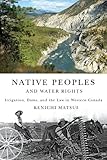
Kenichi Matsui. Native Peoples and Water Rights: Irrigation, Dams, and the Law in Western Canada. Native and Northern Series. Montreal: McGill-Queen's University Press, 2009. 256 pp. $29.95 (paper), ISBN 978-0-7735-3534-3; $95.00 (cloth), ISBN 978-0-7735-3521-3.
Reviewed by Shannon Stunden Bower (University of Alberta)
Published on H-Water (September, 2010)
Commissioned by John Broich (Case Western Reserve University)
Water and Colonialism in Semiarid British Columbia and Alberta, Canada
In Native Peoples and Water Rights, Kenichi Matsui explores the relationship between water management, colonialism, and aboriginal lives. Matsui documents some of the ways the aboriginal people and non-aboriginal settlers of the semiarid regions of the Canadian provinces of British Columbia (BC) and Alberta interacted with each other and federal and provincial administrators in the areas of irrigation and hydroelectric development. The experiences and actions of aboriginal people are Matsui’s major concern, and his interpretation emphasizes cross-cultural interactions and aboriginal agency in a manner that, in Matsui’s view, distinguishes his work from other studies that focus on oppression and what he calls “victim narratives” (p. 7).
Published by McGill-Queen’s University Press as part of the expansive Native and Northern Series (edited by historian Sarah Carter and historical geographer Arthur J. Ray), Matsui’s work will interest scholars concerned with Canadian history and aboriginal issues, as well as water history. Following a general introduction, Matsui offers a chapter on water and property rights in the North American settler societies of Canada and the United States and a chapter on jurisdictional contention between the federal and provincial governments in relation to BC’s aboriginal reserves. The following three chapters provide case studies that, as Matsui explains, are intended to highlight heterogeneity of experience, even among aboriginal groups living in similar landscapes and dealing with water issues. Chapter 4 addresses irrigation in the BC interior with particular attention to the Secwepemc people, chapter 5 considers irrigation in the Treaty 7 region of Alberta with a focus on the Siksika people, and the final substantive chapter considers hydroelectric development in the Treaty 7 region of Alberta with particular attention to the Stoney Nakoda people.
Matsui’s case studies make clear that, with respect to irrigation and hydroelectric development in semiarid BC and Alberta, at least, there were no clear and stable lines of opposition between government agents and non-aboriginal settlers on the one hand and aboriginal communities on the other. Government officials on the ground recognized the need to provide access to water if efforts to assimilate aboriginal people through agriculture were to succeed. Non-aboriginal settlers positioned themselves to take advantage of policies designed to benefit aboriginal people. Governments fought among themselves as federal and provincial agents disagreed over which level of government had jurisdiction over water management. Drawing attention to these and other shifting alliances and unstable oppositions is part of Matsui’s effort to provide an account in tune with the thinking of colonial theorists, such as Nicholas Thomas and Edward Said, one that emphasizes negotiation and resistance in the relation between colonizer and colonized. Along with a summary of key aspects of his work, Matsui’s conclusion offers a return to explicit discussion of the actual colonial context in late nineteenth- and early twentieth-century Canada, which was addressed directly in the introduction and second chapter but which was largely implicit in the arguments presented in chapters 3 through 6. This may reflect the difficulty of illustrating precisely how the big ideas that inspired the international project of colonialism (and that are analyzed by such theorists as Thomas and Said) connected to the on-the-ground workings of government bureaucracy that were among colonialism’s local incarnations.
Matsui’s geographical area of concern is best described as the semiarid region of BC and Alberta. This region, defined by similarity of landscape and climate, overlaps with a number of geographical divisions more familiar to historians. The boundary between Alberta and BC has typically been seen as quite significant, because of differences of legislative regime and historical periodization between the provinces of the Canadian prairies and the coastal province of BC. A certain awkwardness to Matsui’s book, evident in the need to specify repeatedly differences in timing and law, might perhaps underline the continued validity of dealing separately with the prairies and BC, at least with respect to the late nineteenth and early twentieth century addressed in this work. At the same time, Matsui’s focus on an environmentally defined area, one that includes part but not all of the Canadian prairies, provides a useful reminder of the need to accommodate environmental differences, and especially differences related to water quantity, in analyses of a region that encompasses Manitoba’s wet prairie as well as the dry lands further west.
Scholars concerned with water from an environmental history perspective might wonder about the role of nonhuman nature in the complex human situations described by Matsui. Historians and geographers working on irrigation in Canada and the United States have made clear that moving water from place to place is a challenging undertaking, one fraught with issues that can redouble the complexity of the sort of human questions of fairness and entitlement that underlie many administrative disputes over water management.[1] While Matsui recognizes the relevance of environmental history, Native Peoples and Water Rights is an analysis of how people managed nonhuman nature, not of how nonhuman nature figured in human attempts at management. Neither are aboriginal perspectives on water or water management afforded significant consideration. While the preface and conclusion include references to the ways that the relevant aboriginal communities conceptualized their relation to water and other aspects of the natural world, Matsui explains that an adequate exploration of these distinctive viewpoints is beyond the purview of his work.
Native Peoples and Water Rights represents an important effort to explain what wrongly could be dismissed as either a minor topic in water history or a minor topic in native history. By building on the work of other scholars, Matsui argues convincingly that water has been of unrecognized importance to both agricultural development and property theory, providing the intellectual context in which aboriginal water rights illuminate larger questions related to both water management and human experiences. While the connection between large-scale colonialism and the local project of water management might have been more carefully drawn and more consistently emphasized, it is nevertheless this linkage that gives the work an appeal extending beyond the geographical area in question and the scholars focused on closely related issues.
Note
[1]. Christopher Armstrong, Matthew Evenden, and H. V. Nelles, The River Returns: An Environmental History of the Bow (Montreal and Kingston: McGill-Queen’s University Press, 2009); Matthew Evenden, “Precarious Foundations: Irrigation, Environment and Social Change in the Canadian Pacific Railway’s Eastern Section, 1900-1930,” Journal of Historical Geography 32, no. 1 (2006): 74-95; and Mark Fiege, Irrigated Eden: The Making of an Agricultural Landscape in the American West (Seattle: University of Washington Press, 1999).
If there is additional discussion of this review, you may access it through the network, at: https://networks.h-net.org/h-water.
Citation:
Shannon Stunden Bower. Review of Matsui, Kenichi, Native Peoples and Water Rights: Irrigation, Dams, and the Law in Western Canada.
H-Water, H-Net Reviews.
September, 2010.
URL: http://www.h-net.org/reviews/showrev.php?id=30886
 | This work is licensed under a Creative Commons Attribution-Noncommercial-No Derivative Works 3.0 United States License. |

