



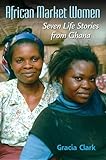
Gracia Clark. African Market Women: Seven Life Stories from Ghana. Bloomington: Indiana University Press, 2010. 265 pp. $65.00 (cloth), ISBN 978-0-253-35417-4; $24.95 (paper), ISBN 978-0-253-22154-4.
Reviewed by Sara Berry (Johns Hopkins University)
Published on H-Africa (July, 2010)
Commissioned by Brett L. Shadle (Virginia Tech)
Little by Little: Life Histories of African Market Women
Gracia Clark is an anthropologist whose ethnographic research and writings center on the lives of women traders in Kumasi, Ghana’s second largest city and capital of the historic Asante Region. Since she first began working in Kumasi in the late 1970s, Clark has carried out several extended periods of ethnographic research in and around Kumasi’s vast Central Market, observing women’s activities, sharing their surroundings, and following them on trading journeys to the countryside around Kumasi, and to markets, towns, and cities in other regions of Ghana. In journal articles and, now, two monographs, Clark has produced richly detailed accounts of the women’s business practices, their daily lives, and the economy, society, and political world in which they live and work. In addition to intensive ethnographic observation and analysis, she brings a historical perspective to her work--tracing continuities and changes over time in economic conditions, government policies, and city life in Kumasi, and discussing their significance for market women’s lives.
Clark’s first book, Onions Are My Husband: Survival and Accumulation by West African Market Women (1994), is a meticulously detailed description and analysis of women’s business practices, market conditions, traders’ social and familial relationships, and the place of Kumasi Central Market in the regional economy of central and southern Ghana in the early 1980s, when Clark did her fieldwork. Dominating wholesale trade in staple foodstuffs in Central Market and the surrounding region, Kumasi’s women traders built their own system of market governance--organized in associations of women who trade in a particular commodity, elect their own “market queen,” and meet as needed to exchange commercial information, resolve disputes, and debate strategies for coping with official interventions or with crises, such as a collapse in prices, a fire, or a change in government policy. Approaching fieldwork as a learning experience, Clark positioned herself as a student, her informants and research assistants as teachers. Realizing during the early stages of her fieldwork that traders often responded to her as they would to a small child, she incorporated her social position into her research methods. As time passed, “I began to be entrusted with tasks appropriate to a five-year-old--watching the stall for theft or playing with the baby. Then I was promoted to eight- or nine-year-old status, capable of making ordinary retail sales and purchases and carrying complex messages.”[1] Based on this extended process of learning and social maturation, Clark developed a deep, experiential understanding of Asante society and the market economy that lies at the center of the women traders’ lives. African Market Women builds on this understanding.
Soon after Onions Are My Husband was published, Clark returned to Kumasi for further research on market women’s life histories. Reconnecting with some of the women she had known through her earlier research and getting acquainted with others, she asked for volunteers who would be willing to narrate the stories of their lives and have her record them. Seeking uninterrupted reflections from each of her informants, she altered her research methods from the earlier study. Instead of conversing with and observing women in the marketplace and on trading journeys, she invited volunteers to visit her lodgings, one at a time, thereby removing them from the noise and distractions of the market, and recorded their narratives as they told them, interrupting as infrequently as possible, and only to ask the speaker to clarify or expand on a point. The result is African Market Women, a collection of autobiographical narratives told by the women in Twi, transcribed and translated by Clark and two Ghanaian assistants, and reproduced in the book with short chapter introductions and minimal editing by Clark, plus an introduction and a conclusion. In the introduction, Clark provides a brief overview of the history of Kumasi Central Market and the position and importance of women traders there, and describes in detail the methods she used in eliciting, recording, and producing the women’s narratives. In the conclusion, she reflects on the collected stories, pointing out some of their common themes, but concluding that what is most valuable about them are their idiosyncracies. “Privileging their individuality focuses ... on the interpretive insights for which in-depth interviewing has the most advantages.... Rooted in multiple contradictory connections ... they ... illuminate ... social cleavages, [but] they do so by also partly bridging them” (p. 218).
The narratives themselves share a central focus on the women’s work as traders--detailing business strategies and practices, describing market conditions at different points in time, and recalling contingent events that opened new business opportunities or destroyed a trader’s capital. Most women interspersed their accounts with reflections on their families and, less frequently, other topics, such as biblical allusions, government policies, or the puberty ceremonies that their families had held for them in their youth. For the most part, the narratives are not arranged in chronological order or by theme, but move from one topic to another, sometimes within a single paragraph, often returning repeatedly to a particular theme, connecting it to various topics, circling back to offer explanations, or make judgmental comments on particular actions or associates described at an earlier point in the story. After commenting on skills required to trade in a particular commodity, a woman might go on to discuss her own business successes or misfortunes, describe her relations with a “mother” or “sister” who had helped her with her trade, detail her experiences with a former husband, or reflect on the way prices or standards of living had changed since she was young.
As Clark emphasizes in her conclusion, the narratives do not provide systematic accounts of changing market conditions, trading practices, or stages in a woman’s life course, but do help to illuminate the kinds of connections market women make between one theme and others, and the ways in which they explain the causes, or weigh the morality, of seemingly disparate activities and behaviors. Unfailingly realistic, they do not waste energy hoping for miracles. “Slow but steady progress, kakrakakra (literally, little by little),” as one elderly trader put it, is the key to business and personal success (p. 229). It is also a useful guideline for reading this book. Because Clark has chosen to give us the women’s narratives largely in their own words, African Market Women does not immediately engage the reader in a compelling plot or hold her attention by using its ethnographic evidence to unravel an analytical puzzle. Rather, its strengths lie in the understated manner with which it brings the reader into Clark’s conversations with her informants and the texture of their take on the circumstances and events of their lives. The book may be read as both a scholarly study and a collection of primary sources: accessible to a general reader, and likely to be of particular interest to students and scholars seeking knowledge about Ghana, women’s studies, and/or African social history and economic life. For readers who are already familiar with Clark’s first book, African Market Women will be a welcome and rewarding companion volume.
Note
[1]. Gracia Clark, Onions Are My Husband: Survival and Accumulation by West African Market Women (Chicago: University of Chicago Press, 1994), 22.
If there is additional discussion of this review, you may access it through the network, at: https://networks.h-net.org/h-africa.
Citation:
Sara Berry. Review of Clark, Gracia, African Market Women: Seven Life Stories from Ghana.
H-Africa, H-Net Reviews.
July, 2010.
URL: http://www.h-net.org/reviews/showrev.php?id=30817
 | This work is licensed under a Creative Commons Attribution-Noncommercial-No Derivative Works 3.0 United States License. |

