



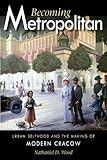
Nathaniel D. Wood. Becoming Metropolitan: Urban Selfhood and the Making of Modern Cracow. DeKalb: Northern Illinois University Press, 2010. 268 pp. $40.00 (cloth), ISBN 978-0-87580-422-4.
Reviewed by Brendan Karch (Harvard University)
Published on H-Urban (March, 2011)
Commissioned by Alexander Vari (Marywood University)
Looking to Europe: Identities in Urbanizing Cracow
Historians of modern central and eastern Europe often flock to cities as the focus of their studies. Existing within multi-ethnic empires and invariably home to multi-ethnic populations, cities such as Riga, Budapest, Prague, Vienna, Trieste, Warsaw, or Cracow--to name but a few--have served largely as lenses to examine the shifting ethno-political landscape of the nineteenth and twentieth centuries. They have become prime sites to answer questions about issues in nationalism or anti-Semitism.
But what should we make of the city in its own right, of the forging an urban community? Nathaniel D. Wood, in his volume Becoming Metropolitan: Urban Selfhood and the Making of Modern Cracow, takes up this question. The process of “becoming metropolitan” surely changed local citizens’ identification with one another, with modernity, and with ideals of European civilization--and not just with the nation, the lodestar of most east European studies. Wood focuses on the relationship between urban self-identification in Cracow before World War I and citizens’ complex desires to become “European.” It is a well-organized, tightly argued study on overlooked aspects of urban self-identity outside the bounds of national imagined communities, and as such deserves attention from scholars of the region or urban historians interested in issues of identity and modernization.
Wood positions his work in contrast to studies focused on nationalism. It is all but impossible not to read Wood in part as a response to another work on turn-of-the-twentieth-century Cracow, Patrice Dabrowski’s Commemorations and the Shaping of Modern Poland (2004). The narratives are like a set of fraternal twins: both born from the same place and time, and both raised in the same historiographical tradition, but each independently minded and more than willing to reach its own conclusions. Dabrowski analyzes how nationally minded Cracovians constructed their vision of a Polish national past through commemorations. This “invention of tradition” in Cracow took on special meaning for a Polish nation without a state. Poland had been partitioned since the late eighteenth century between Prussia, Russia, and Austria, and Cracow became a center for Polish nationalists from across the partitions to promote historical monuments and commemorations to Poland. As Dabrowski shows, Cracow’s urban politics looked to the past in hopes of constructing a mass Polish nationalism for the future.
In Wood’s work, Cracovians instead looked primarily to their urban future as a way to construct their place not in Poland, but rather in Europe. Wood traces the rapid transformation of Cracow from a dilapidated Austrian garrison town in 1900 into something resembling a small European metropolis by 1915. The processes driving this urban transformation--huge territorial expansion through the incorporation of neighboring suburbs, along with the modernization of infrastructure--were common across east central Europe around 1900, and will be familiar to any urban historian.
Wood suggests that the key debates and conflicts in Cracow’s broader public sphere during this period of rapid urban growth were driven not by nationalism, but rather by the terms of entry into “European” civilization. The modern, urban Cracow he depicts--of electric trams and running water, streetlamp vandalism and tabloid-worthy crime--is one that arguably engaged most Cracovians and permeated their daily lives far more than backward-looking national commemorations did. Wood argues, “As an ‘imagined community,’ urban identification has a place in the modern self that may be more stable, intimate, and proximate than identification with the nation, but it has been generally overlooked” (p. 11). He recognizes that the two forms of identification are not mutually exclusive. A nationalist vision of Cracow as a “Polish Athens,” with its dense urban core of medieval Polish treasures, animated nationally minded elites before World War I. But Wood also finds a direct discourse about the Europeanization of Cracow unmediated by nationalist ideas.
After a background chapter depicting the urban landscape of Cracow around 1900, before its transformation, Wood begins his argument in earnest by analyzing what he calls the “interurban matrix.” By this term he suggests that Cracow joined an imagined community of fellow European cities which shared the common concerns and lifestyles of the modern metropolis (or aspiring metropolis). Wood’s evidence in this chapter, and throughout the book, relies on the Cracovian press. In particular, he examines a new kind of boulevard press which appealed to mass audiences through tabloid-style journalism and stood in marked contrast to an older, stodgier political press. Wood sees this new boulevard press as mixing local stories with tales from fellow European cities to place Cracow in an imaginative dialogue with European urban civilization. Sensationalist journalism on murders in Cracow and in Paris, for example, could give readers the sense of being connected to other European big cities. This “interurban matrix,” as Wood argues, cultivated a sense of urban, European identities among readers much more than any Polish national identity.
Wood’s subsequent two chapters address the incorporation of surrounding suburbs to create a “Greater Cracow.” One chapter is a micro-study of a 1903-4 article series in Nowiny dla wszystkich (News for Everyone) which promoted the idea of urban territorial expansion. The paper saw Cracow’s expansion as key to its joining the ranks of European great cities. Another chapter examines the broader public debates which accompanied Cracow’s expansion from 1910-15. Wood traces these debates mainly to pragmatic issues (old Cracow was overpopulated and out of room) and to discourses of progress or European civilization. Visions of “Greater Cracow” focused less on the old historical core and more on an integrated, bustling, modernized metropolis--one ready to join Europe. Wood supports his account with lively, often untraditional evidence. During the city’s largest territorial expansion in 1910, for example, Wood reprints the full menu at the official celebration dinner, which resembled a grand tour of European cuisine, as if the meal announced Cracow’s arrival at the table of European metropolises. At times, Wood seems to openly side with the progressive, pro-expansionist politicians, and dismisses oppositional conservatives as “merely defending their outdated ways” (p. 115). Yet the ambiguities of modernization which worried opponents are more explicitly and subtly addressed in later chapters.
Wood’s chapters on the more ambiguous consequences of urban growth are among the liveliest in his work. Chapter 5 focuses largely on the introduction of electric trams to Cracow in 1901. A spate of early tram accidents, including many pedestrian injuries or deaths, unleashed public discontent in the popular press. Some complaints took on a nationalist tinge, as the Belgian-owned tram company came under attack as a foreign profit-seeker unresponsive to Polish, Cracovian needs. Yet these initial debates mainly revealed not nationalist fervor, but rather an ambiguity about European progress. In particular, fears of technological advance ushering in a new era of easy death were mapped onto the trams, and onto automobiles or airplanes. Wood argues that the boulevard press that fed these public fears also ultimately helped to quell them; as Cracovians adjusted to the speed of trams and accidents dwindled, readers were encouraged in the papers to embrace the new technology in the name of becoming more cultured, or European.
Becoming metropolitan thus involved ambiguous responses to modernization. As Wood shows in chapter 6, nowhere was this ambiguity greater than in the city’s attitude towards the urban ills of new big cities, namely filth, supposed moral decay (such as prostitution), and violent crime. When the underbelly of urban life in European metropolises surfaced in the boulevard press, Cracow’s papers often sought to distance their city from direct comparisons; the “interurban matrix” thus worked oppositely when urbanization’s negative consequences came to the fore. One article in 1908 noted that, since Cracow only had fifty-six public violent acts the previous year, it could not possibly be a great city like Warsaw or Vienna. When the issue was hygiene and cleanliness, the explicit goal in the press became to meet “European” standards, and to overcome “Asiatic conditions” (p. 184). This was no doubt a sensitive issue for a city positioned discursively on the edge of European civilization, just miles from the Habsburg-Russian border.[1] Wood brings out the many ambiguous responses to urban growth and modernization, including vandalism of new streetlamps. But ultimately he concludes that the boulevard press proved the key actor in promoting the spread of these “metropolitan” beacons of European progress and civilization to Cracow, in the process creating an urban, metropolitan “imagined community” that was primarily non-national in content (p. 202).
Wood’s conclusions, in addition to providing a foil to Dabrowski, reinforce recent trends in the study of national ambiguity or indifference in modern central Europe. Historians have recently challenged long-held notions that most citizens were actively engaged in the nationalist battles which turned a land of three nineteenth-century empires into nearly homogeneous nation-states after World War II. Many Poles, Czechs, Germans, or Hungarians, especially in borderlands or mixed-language regions, resisted identifying unambiguously with a single nation. In many cases, this resistance was an intentional response to national radicalism. By crafting their own national or ethnic ambiguity, some central Europeans were able to escape the worst excesses of violent repression or expulsions in the 1930s and 1940s, changing their apparent loyalties according to the ruler of the day.[2] Wood expands our view beyond the typically identified rural or borderland sites of national indifference to include urban settings. Even in a mostly monolingual Polish urban space, one seemingly dominated by activists’ efforts to instill the population with Polish national feeling, the majority of citizens, as Wood suggests, showed little interest in Polish nationalism. They instead preferred to imagine themselves as a part of an imagined network of cultured European cities.
Wood’s argument is not without some loose ends. Cracow’s population began soaring decades before 1900, and Wood could better justify why the 1900-15 period he focuses on is the key period in which Cracovians “became metropolitan.” His “interurban matrix” also needs further elaboration to be proven a valuable analytic category, since it seems neither as new nor as unique as he suggests. Reporting on and from foreign metropolises pre-dated 1900, and educated locals often read foreign-language dailies from Vienna or abroad. Did these not also create a type of “interurban matrix” linking Cracovian urban self-identity to European metropolises? Wood’s use of newspapers as his primary source also comes with limitations. Urban “imagined communities” were forged in various political, commercial, or recreational urban spaces, and not just on the pages of the boulevard press. These other forums for forging urban self-identity appear only fleetingly. Finally, for an argument that seeks to discredit the primacy of national identity in pre-World War I Cracow, he often avoids some of the direct evidence of a strong nationalist life, evidence which would contradict his argument. His work is better at proving the primacy of urban, metropolitan self-identity than disproving the importance of nationalism to Cracovians. Indeed, when his work is compared with Dabrowski’s on nationalist Cracow and with other similar works on other cities, one comes away with the impression that national and European self-identities coexisted in an uneasy overlap and tension with each other. But the absolute primacy of non-national over national identity in Cracow, which he asserts, is difficult to prove.
Nonetheless, by telling the non-national side of the story with imaginative use of evidence and impressive analytic skill, Wood provides a valuable contribution to the field. His conclusion that Cracovian self-identity ultimately strived towards a European ideal is a welcome counterpoint to nationalist narratives, and suggests new, exciting avenues for exploring the effects of modernization and growth on urban selfhood.
Notes
[1]. For the classic examination of eastern Europe as existing on the edge of European civilization, see Larry Wolff, Inventing Eastern Europe: The Map of Civilization on the Mind of the Enlightenment (Stanford: Stanford University Press, 1994).
[2]. Notable contributions to this literature include Tara Zahra, Kidnapped Souls: National Indifference and the Battle for Children in the Bohemian Lands, 1900-1948 (Ithaca: Cornell University Press, 2008); Pieter Judson, Guardians of the Nation: Activists on the Language Frontiers of Imperial Austria (Cambridge, MA: Harvard University Press, 2006); Eagle Glasheim, Noble Nationalists: The Transformation of the Bohemian Aristocracy (Cambridge, MA: Harvard University Press, 2005); James E. Bjork, Neither German nor Pole: Catholicism and National Indifference in a Central European Borderland (Ann Arbor: University of Michigan Press, 2008). For a sociological approach see Rogers Brubaker et al., Nationalist Politics and Everyday Ethnicity in a Transylvanian Town (Princeton: Princeton University Press, 2006).
If there is additional discussion of this review, you may access it through the network, at: https://networks.h-net.org/h-urban.
Citation:
Brendan Karch. Review of Wood, Nathaniel D., Becoming Metropolitan: Urban Selfhood and the Making of Modern Cracow.
H-Urban, H-Net Reviews.
March, 2011.
URL: http://www.h-net.org/reviews/showrev.php?id=30808
 | This work is licensed under a Creative Commons Attribution-Noncommercial-No Derivative Works 3.0 United States License. |

