



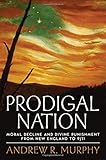
Andrew R. Murphy. Prodigal Nation: Moral Decline and Divine Punishment from New England to 9/11. Oxford: Oxford University Press, 2009. x + 232 pp. $29.95 (cloth), ISBN 978-0-19-532128-9.
Reviewed by Dennis Downey
Published on H-Law (January, 2011)
Commissioned by Christopher R. Waldrep (San Francisco State University)
"Where Have You Gone, Joe DiMaggio?" Decline, Renewal, and the American Jeremiad
From John Winthrop and Increase Mather to Glen Beck and John Hagee, tales of lamentation and woe, and a narrative of decline and renewal, have enlivened American civic culture. Puritan divines, evangelical acolytes of the end-time, and latter-day messianic prophets from across the religious and political spectrum--strange bedfellows all--have exploited signs of Armageddon and American exceptionalism to give meaning and shape to the American experience. This jeremiad tradition, with all of its biblical and social import, continues to hold sway over public discourse and civil society. At its heart, this fusion of religion and public consciousness addresses the vexing set of questions: Who are we, and where are we going as a people and a nation?
The word “jeremiad” comes from the Jewish prophet Jeremiah and his Old Testament text of humanity’s capacity for sin and estrangement from a covenanted relationship with God, and God’s holy wrath for wayward Israel. More than a mere denunciation of the current state of affairs, the jeremiad as a rhetorical device served to call a “chosen” or “prodigal” people back onto the path of righteousness. Jeremiah was a prophet, and in the jeremiad tradition the prophetic lament was as much about the future as it was about the past and present moment. Spiritual in nature, the jeremiad could have profound social and political implications. Whether a preacher in the pulpit or a politician on the stump, the continuing appeal of the jeremiad, and its blending of sacred and secular imagery, can be found in exultations to prophetic witness in times of crisis.
Political scientist Andrew R. Murphy offers a careful and discerning analysis of the continuing importance of the jeremiad in American thought and culture, from its colonial origins to the present post-9/11 world. “What makes the American jeremiad American,” he writes, “is its connection to a larger, sacred story tied intimately to the particularities of the nation’s origins and development” (p. 10). Murphy especially is interested in the influence of religion on American civic culture, the contested issues of exceptionalism and chosen-ness as a foundation for our national identity, and what he terms the sustaining influence of “religious patriotism” over four centuries (p. 62). “This tension between despair and hope,” Murphy notes, “is the critical feature separating jeremiads from other types of political narratives” (p. 13). Ultimately, Murphy states, the jeremiad tradition centers on “national self-image” (p. 51), a phrase he borrows from Daniel Walker Howe, and Americans’ interpretation of their national experience in moments of crisis and uncertainty.
Murphy is not the first scholar to write on the jeremiad in America, and much of the early portions of this narrative will be familiar to students of seventeenth-century religious and political history. Before intellectual history fell out of vogue, scholars like Perry Miller, Vernon Louis Parrington, David Hall, and Sacvan Bercovitch wrote cogently about the jeremiad tradition in colonial America. Murphy is as indebted to Miller and Bercovitch as he is to sociologist Robert Bellah, who as much as anyone identified the American tendency to interpret “historical experience in light of transcendent reality” (p. 10).
Prodigal Nation should not be read as a comprehensive history of the jeremiad tradition in America. Rather, it offers a series of interrelated reflections, some more persuasive than others. That said, the book is divided into two parts and eight chapters. Part 1 is more chronological. It includes a well-written exposition of the origin and adaptation of the jeremiad tradition to colonial New England, along with chapters that assess the jeremiad and the crisis of disunion, and the contemporary Christian Right and the campaign to bring America back to the path of faithfulness (religiously and politically). Part 2 includes topical chapters devoted to a “usable past” and “the culture wars” as well as a concluding chapter on the “future of the American Jeremiad” (p. 156).Although the narrative is filled with insight, there are significant gaps and omissions in this approach. The discussion of the role of religion in public life from the end of the Civil War through World War Two is incomplete and one-dimensional, and except for his discussion of Martin Luther King Jr., Murphy has little to say about African Americans and the jeremiad tradition. Though likely a concession to publication schedules, it is unfortunate that there is no mention of the 2008 presidential campaigns. Such a presentation could have provided a vivid concluding commentary on themes of decline and renewal, to say nothing of Barack Obama and the “audacity of hope!”
In a sense, the bookends are what matter in Prodigal Nation. In the early chapters, Murphy does a good job organizing colonial New England thought and the primacy of a Puritan theology in the emergence of a jeremiad rhetorical tradition. He offers insight into the transatlantic migration of ideas and religious sensibilities, and the saliency of an English and Calvinist mind-set. How this worldview evolved into a civic faith centered in politics is one of the great strengths of Prodigal Nation. Similarly, Murphy’s final chapters on civil discourse and the culture wars, and on the jeremiad and social reform are well developed. I especially appreciated his extended comments on King and the civil rights movement. Delineating two jeremiad traditions--traditional and progressive--at work in public discourse, Murphy reframes the continuing place of prophetic oration in a “nation radically transformed from its earlier self yet shaped in fundamental ways by the legacy of evangelical Protestantism, its Puritan past, and its sense of national mission” (p. 169).
Anyone interested in American religious history, the creation of a national identity, and the perplexing battle over the place of religion in public life will profit by reading Prodigal Nation. By carrying the narrative forward to recent times, Murphy has extended and expanded the body of scholarly work associating the jeremiad with early American history and identity. Prodigal Nation also has important implications on the continuing role of Christianity in a diverse, multicultural, and more secular society.
I conclude where I began. I thought of Beck and Hagee while reading Prodigal Nation. Beck’s August 28, 2010, tent revival in front of the Lincoln Memorial is perhaps the clearest example of the continuing popularity of the jeremiad tradition in America. “Call for a Rebirth,” our local newspaper headline proclaimed above a photograph of the faithful assembled. “America today begins to turn back to God,” the television personality announced with dripping sincerity. “My role as I see it,” he explained of the gathering, “is to wake America up to the backsliding of principles and values and most of all of God.” Invoking the doctrines of original intent and American exceptionalism, Beck unapologetically mixed religion and politics in a biblically based interpretation of American history. “For too long this country had wandered in darkness,” he professed to a chorus of “Amens.” The time for renewal was at hand. Sarah Palin picked up the theme in her own remarks: “We must restore America, and restore her honor.” Echoes of what Murphy terms “religious patriotism” reverberated across the National Mall and up to the U.S. Capitol.
Pastor, televangelist, and author Hagee offers a more dour view of America’s future. On his nightly television show, a slicked up version of the old time gospel hour seen by tens of millions of viewers, Hagee denounces the “idolatry” of present-day America and its betrayal of a sacred calling. Hagee lacks Beck’s emotional warmth, but they are kindred spirits in their call for conservative renewal against the forces of godlessness, secular humanism, and what Hagee calls “neopagan environmentalism.” In his latest book, appropriately entitled Can America Survive? (2010), Pastor Hagee invokes the image of Four Horsemen of the Apocalypse and the “Coming Anti-Christ” as foreshadowing the end of American greatness. Announcing December 12, 2012, as the probable “day of disaster” ushering in the end time, Hagee ends his personal jeremiad against what he calls the “terminal generation” with a question: “Are we ready?” (p. 260).
In such moments, as Murphy makes clear in Prodigal Nation, the American jeremiad is alive and well.
If there is additional discussion of this review, you may access it through the network, at: https://networks.h-net.org/h-law.
Citation:
Dennis Downey. Review of Murphy, Andrew R., Prodigal Nation: Moral Decline and Divine Punishment from New England to 9/11.
H-Law, H-Net Reviews.
January, 2011.
URL: http://www.h-net.org/reviews/showrev.php?id=30701
 | This work is licensed under a Creative Commons Attribution-Noncommercial-No Derivative Works 3.0 United States License. |

