



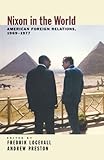
Fredrik Logevall, Andrew Preston, eds. Nixon in the World: American Foreign Relations, 1969-1977. Oxford: Oxford University Press, 2008. xv + 348 pp. $99.00 (cloth), ISBN 978-0-19-531535-6; $21.95 (paper), ISBN 978-0-19-531536-3.
Reviewed by Ryan M. Irwin (Yale University)
Published on H-1960s (November, 2010)
Commissioned by Ian Rocksborough-Smith (University of the Fraser Valley)
Nixon's 1970s
For much of the first two decades after World War II, the Cold War shaped the contours of world affairs. American consumerism merged with Keynesian planning in the West, powering a durable yet militarized economic recovery that linked North America with Europe and Japan, while the Soviet Union--locked in an awkward diplomatic marriage to communist China--gravitated toward a sturdy homeostasis based on domestic austerity, defense spending, and geopolitical opportunism. The resulting arrangement was a portrait of paradox. Cast as ideological antipodes on the world stage, Washington and Moscow stumbled into an expensive arms race and a vicious set of proxy conflicts, even as they reinforced comparable norms about geopolitical bipolarity, state-led economic development, and cultural homogeneity.
As readers of H-1960s know well, this status quo ended during the 1960s. Precipitated by decolonization abroad and demographic change at home--to say nothing of the rights revolution and America’s controversial war in Vietnam--activists, academics, and politicians everywhere began removing the “lens” of the early Cold War. By the end of the decade, political, social, and cultural assumptions once cast in static, universal terms had given way to novel arguments about dependency, racism, and imperialism. “Like balls of yarn, stable lines of postwar geopolitics came undone as people pulled at them from multiple directions,” historian Jeremi Suri explains (p. 67). The resulting upheavals not only reset the trajectory of world politics, but also established an infinitely more complex global system based on geopolitical plurality, economic decentralization, and cultural contestation.
Nixon in the World provides a series of snapshots of the post-1960s world. The book is a study of high diplomacy and grand strategy, framed by a simple question: how did the U.S. government respond to the challenges of this uncertain era? With a combination of hard-nosed realpolitik and strident amorality, editors Fredrick Logevall and Andrew Preston argue. “Rather than unrealistically demonizing its adversaries,” the United States embraced the notion “that in an increasingly globalized world it could no longer seal off its rivals” (p. 8). Communist countries, like the Soviet Union and China, dismissed once as existential threats to the United States, reemerged as viable political partners, while Germany, France, and Japan--integral parts of Washington’s postwar alliance during the first two decades of the Cold War--found themselves recast as mere pawns on the chessboard of global affairs. “Conservative in its aims” yet “revolutionary in its methods,” the resulting approach transformed the rules of foreign affairs, revitalizing America’s strategy of containment while softening the logic and implications of the superpower contest (p. 7). The goal, in short, was to refresh U.S. power in an age of relative decline.
Nixon in the World’s individual chapters catalogue the administration’s successes and failures in implementing this “grand design.” In an attempt to explicate President Richard Nixon’s worldview, as well as his relationship with National Security Advisor Henry Kissinger, the opening section looks equally at events in the domestic and international arenas. Jussi Hanhimäki provides an especially insightful essay about the Nixon Doctrine and détente, connecting the administration’s elusive global plan to the war in Vietnam, while David Greenberg, Dominic Sandbrook, and Suri advance diverging (and occasionally overlapping) interpretations of the Nixon administration’s goals and shortcomings. Parts 2 and 3 turn attention to U.S. relations in East Asia and West Europe, tackling stories of triangulation, linkage, and ostpolitik head-on, before shifting to the slow-moving tragedy of Vietnam. With chapters from Francis Gavin, Lien-Hang Nguyen, Margaret MacMillan, Michael Morgan, Mary Sarotte, and Robert Schulzinger, the sections are predictably balanced with especially judicious explanations of U.S. nuclear strategy, West German foreign policy, and the opening of China. Part 4 surveys crises that erupted in the Middle East, South Asia, and Latin America between 1969 and 1977, as well as the administration’s peacetime relationships with Japan and Canada. Angola’s civil war and OPEC’s oil embargoes are mostly overlooked, but this section too is strong, with provocative contributions from Robert Bothwell, Mark Lawrence, Robert McMahon, Salim Yaqub, and Thomas Zeiler.
The authors and editors hedge their bets in advancing a final verdict about Nixon’s tenure in the White House. The president’s team earns generally high marks for the Soviet and Chinese summits of 1972, as well as the Paris Peace Accord that ended the Vietnam War in 1973, and most contributors accept triangular diplomacy as an innovative way to extend Washington’s influence in uncertain times. However, they scoff collectively at détente, which not only “failed” to end the Cold War but also lagged behind comparable efforts in West Europe (p. 13). The president’s approach in the third world is likewise lambasted, with most authors in agreement that U.S.-funded authoritarians perpetuated cycles of conflict, instability, and brinksmanship throughout the global South. Moreover, Nixon’s cynical nature--as problematic abroad as it was at home--sowed the seeds of an inevitable decline, fueling an intense backlash among activists on both ends of the political spectrum who were convinced (for very different reasons) that realpolitik was eroding America’s moral standing in the world. The Nixon who emerges from this contested milieu is neither a tragic nor an evil character--merely an ambitious politician, equal parts prudent, foolish, and arrogant.
Nixon in the World casts aside many of the polemics that attached themselves to the thirty-seventh president during the 1970s, and advances in their place a confident yet nuanced story about détente. On one level, the volume is a masterful illustration of diplomatic history as a craft. However, the volume leaves an important--arguably the most important--question curiously under-examined: what exactly changed during the 1970s? If Logevall and Preston’s book has a flaw, it is its reliance on the perspective of American policy makers. While explicated with élan, the grand strategy of the Nixon administration seems detached at times from the complexities it confronted, and the president’s “conservative” yet “revolutionary” foreign policy, chronicled in rich detail, occasionally feels aloof from the structural transformations that actually marked the 1970s. As most historians agree, the White House’s reconceptualization of containment happened in an arena where assumptions about global order--codified at New Hampshire’s Bretton Woods resort in July 1944--were giving way to new types of cross-national economic exchange, financial innovation, and nongovernmental activism. Did détente drive or follow these processes? Determining an answer requires jumping headlong into the contorted history of globalization--a plunge not made by Nixon in the World. Working firmly within the confines of political history, the book leaves others to determine how Washington’s initiatives intersected with such structural transformations as China’s embrace of market capitalism, OPEC’s rejection of the West, and Africa’s descent into economic catastrophe.
None of which is to question directly the importance of Nixon in the World. The book deserves to be read widely. A historical consensus is emerging about the 1970s. Dismissed once as an anomaly in the twentieth century, the tumultuous decade is reemerging as one of the seminal pivot-points of the modern era--equal in importance only to the 1890s and 1930s.[1] Nixon in the World tells a story of U.S. foreign policy during this age of upheaval, and it does so with analytical precision and interpretive balance. To future volumes will fall the daunting task of uncovering new questions, and recasting America’s story in an international framework.
Note
[1]. For an important recent international history of the 1970s, see Niall Ferguson, Charles Maier, Erez Manela, and Daniel Sargent, eds., The Shock of the Global: The 1970s in Perspective (Cambridge: Harvard University Press, 2009).
If there is additional discussion of this review, you may access it through the network, at: https://networks.h-net.org/h-1960s.
Citation:
Ryan M. Irwin. Review of Logevall, Fredrik; Preston, Andrew, eds., Nixon in the World: American Foreign Relations, 1969-1977.
H-1960s, H-Net Reviews.
November, 2010.
URL: http://www.h-net.org/reviews/showrev.php?id=30637
 | This work is licensed under a Creative Commons Attribution-Noncommercial-No Derivative Works 3.0 United States License. |

