

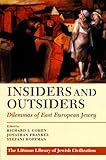
Richard L. Cohen, Jonathan Frankel, Stefani Hoffman, eds. Insiders and Outsiders: Dilemmas of East European Jewry. Oxford: Littman Library of Jewish Civilization, 2010. Illustrations. 248 pp. $29.95 (paper), ISBN 978-1-906764-00-5.
Reviewed by Piotr Wróbel (University of Toronto)
Published on HABSBURG (February, 2011)
Commissioned by Jonathan Kwan (University of Nottingham)
Accidental Insiders and Permanent Outsiders?
Heinrich Graetz, the father of Jewish modern historiography, believed that suffering and intellectual achievements constituted the two most important aspects of the history of the Jewish Diaspora. Rejection, a lack of sense of belonging, and a feeling of being disliked or even hated contributed greatly to Jewish suffering. Consequently, a bibliography concerning Jews as outsiders trying to tear the walls of religious, racial, political, and cultural intolerance has been growing quickly for a long time.
The book under review, a recent valuable addition to this bibliography, developed out of a conference, "Insiders, Outsiders and Modern East European Jewry." Held in January 2006 at the Hebrew University of Jerusalem, it honored the work of Ezra Mendelsohn, an expert on the modern history of East European Jews. The book, divided into four parts, includes twelve essays preceded with the brilliant "Reflections on Insiders and Outsiders: A General Introduction." Its author, Steven E. Aschheim, a renowed professor of the Hebrew University and a top specialist on German-Jewish history, reviews theories on insiders and outsiders as social categories and applies them to the Jews.
The first part, "Insider/Outsider: The Cultural Conundrum," includes five essays. The opening text, "The Project of Jewish Culture and Its Boundaries--Insiders and Outsiders" by Richard I. Cohen, the chair in French Jewry Studies at the Hebrew University, discusses the "boundaries enclosing Jewish culture" and summarizes Mendelsohn's most important works and arguments devoted to this issue (p. 17). In the second essay, Zvi Jagendorf, a professor emeritus of English and theater at the Hebrew University, analyzes Itzik Manger's and Avot Yeshurun's poetry, looking for their understanding of home and homecoming. Amitai Mendelsohn, a doctoral student in art history at the Ben-Gurion University, devotes his essay to Reuven Rubin's paintings in "Agony and Resurrection: The Figure of Jesus in the Work of Reuven Rubin." Leon Volovici--an alumnus of the University of Jassy, a Romanian expert of Yad Vashem, and currently at the Vidal Sassoon International Center for the Study of Antisemitism at the Hebrew University--describes a dramatic attachment of a Jewish writer to a Romanian radical nationalist Nae Ionescu in "Mihail Sebastian: A Jewish Writer and His (Antisemitic) Master." The final essay in this first part, "Insiders/Outsiders: Poles and Jews in Recent Polish Jewish Fiction and Autobiography," is coauthored by Karen Auerbach (an applied research scholar in the Center for Advanced Holocaust Studies at the U.S. Holocaust Memorial Museum) and by Antony Polonsky (one of the most important experts on Polish Jewish history and the editor of the invaluable series Polin: Studies in Polish Jewry). It offers a useful review of several books but concentrates on Henryk Grynberg's Memorbuch (2000), Joanna Olczak-Roniker's In the Garden of Memory (2003), and Krzysztof Teodor Toeplitz's The Toeplitz Family: Book of My Father (2004).
The second part, "Acculturation, Assimilation, and Identity," includes three essays. In "Negotiating Czechoslovakia: The Challenges of Jewish Citizenship in a Multiethnic Nation-State," Hillel J. Kieval, a professor of Jewish history and thought at Washington University in St. Louis, depicts identity problems and strategies of Czech and Slovak Jews. In "The Debate over Assimilation in Late Nineteenth-Century Lwów," Rachel Manekin, an assistant professor of Jewish history at the University of Maryland, concentrates on the pro-Polish integrationist groups in Galicia. Finally, in “The Culture of Ethno-Nationalism and the Identity of Jews in Inter-War Poland: Some Responses to 'the Aces of Purebred Race,'" Joanna B. Michlic, the director of the Project on Families, Children and the Holocaust at Hadassah-Brandeis Institute at Brandeis University, writes about defensive strategies of assimilated Polish Jews and cultural Jewish nationalists against militant and exclusivist Polishness. She builds her argument on the examples of Julian Tuwim, one of the most outstanding Polish poets, and Samuel Jacob Imber, a less-known Polish Jewish writer.
The third part, "Inclusion/Exclusion: Society and Politics," also offers three essays. In his brilliant "Urban Society, Popular Culture, Participatory Politics: On the Culture of Modern Jewish Politics," Scott Ury, a postdoctoral fellow in Tel Aviv University’s Department of Jewish History, argues that the "explosion" of the Jewish press and the Jewish theater at the beginning of the twentieth century changed East European Jewish societies forever, triggered the birth of "modern Jewish politics," and contributed to the formation of the modern Jewish nation. In "The 'Non-Jewish Jews' Revisited: Solzhenitsyn and the Issue of National Guilt," the late Jonathan Frankel, the author of several classic works on Russian Jewry, discusses Aleksandr Solzhenitsyn's Dvesti let vmeste (Two hundred years together [2002-2003]). It "can be read, inter alia, as a bill of indictment against the Jewish people" (p. 166), but Frankel goes beyond it and takes the Solzhenitsyn book as a point of departure for some reflections on the participation of Jews in the Russian revolutionary movement and the Bolshevik party. Finally, in "The Jewish Informer as Extortionist and Idealist," Ruth R. Wisse, who teaches Yiddish and comparative literature at Harvard University, shows two different kinds of Jewish informers. Petty denunciators of the early modern era were motivated by greed or personal vengance and were not dangerous to the survival of Jewish communities, but ideologically motivated Haskalah activists or Jewish Communists could be very dangerous to the traditional Jewish way of life.
The last and fourth part of the book consists of two essays. Was Czernowitz, the capital of Habsburg Bukovina, really so good to the Jews?--asks David Rechter, a university research lecturer in Oriental studies at the University of Oxford, in "A Jewish El Dorado? Myth and Politics in Habsburg Czernowitz." His answer is a qualified yes. Another question is asked in "Wilno/Vilnius/Vilne: Whose City Is It Anyway?" by Mordechai Zalkin, an associate professor in the Department of Jewish History at the Ben-Gurion University of the Negev. This piece analyzes the meaning of Vilna to Poles, Lithuanians, and Jews.
The most striking character feature of this collection is its diversity. Some essays are devoted to large phenomena, like Ury's text on the transformation of Jewish politics at the beginning of the twentieth century, Frankel's essay on the participation of Jews in communism, or Kieval's thesis on the strategies of the Czechoslovak Jews. Some other contributions are microstudies, such as Mendelsohn's essay on Rubin's figure of Jesus. The latter text represents contributions that are very loosely linked to the main topic of the book. Some other works, such as Jagendorf's essay on Manger and Yeshurun are closely connected to the essence of the "Insider/Outsider" problem. Several chapters, like the works of Ury and Wisse, present an argument; others, like the essay about Czernowitz, are more descriptive than analytical. Some contributions, such as the text of Frankel and Manekin's thesis about assimilation in Lvov, return to topics discussed many times before. Yet some chapters, such as Wisse's essay on informers, are devoted to issues rarely discussed.
Most essays published in the book under review are very convincing; yet, some do provoke questions and doubts. The essay about Mihail Sebastian is fascinating but its main question--how was it possible that a Jewish liberal writer was so attached to a Romanian chauvinist and radical right ideologue?--remains, in my opinion, unanswered. When Sebastian's novel For Two Thousand Years appeared in 1934 with "an appallingly antisemitic preface by Ionescu," did it happen with the approval of Sebastian (p. 60)? Or was it a kind of a violation of copyrights with the introduction being added without Sebastian's knowledge? Does the Sebastian-Ionescu relationship "resemble that between Maurycy Gottlieb and Jan Matejko" (p. 58)? It is surprising that the text on recent Polish Jewish fiction and autobiography ignores the works of Hanna Krall and Agata Tuszyńska's Rodzinna Historia Lęku (A family history of fear [2005]), one of the most important testimonies on the Polish Jewish experience after World War II. Also, several books about or by Marek Edelman would be appropriate here.
The most surprising element in the entire volume is Zalkin's understanding of Czesław Miłosz, who, allegedly, believed that "in other words, the entire concept of a Polish Wilno was based on religious and cultural perceptions, on an unrealistic image, a dream. Discount the Stefan Batory University and the Matka Boska Ostrobramska (the Church of Our Lady of the Gate of the Dawn, one of the most popular Marian shrines of eastern Europe) and there is no longer a Polish Wilno" (p. 222).
Intellectual provocations and controversal and new interpretations are very important, especially if they come together with solid scholarship. This is the case of the book under review, which is a must read for everybody interested in the assimilation of East European Jews.
If there is additional discussion of this review, you may access it through the network, at: https://networks.h-net.org/habsburg.
Citation:
Piotr Wróbel. Review of Cohen, Richard L.; Frankel, Jonathan; Hoffman, Stefani, eds., Insiders and Outsiders: Dilemmas of East European Jewry.
HABSBURG, H-Net Reviews.
February, 2011.
URL: http://www.h-net.org/reviews/showrev.php?id=30493
 | This work is licensed under a Creative Commons Attribution-Noncommercial-No Derivative Works 3.0 United States License. |

