



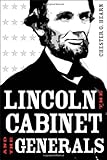
Chester G. Hearn. Lincoln, the Cabinet, and the Generals. Baton Rouge: Louisiana State University Press, 2010. xii + 357 pp. $39.95 (cloth), ISBN 978-0-8071-3637-9.
Reviewed by Stephen L. Hansen (Southern Illinois University Edwardsville)
Published on H-CivWar (December, 2010)
Commissioned by Martin P. Johnson (Miami University Hamilton)
Master Politician: Lincoln, His Cabinet, and the Generals
The purpose of Chester G. Hearn’s book is to examine the relationships among Abraham Lincoln, his cabinet members, and his significant generals. By exploring these relationships, Hearn hopes to provide a broad synthesis of how Lincoln managed the political and military strategies of the Civil War. Hearn, author of eighteen books on military histories ranging from the American Revolution to Desert Storm, writes Lincoln, the Cabinet, and the Generals for the general public, although he explicitly addresses the book to the scholarly community as well. Hearn’s lively narrative captures the drama and political intrigue of Lincoln’s presidency, which will appeal to the popular history market, but he falls short of his goal to provide fresh insights for the scholarly community.
Hearn’s thesis is that Lincoln was more successful in managing his cabinet members than he was his generals, and that the military failures of the generals complicated his relationships with the politicians. Hearn contends that Lincoln sought differing opinions when formulating his political and military strategies, which explains why Lincoln chose such strong and politically diverse men to serve in his cabinet. Despite the rivalries, intrigue, and dissension, Hearn argues, Lincoln successfully managed his cabinet, maneuvering through the controversies and getting the best each man had to contribute. Managing the generals, however, was a different story. According to Hearn, Lincoln soon disregarded everyone’s advice and assumed the role of de facto army chief. Even after promoting Ulysses S. Grant, Hearn argues, Lincoln continued to intervene in military affairs. Hearn concludes that the poor performance of his military commanders nearly offset everything that Lincoln attempted to accomplish, vexing further the complicated relationship with his cabinet members.
One of the strengths of Hearn’s book is his analysis of how military failures affected Lincoln’s ability to set policy and to manage politically rival politicians. Hearn, for example, deftly describes the complicated maneuverings among cabinet members, congressional leaders, the president, and General George B. McClellan. Hearn carefully and clearly leads the reader through the shifting political ground in the fall and winter of 1861 and 1862 as William H. Seward, Salmon P. Chase, Simon Cameron, Lincoln, and various congressional leaders all jockeyed for position to define military and political strategy while McClellan postured with the army.
Hearn is also very effective in describing certain military and political developments, infusing his narrative with colorful detail and drama. For example, his portrayals of Benjamin F. Butler, Joseph Hooker, and George Meade are lively and compelling. In cleverly describing Meade, Hearn characterizes the general as lacking “the charisma of McClellan, the sociability of Burnside, and the bluster of Hooker” (p. 164). Likewise, Hearn’s description of the political intrigue surrounding Lincoln’s renomination and election campaign in 1864 juxtaposed to the Atlanta campaign is well done.
While Hearn’s well-written narrative makes Lincoln, the Cabinet, and the Generals interesting to read, the book falls far short of its promise to provide new insight into the shifting relationships among the political and military leaders of the Union. Hearn ignores the literature that has already explored the relationships between the president and his cabinet (e.g., studies by Doris Kearns Goodwin, Ronald White Jr., Philip Shaw Paludan, and David Donald, among others), and between Lincoln and his generals (e.g., work by Stephen Sears, John Y. Simon, Gabor Boritt, and others). As a consequence, Hearn offers neither new insights nor new interpretations. For example, in discussing the cabinet crisis in 1862, Hearn misses the nuances and complexities so well analyzed by Goodwin, Donald, and White.
Equally disappointing is Hearn’s tendency to overstate his points, presumably for dramatic effect. For example, Hearn declares that upon meeting William T. Sherman after the Battle of Bull Run, an impressed Lincoln would not forget the man’s combat resolve (p. 81). In another instance, Hearn boldly asserts that the harshness of Ohio Congressman Clement Vallandigham’s antiwar speeches so alienated moderate Republicans and Peace Democrats that it prevented the fusing of the two groups into a new centrist party (p. 158). This complete misreading of the moderate Republicans and Peace Democrats is later matched by a claim that “out of desperation Lincoln turned to the one untapped source of manpower he had vowed never to use, African-Americans” (p. 173). Such a provocative claim is unsupported by fact and ignores the scholarship of most historians. Unfortunately, these kinds of provocative assertions and misstatement of facts occur with sufficient frequency as to undermine the book’s credibility. Still, within these important limitations, Hearn has raised some intriguing questions in Lincoln, the Cabinet, and the Generals.
If there is additional discussion of this review, you may access it through the network, at: https://networks.h-net.org/h-civwar.
Citation:
Stephen L. Hansen. Review of Hearn, Chester G., Lincoln, the Cabinet, and the Generals.
H-CivWar, H-Net Reviews.
December, 2010.
URL: http://www.h-net.org/reviews/showrev.php?id=30351
 | This work is licensed under a Creative Commons Attribution-Noncommercial-No Derivative Works 3.0 United States License. |

