



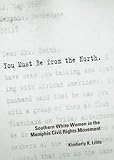
Kimberly K. Little. You Must Be from the North: Southern White Women in the Memphis Civil Rights Movement. Jackson: University Press of Mississippi, 2009. ix + 219 pp. $40.00 (cloth), ISBN 978-1-60473-228-3.
Reviewed by Elizabeth Gritter
Published on H-SAWH (November, 2010)
Commissioned by Antoinette G. van Zelm (TN Civil War Nat. Heritage Area Center for Historic Preservation)
Social Reform, Interracialism, and Civil Rights: Memphis’s White Women in the Black Freedom Struggle
Kimberly Little provides a nuanced examination of white women’s involvement in the civil rights movement in You Must Be from the North. She argues that their role was overwhelmingly positive, but she does not shy away from acknowledging the limits of their activism and the paternalism of some women. Little also recognizes that African Americans took the lead in the black freedom struggle.
Covering the years from the Brown v. Board of Education decision in 1954 to the imposition of court-ordered busing in Memphis in 1973, Little provides illuminating character portraits of members of the small group of middle- to upper-class white women who engaged in interlocking efforts for social reform, interracial cooperation, and civil rights progress. Drawing on her interviews with these women, she demonstrates the political nature of the women’s work as they challenged the status quo by lunching with black women on an equal basis and forced the city government to devote more funding to school lunch programs. After the assassination of Martin Luther King, Jr., in Memphis in 1968, many of these women became more aggressive in pursuing racial equality.
Little’s study is the first to focus solely on white women’s role in the black freedom movement in Memphis. Furthermore, she spotlights a generation of white women--those born in the interwar period--who hitherto have not been a focus of civil rights scholars. Little writes, “Unlike the white women usually included in studies of the civil rights movement--college women who were born during World War II or in the early years of the post-war baby boom--the wives and mothers of Memphis did not jeopardize their lives by participating alongside black activists in sit-ins and freedom rides” (p. 8). She argues, however, that their activism nonetheless was crucial to the movement’s success and shows that these women “experienced an awakening” through their interracial and social reform efforts “that led them to question the South’s racial hierarchy and ultimately engage in actions that challenged the region’s racial system more directly” (p. 8). In addition, she asserts that these white women, unlike black activists, had the ear of the white southern elite and were able to work for change within their own communities.
Little also makes a historiographical contribution by focusing on the 1969-73 period in Memphis; previous civil rights studies have largely ended with the death of King, and, with the notable exception of Marcus Pohlmann and Michael P. Kirby’s Racial Politics at the Crossroads: Memphis Elects Dr. W. W. Herenton (1996), few works examine politics in the city after 1968.
One of the best aspects of You Must Be from the North is Little’s discussion of how these white women, many of whom grew up believing in segregation, experienced changes in their racial consciousness and came to involve themselves in civil rights work. For some, their religious beliefs caused them to question the southern system of inequality among human beings. For others, they lived or traveled outside the South and were exposed to different points of view. By dining with black women as part of the monthly Saturday Luncheon Group, they bridged the gap between the races, became more racially enlightened, and challenged segregation in restaurants. Little also shows how African American women became disgusted by some white members of the group who participated largely because they viewed it as a novelty to dine with members of the other race.
Little provides a particularly fascinating portrait of the Fund for Needy Schoolchildren program. Founded by Myra Dreifus in 1964 after she discovered that the Memphis Board of Education was failing to use all of its federal funding for school lunch programs, she mobilized black and white women to press the city government to provide lunches to qualified children. The women helped eligible families complete applications for the program, and they, along with other volunteers, staffed school lunch programs. The women also gave clothing and shoes to poor children; provided poor families with workshops on good nutrition, the food stamp program, and other matters; and took other poverty relief steps. Though some blacks labeled the program as paternalistic and whites criticized it as well, the program met with much success and received local and national acclaim. “By 1972, what had been twelve volunteers in four schools in 1964 had grown to over four hundred volunteers working in fifty-seven schools around Memphis and Shelby County,” Little writes. “[E]nrollment in the National School Lunch Program jumped from seven hundred students in 1968 to twenty-five thousand five hundred students by 1974” (p. 43).
White women’s involvement in the Fund for Needy Schoolchildren program also caused many of them to realize the linkage between poverty and racism. No event, however, was as transformational to white women’s participation in the civil rights movement as the sanitation strike in 1968. After two black sanitation workers were killed operating archaic machinery, sanitation workers walked off their jobs to protest working conditions, low pay, and racist supervisors. The strike mobilized black Memphians to the greatest extent in years. Believing that the strike was illegal, Mayor Henry Loeb, who was widely disliked among black Memphians for his conservative racial views, refused to negotiate with the strikers. Martin Luther King, Jr., came to the city to lend his support to the sanitation strike and was shot to death. The mayor reached a settlement with the strikers only after King’s murder.
White women, some of whom were involved with the Saturday Luncheon Group and Fund for Needy Schoolchildren, became active in the sanitation strike in a number of ways: they gave food and clothing to striking sanitation workers, pressed the mayor to settle the strike, joined marches in support of the strike, and participated in the interracial “Memphis Cares” rally after the assassination. As a result of the strike and King’s death, some women’s groups grew in membership and others developed as the quest for racial harmony took on more urgency for the white community. While some women held workshops and meetings to enlighten the white community about the pernicious effects of racism, others took such direct civil rights action as helping successfully press for the redistricting of Memphis’s school board to allow for black school board members. As they had throughout their interracial, social reform, and civil rights work, white women faced opposition from their own communities and even from their families. In addition, African Americans were sometimes suspicious of their work.
Perhaps the strongest evidence of the increase in white women’s civil rights work during this time was the support that some of these women lent to busing. In the early 1970s, the prospect of busing met with virulent outcry from white Memphians. Little shows that white women activists supported busing in several ways, including keeping their children at schools affected by the program and soliciting funds for the purchase of buses. One white women, Frances Coe, a long-time member of the school board who was racially progressive, consistently voted with black school board members to press for an accelerated pace to busing. Despite these efforts, the imposition of court-ordered busing in 1973 led to white flight to the suburbs.
Although Little provides a valuable, in-depth focus on the myriad ways in which white women were involved in Memphis’s civil rights movement, she does not exhibit a strong grasp of how black Memphians perceived the work of these women. Her bibliography and source notes reveal that she only interviewed white women involved in the struggle and not black women active in the civil rights movement and/or interracial groups. Instead, she relies on a couple of 1968 interviews with black women to get African American women’s perspectives on the efforts of white women. Certainly, the views of these black women could have changed over time, and an interrogation of how they saw the work of white women would have best been accomplished through interviews Little could have conducted with those still living. Hence, though she sporadically deals with how black Memphians saw the work of these white women and addresses the limits of white women’s activism, the voices of black women are mostly missing from her account.
Having more discussion about how black Memphians saw the work of white women would have led to a stronger assessment of the strengths and limits of the work of white women, helped Little to better analyze white women’s work within the larger context of the civil rights struggle in Memphis, and resulted in a stronger interpretation of some events detailed in the book. (For example, when she mentions that white women’s activism contributed to the restructuring of Memphis’s school board to allow for black representation, she largely does not discuss the role of the Memphis NAACP’s “Black Monday campaign” that spurred this development.) It is crucial that analyses such as Little’s adequately explore how African Americans saw the work of the women aiming to help them.
On a related note, Little does not demonstrate that she has a thorough understanding of the wider context of politics and the civil rights movement in the city. She gets the name wrong of long-standing Memphis political boss Edward H. Crump--calling him William H. Crump--and incorrectly labels him as mayor of Memphis for a time period in which he was not. More seriously, Little leaves out key pieces of the movement and mischaracterizes other parts. Missing is any discussion of the black community’s formal political activism, a major component of the local freedom movement even in the 1950s as black Memphians faced few barriers to voting, in part because Crump had allowed them the right to vote. It would have been interesting to know the voting patterns of white women profiled in her study and how they viewed local black political groups, including their voter registration efforts and other political activities. Furthermore, in the very brief overview that she provides of the Memphis civil rights movement at the beginning of her book, Little incorrectly states that the U.S. Supreme Court ruled Memphis’s park desegregation plan illegal after the Civil Rights Act of 1964 when in fact this decision came about in the 1963 Watson v. Memphis case. Another example of Little’s flawed portrayal of civil rights in Memphis is her statement that school desegregation began in 1965. In fact, the Memphis NAACP led a successful effort to integrate schools in 1961, although only token integration occurred.
As a result of these and other misinterpretations and omissions, Little’s book overemphasizes the role of white women in the movement. She could have drawn more on existing studies, including Sherry L. Hoppe and Bruce W. Speck’s Maxine Smith’s Unwilling Pupils: Lessons Learned in Memphis’s Civil Rights Classroom (2007) and Laurie B. Green’s Battling the Plantation Mentality: Memphis and the Black Freedom Struggle (2007), both of which she mentions in her introduction. Little’s work also would have benefited had she consulted the honors senior theses and master’s theses that provide valuable information on the local freedom struggle. Furthermore, Little overrelies at times on oral histories instead of checking the information against other sources.
You Must Be from the North provides an important contribution to civil rights scholarship and southern women’s history by profiling the involvement of middle- to upper-class white women in the Memphis civil rights struggle. It certainly would have been a better book had the perspectives of black Memphians been fully integrated and the wider context of civil rights and politics covered thoroughly. Nonetheless, these flaws should not detract from the rigorous research that Little has done and the important contributions that she has made.
If there is additional discussion of this review, you may access it through the network, at: https://networks.h-net.org/h-sawh.
Citation:
Elizabeth Gritter. Review of Little, Kimberly K., You Must Be from the North: Southern White Women in the Memphis Civil Rights Movement.
H-SAWH, H-Net Reviews.
November, 2010.
URL: http://www.h-net.org/reviews/showrev.php?id=30129
 | This work is licensed under a Creative Commons Attribution-Noncommercial-No Derivative Works 3.0 United States License. |

