



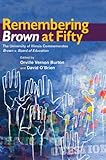
Orville Vernon Burton, David O'Brien, eds. Remembering Brown at Fifty: The University of Illinois Commemorates Brown v. Board of Education. Urbana: University of Illinois Press, 2009. 435 pp. $75.00 (cloth), ISBN 978-0-252-03477-0; $35.00 (paper), ISBN 978-0-252-07665-7.
John B. Freed. Educating Illinois: Illinois State University, 1857-2007. Virginia Beach: Donning Company Publishers, 2009. 480 pp. $30.00 (cloth), ISBN 978-1-57864-536-7.

Winton U. Solberg. Reforming Medical Education: The University of Illinois College of Medicine, 1880-1920. Urbana: University of Illinois Press, 2009. xiv + 309 pp. $35.00 (cloth), ISBN 978-0-252-03359-9.
Reviewed by Mario Rios Pérez (University of Illinois at Urbana-Champaign)
Published on H-Education (March, 2011)
Commissioned by Jonathan Anuik (University of Alberta)
Regional Histories, National Contexts: Illinois and the State of Education
One of the rigors historians encounter in explaining the past is determining the significance of individuals, movements, events, ideas, and institutions. Historians can invoke a multitude of theoretical approaches and methodological techniques to elude arbitrary judgments, yet may be left wondering how reclusive people or isolated events can have mutual relationships with the body politic and nation-state. How can an event or one person be tied to larger contexts? The three books discussed in this review essay examine the state of education in Illinois and engage the above questions by demonstrating how history is incumbent on the particularities of localized events. They contribute to the history of education by revealing the pivotal role local leaders, movements, and institutions play in national educational agendas.
In Educating Illinois, historian John B. Freed looks at the founding and development of the first public university in Illinois from the 1850s to the present. Charted and opened in 1857, Illinois State Normal University (ISNU) was established as a coeducational university in Bloomington, Illinois, at a time when approximately sixteen small denominational colleges enrolled the majority of Illinois postsecondary students. According to Freed, there were 351 students who attended these private colleges, and though ISNU was part of a select few normal schools established across the country during this period, it purposely included “university” in its title. The inclusion of “university” is telling of the debates surrounding the purpose and aspirations of institutions of higher education in the 1860s. “The name was earnest for the future,” Freed asserts (p. 47). The author foregrounds the prescience of the ISNU founders, whose educational platform was based on the goal that their school would become the leading institution in Illinois to prepare students in the fields of education, agriculture, and engineering. This name game went beyond a virtuous belief of serving the state in a wide breadth of fields. Rather, the intention was to stage an institutional identity that would help coax government officials for additional funding. State support was not unforeseeable for these founders; ISNU founders were early proponents of state funding programs and policies.
Titled after its recent strategic plan, Educating Illinois, the book’s twelve chapters and more than four hundred pages walk the reader through a history of undulating success--ups, downs, and departures from its original mission. ISNU went through three major phases: normal school, a teacher’s college, and university. Much to the chagrin of the university’s administration, the aspiration of becoming the leading university in Illinois was extinguished in 1867, when Champaign County won the bid to become the official land grant university in the state. The dismay of McLean County (site of ISNU) leaders felt was well founded, since Champaign had yielded a smaller bid and did not have the reputation or institutional foundation established in Bloomington. Accusations of backdoor dealings surged, but the covenant between Champaign and the state remained.
The grief inflicted by the lack of funding caused ISNU to slowly reinvent its image, and it hesitantly became a teacher’s college in 1907. Though it had served as the epicenter for the scientific study of education through its National Herbart Society, teaching was slowly chided as the prime mission. The makeover continued, and the state first allowed it to grant MA and MS degrees during the Cold War. In 1964, it was renamed Illinois State University at Bloomington (ISU), and by 1965 it granted its first PhD degree, which was in education. In the 1970s it was not swayed by the social movements affecting many schools. It did contain a Students for a Democratic Society chapter, did experience a few National Association for the Advancement of Colored People (NAACP) protests, and had a club known as the “Blond Student Association,” formed to mock students of color, but the author contends that the campus remained in an “island of calm” compared to other institutions (pp. 306, 317). Yet it was unaffected by the torrent of higher education reforms affecting this period. In 1970, ISU hired Will Robinson, which made it the first school in the country to hire an African American head coach to lead a Division I intercollegiate sport. ISU was affected by the financial cutbacks triggered by the 1973 oil crisis. Despite the social revolts and financial upheavals, ISU chugged toward its goal of becoming a comprehensive, research-oriented national university. And by the middle of the century, it had changed from being a teaching school to one known as a residential university primarily composed of white, upper-class students.
The book’s organization, angle, and focus accentuate the university’s success. The author successfully provides a sweeping history of the institution and does not raise an individual or interest group to icon status. Heavily based on primary sources, it is thorough and well balanced in terms of what university department it relies on to build the narrative. What is clear is that this book serves as a fundraising tool. It tells an often told story--a great university bustling through bad economic times. It is a classic David and Goliath battle. Recently ISU ended a multiyear fundraising campaign called “Redefining ‘normal’” that increased its endowment and raised over ninety-six million dollars (p. 446). ISU overcomes close calls, especially a recommendation made by the Illinois Board of Higher Education to cut its MA and PhD programs. A setback like this could have thrust it back to the 1860s, when it sought not to be classified as a regional teaching school. However, through political and administrative ingenuity, its ambitious goals have kept it afloat. It evades failure. Therefore, the book is a feel-good history that concludes on a positive note. The meat and bone of this story is perseverance.
Reforming Medical Education, the second book discussed in this essay, is Winton U. Solberg’s third volume on the history of the University of Illinois (U of I) (the other two volumes are The University of Illinois, 1867-1894: An Intellectual and Cultural History [1968] and The University of Illinois, 1894-1904: The Shaping of the University [2000]). Solberg is interested in regaining the prominence of the U of I’s College of Medicine within the “emergence of the US as a World center of medical research and education” (p. 1). The book is organized into twelve chapters and begins with a panoramic view of the medical field and delicately brings the details of the institution into focus.
The founding of the U of I’s medical program began when the norm was to treat symptoms rather than diseases--treatments included bloodletting, blistering, purgatives, and emetics to purge the body of harmful matter. In most parts of the country, physicians were trained through apprenticeships. They paid practicing doctors a one hundred dollar annual fee to serve as apprentices and at the end of three years anticipated a certificate of completion. The few medical training centers in the United States were not affiliated with universities or the state. Instead the eighteenth century experienced a growth in proprietary colleges that were transitory, ill staffed, and mostly interested in financial gain.
The College of Physicians and Surgeons (P&S), which evolved into the university’s medical department, was founded in Chicago in 1882. Although the U of I was based more than 130 miles south of the P&S, it actively sought a partnership early on. By the late nineteenth century, the P&S was the only prominent institution in Chicago without a university affiliation. It first was affiliated with the U of I in 1897 and formally became its College of Medicine in 1913. Solberg details how women were influential members of the institution and how the formation of its library was central to its success. For students, their activities were not limited to working on cadavers or long nights in the laboratory. They had football, basketball, and baseball teams and were part of a glee club and mandolin club that could draw their attention. In particular cases, students challenged their professors by taking part in class riots where they howled, shrieked, and broke furniture.
The story of the P&S is not solely about school culture. The 1910 national critique ignited by Abraham Flexner detailed the substandard state of medical education across the country. Flexner’s travails, underwritten by the respectable Carnegie Foundation, brought shame to cities across the country, and Chicago lay gored with a direct blow. One of Flexner’s statements was nearly mortal. “The city of Chicago,” Flexner reported, “is in respect to medical education the plague spot of the country.”[1] Chicago had a high concentration of medical training centers, with three major universities leading the way (the U of I, the University of Chicago, and Northwestern University), but Flexner was not impressed. As a result, the U of I sought to change its admission policies and increase the quality of education or else dissolve its affiliation with the P&S.
This study does not center on the Flexner report, however. It covers a period when medical education was being reformed and standardized at the national scale. And the Flexner report, called the “holy trinity of medical education,” was only part of the story.[2] One of Solberg’s implicit goals is to flatten Flexner’s influence by showcasing the local catalysts for medical education reform. Solberg makes it clear that medical reform in Illinois was set in motion a half-century earlier when physicians and medical researchers from Northwestern University, the University of Chicago, and the U of I sought to transform the medical field in Illinois. It is a gentle critique of the top-down approach to reform of medical education.
Solberg’s book is as much about Chicago as it is about the development of higher education across the country. It is integrated meticulously with biographies and vignettes of how donors, professors, and lawmakers built this program. For example, college president Edmund James is talked about at length, which gives readers a taste of how local ideas were formalized and how they were ignored at critical junctures in an institution’s history. The tension many of these schools dealt with was they wanted their students to remain local, yet receive a world-class education. And, therefore, one of the strengths of the book is that it does not strip Chicago, the U of I, or the P&S of national significance in an attempt to localize the focus of educational history.
The last book reviewed in this essay is unlike the first two, which rely on primary sources and are free of theory. Remembering Brown at Fifty is an edited selection of essays paying tribute to the 1954 Supreme Court case, Brown v. Board of Education of Topeka. A portion of the essays were originally presented in 2004 during a conference at the U of I to commemorate the fiftieth anniversary of the case. Since the significance of this case is debatable, the aim of the book is to commemorate and not celebrate the milestones that came before and after the case. The book is a mix of upbeat essays, some with a eulogistic disposition.
Remembering Brown is divided into five sections and has a total of twenty-eight chapters. Each section is organized thematically and is directed at a different audience. The authors are from an array of backgrounds and look at the case through different perspectives--philosophy, sociology, history, law, policy, media, and art. This compilation includes contributions from historian Darlene Clark Hine, sociologist Joe Feagin, legal scholar Lani Guinier, artistic director Ralph Lemon, and civil rights activist Constance Curry, to name a few. As a whole, the book provides a superb crosscut assessment of the case.
In a section on how the case affected the “lived experience” of African Americans, the late historian John Hope Franklin speaks to an “exhilarating” time in his life when he produced research material for Thurgood Marshall and the NAACP (p. 201). Like Franklin, not all of the authors focus on Brown. Some essays center on the Freedom Riders, the death of Emmet Till, the history of racial justice at the U of I, art competitions in memory of Brown, and the achievement gap between whites and students of color. In “Getting around Brown,” historian George Lipsitz discusses how integration was defined by communities. Lipsitz tracks the ways in which communities of color experienced “deliberative, collective, and organized white resistance to the desegregation of opportunities and life chances” (p. 38). James Loewen goes further in his chapter, entitled “Enforcing Brown in Sundown Towns.” Loewen, who is widely known for his pathbreaking scholarly work on sundown towns, shows how racially restrictive towns despised Brown and maintained white supremacist practices. The power of Brown could only go so far, Loewen argues, because it was limited to an impartial conformance. The existence and persistence of sundown towns is telling for Loewen because “Brown did not change sundown towns, but sundown towns did change Brown” (p. 332). Guinier, nevertheless, places the case as one of many factors that can lead to racial equality. “If there is only one lesson to be learned from Brown,” Guinier asserts, “it is that all Americans need to go back to school. The courts action alone cannot move us to overcome, and the federal government has not assumed leadership in this arena since the 1960s” (p. 172).
The array of essays in this volume shows that there is much uncertainty and disagreement regarding the Brown case. In a section dedicated to public intellectuals, Julian Bond defends the emotional power of the case and highlights its place within the civil rights movement. To him, Brown is a “cause for sober celebration, not impotent dismay” (p. 324). Bond affirms how the focus on economic regressions or contemporary political aggressions on communities of color should not extinguish the case’s significance. According to Bond, the case was not only a legal victory, but a major achievement that “gave a nonviolent army the power to destroy segregation’s morality as well” (p. 339).
This book, however, does not focus on the local. Rather, the editors of Remembering Brown invert the approach invoked by Freed and Solberg. Orville Vernon Burton and David O’Brien are interested in the national and at times move inward. Champaign and Urbana, the twin cities where the U of I resides, are only a small part of what the book is about. The book does, even so, accomplish its goal by forcing the reader to reflect and engage how potent mandates like Brown have the potential of effectuating rugged change. The editors are accurate, then, by calling it a case that is “perhaps the most significant decision in American constitutional law” and simultaneously the cause for so much glum (p. 1). Most important, the commemorative slant of the book reveals that Brown v. Board of Education of Topeka was a major victory in the struggle for social justice and justifiably deserving of much celebration.
The three books discussed in this essay are regional histories anchored in national contexts. The first two books, authored by Freed and Solberg, might be disregarded as institutional or house histories that sterilize the past. They are prudent, however, in balancing the local, regional, and national, and, as a whole, complicate readers’ understanding of the nation-state. Of course, they must be read alongside other studies to reveal their value.[3] But these approaches are the lifeblood of studies that give readers an understanding of larger movements. Perhaps the most notable national study in the history of education to do this was John Rudolph’s 1965 classic book, The American College and University, which was largely based on a wealth of regional and institutional studies like those discussed in this essay. These studies demonstrate not only the relationships between cities, funding sources, and individuals, but also the shaping and redefinition of the field of history. Significantly, they point to the local with great tact and avoid snubbing a wider angle that considers the national and global. If historians of education remain doubtful about the value of institutional approaches, these authors may change their minds in the affirmative.
Notes
[1]. Abraham Flexner, Medical Education in the United States and Canada: A Report to the Carnegie Foundation for the Advancement of Teaching (New York: Carnegie Foundation for the Advancement of Teaching, 1910), 216.
[2]. Howard Markel, “Abraham Flexner and His Remarkable Report on Medical Education: A Century Later,” Journal of the American Medical Association 303, no. 9 (2010): 888.
[3]. Freed does an excellent job in setting the national stage, yet to understand the significance of his study it is important to be familiar with the history of normal schools. For example, see Christine A. Ogren, The American State Normal School: An Instrument of Great Good (New York: Palgrave Macmillan, 2005).
If there is additional discussion of this review, you may access it through the network, at: https://networks.h-net.org/h-education.
Citation:
Mario Rios Pérez. Review of Burton, Orville Vernon; O'Brien, David, eds., Remembering Brown at Fifty: The University of Illinois Commemorates Brown v. Board of Education and
Freed, John B., Educating Illinois: Illinois State University, 1857-2007 and
Solberg, Winton U., Reforming Medical Education: The University of Illinois College of Medicine, 1880-1920.
H-Education, H-Net Reviews.
March, 2011.
URL: http://www.h-net.org/reviews/showrev.php?id=30087
 | This work is licensed under a Creative Commons Attribution-Noncommercial-No Derivative Works 3.0 United States License. |

