



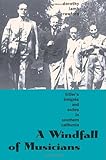
Dorothy L. Crawford. A Windfall of Musicians: Hitler's Emigres and Exiles in Southern California. New Haven: Yale University Press, 2009. xvi + 318 pp. $35.00 (cloth), ISBN 978-0-300-12734-8.
Reviewed by Lindsay Hansen (California State University - Northridge)
Published on H-German (April, 2010)
Commissioned by Benita Blessing (Oregon State University)
Europe's Loss and California's Gain
A Windfall of Musicians is a fascinating account of the diverse group of German musicians who immigrated to Los Angeles to escape the National Socialist regime. Dorothy Lamb Crawford provides rich biographical and historical contexts for the thirty-one musicians she examines. Moreover, she demonstrates the enduring legacy of this European influx of musicians in the 1930s and 1940s on subsequent generations of musicians, including conductor Michael Tilson Thomas, film composer Alfred Newman, and pianist/conductor Jeffrey Kahane. Rather than rely on a simplistic narrative of which musicians arrived when, Crawford organized the analyses topically by groups of musicians (such as teachers), with individual chapters dedicated to well-known figures like Arnold Schoenberg and Igor Stravinsky.
Although Crawford focuses on music history, she is careful not to use musicology jargon in her writing. She questions why musicians chose to settle in Hollywood/Southern California, when other parts of the United States, especially New York, already had strong bases for classical music, and provides fascinating insights into the musicians' lives that complement her history of the music and time. Her analysis suggests that the émigrés fleeing Nazi Germany sought more than a city where they could play music; they were looking for a community of like-minded artists and intellectuals from a variety of disciplines. Southern California had already established itself as a center tolerant of a variety of viewpoints; more importantly, it was a place that encouraged stimulating and even provocative ideas. Émigrés took full advantage of the richness of this intellectual and artistic landscape. As the German film director Gottfried Reinhardt stated, "[T]here was nothing unusual in having one evening with Thomas Mann and the next with [Lion] Feuchtwanger and the next with Franz Werfel, or in driving to the Philharmonic to hear [Otto] Klemperer or having lunch and playing ping-pong with [Arnold] Schoenberg, having coffee and cake with [Erich Wolfgang] Korngold, or visiting Alma Mahler" (p. 31). Still, Crawford notes that the group of émigrés did not always enjoy collegial relationships amongst each other, describing Schoenberg's squabbles with Thomas Mann and Hanns Eisler. She also observes that the group did not share political leanings, or even a shared sense of political responsibility. As Schoenberg said of Eisler, "artists who dabbled in politics should be treated like immature children" (p. 111).
There are numerous surprises in the book for historians and musicologists, with Schoenberg's life figuring prominently in new discoveries about this famous musician. An instructor at the University of California-Los Angeles' (UCLA) music school, Schoenberg envisioned the creation of a unique, progressive music program that would rival all other programs, nationally and internationally. Mocking traditional music classes as lacking in rigor or breadth, Schoenberg claimed that he could teach "composing to tables and chairs" (p. 124). Schoenberg wanted to educate a new generation of musicians who would be proficient in all areas of music, rather than merely skillful in a discrete portion of the musical world. Some of his plans were realized, such as the impressive music library. Schoenberg was less successful at pushing through other ideas, such as musicology exams for music students and required undergraduate classes in harmony.
Crawford deftly illustrates the complexity of Schoenberg's personality with numerous examples from many parts of Schoenberg's life: he defied major conventions of musicology and music instruction, for instance, insisting that the 12-tone composition movement that he had pioneered was an art, not a scheme or a method, as commonly believed. Nor did Schoenberg shy away from judging his students' abilities. Of John Cage, Schoenberg insisted that he was "not a composer ... but an inventor"--a difficult pronouncement for someone whose livelihood came, in part, from composing (p. 119). Alfred Newman, perhaps best known for writing the jaunty fanfare that opens all Twentieth Century Fox films, also studied with Schoenberg. That an avant-garde musician such as Schoenberg, who was not known for mainstream music, film or otherwise, could play such a key role in Newman's artistic growth attests to the many possibilities that artists enjoyed in Southern California. Nor were such relationships one-sided; Newman was responsible for coordinating the Kolish Quartet's 1937 recording of Schoenberg's string quartets on a United Artists sound stage.
Crawford also includes an important discussion in chapter 7 on Ernst Toch, a composer who did not fit into either the Stravinsky or Schoenberg camp. Here Crawford provides a context for Toch's music that stemmed from unique physiological and psychological traits. Toch had very sensitive ears--Crawford describes him as having "abnormally large" ear canals--and was thus deeply affected by the sounds of dripping faucets and steam whistles. This sensitivity to otherwise everyday sounds, Crawford explains, caused him to later incorporate these elements into compositions (p. 125). The arc of Toch's professional life becomes clearer in terms of his impressive musical production versus his less impressive renommé. George Gershwin helped him get a film contract to compose in Hollywood, as well as a membership to the American Society of Composers, Authors, and Publishers (ASCAP), which should have cemented Toch's career in popular venues. Yet, he remained uncredited for most pieces, including those whose musical themes the studios used repeatedly. Still, contemporaries valued Toch enough to hire him at the University of Southern California, in order to rival Schoenberg's teaching at UCLA. Schoenberg and other musicians, more interested in cooperation than one-upmanship, tried to convince UCLA to hire him in order to bring him more closely into the circle of musicians who would have been important colleagues for Toch, but these attempts were unsuccessful. Nonetheless, Crawford intimates, UCLA ultimately recognized its loss: it is UCLA's libraries, not USC's, that house Toch's archives.
Crawford touches upon the struggles of composers working in Hollywood, noting, for example, Erich Korngold's refusal to join the Academy of Motion Picture Arts and Sciences (AMPAS). Korngold angrily stated that AMPAS called itself an "organization of Actors, Directors, Producers, Technicians, and Writers, even though it already has as members several composers and conductors of name" (p. 180). Similarly, as much as a haven as Southern California was for this group of musicians, Crawford notes that they were not so grateful to the area that they lost pride in their work, including what kind of work they wanted to be associated with. A key theme of the book concerns film music composition, for instance. This genre offered the best way to make money in Hollywood, but for musicians it meant "being rejected or ignored by musical circles in the rest of the nation" (p. 165). For this reason, Mario Castelnuovo-Tedesco and others purposely did not take credit for their film works, whether that meant writing under a pseudonym or simply remaining anonymous. Franz Waxman's work serves as a unique case study in success as a film composer: he received credit for his works and was nominated for five Academy Awards. Despite the potential stigma associated with film composition, Waxman founded the Los Angeles Music Festival, which premiered many works by Stravinsky, among other composers.
Crawford's analysis of Hanns Eisler demonstrates a major strength of the book: Southern California was not always kind to those émigrés who sought refuge there, nor was it always easy for these musicians. For example, going beyond common descriptions of Eisler as underpaid and overworked, she notes his anxiety and alcoholism that nearly broke up his marriage. It is at times difficult to reconcile this uncertain side of Eisler with his reputation as a ground-breaking theorist, as demonstrated in his 1947 book, co-authored with Theodor Adorno, Composing for the Films. In another dark chapter of U.S. history, Crawford also explains that Eisler was deported from the United States largely for his loyalty to his communist siblings, not for his own actions or musical compositions. Klemperer and Toch also suffered from depression, exacerbated in part by coming to terms with living as émigrés. Clearly, the vibrant music scene of Southern California came at a price for many musicians.
Crawford closes her volume by discussing Stravinsky, "certainly the most widely publicized of Los Angeles' musical émigrés" (p. 222). She focuses on his scuffles with film studios, and collaborations with George Balanchine, Ingolf Dahl, and Aldous Huxley. Closing the circle of Germans in California by connecting these émigré musicians with contemporary American musicians, she ends with the American music director Michael Tilson Thomas, who still cites Stravinsky as directly affecting his career as a conductor and musician.
The book is not without problems. Crawford acknowledges that she cannot cover every single émigré musician; still, this statement is not always enough to explain away some of the questions raised by her arguments. Her chart (pp. xv-xvi) provides a clear overview of the individuals discussed, when they came to Southern California, and where/when they died. At the risk of cluttering this chart, however, additional information about institutional affiliation (including film studios) would aid the reader in keeping the cast of characters straight. Additionally, given that so many of the composers (including Eisler) were nominated for Academy Awards, a chart or appendix of nominations and wins would complement the work and provide increased context.
Ultimately, Crawford's book successfully addresses a wide audience, so that scholars interested the Nazi era, the cultural-economic development of Southern California, music history, or the relationship between politics and culture will find her work useful. She assumes some knowledge of Adolf Hitler and World War Two, while carefully clarifying anything not commonly known, such as Hitler's own musical interests and plans for the Third Reich and ten mobile orchestras. Her extensive and thorough references to primary- and secondary-source literature, including an exhaustive reference of archive resources, points to an impressive and creative use of materials. The index is comprehensive and allows for easy cross-referencing throughout the book. The photographs and archival materials offer a thorough list of individual collections in various archives--located primarily in Southern California, but also at the Library of Congress and Yale University--that, along with Crawford's stimulating arguments, will point researchers to further avenues of research.
If there is additional discussion of this review, you may access it through the network, at: https://networks.h-net.org/h-german.
Citation:
Lindsay Hansen. Review of Crawford, Dorothy L., A Windfall of Musicians: Hitler's Emigres and Exiles in Southern California.
H-German, H-Net Reviews.
April, 2010.
URL: http://www.h-net.org/reviews/showrev.php?id=30053
 | This work is licensed under a Creative Commons Attribution-Noncommercial-No Derivative Works 3.0 United States License. |

