



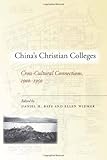
Daniel H. Bays, Ellen Widmer, eds. China's Christian Colleges: Cross-Cultural Connections, 1900-1950. Stanford: Stanford University Press, 2009. xxii + 405 pp. $65.00 (cloth), ISBN 978-0-8047-5948-9; $24.95 (paper), ISBN 978-0-8047-5949-6.
Reviewed by Paul Kahan (Slippery Rock University)
Published on H-Education (August, 2010)
Commissioned by Jonathan Anuik (University of Alberta)
Cross-Cultural Contact and Christian Colleges: The Case of China, 1900-1950
China’s Christian Colleges is an excellent collection of essays for historians of Chinese education and scholars who study cross-cultural encounters. Moreover, the editors managed to assemble an impressive group of chapters written by U.S. and Chinese scholars; they offer a nuanced understanding of China’s Christian colleges. For historians of U.S. education, however, the volume is of limited value because of its narrow focus and lack of a general historical and historiographical overview.
The book’s thirteen chapters grew out of a 2003 conference at Wesleyan University entitled, “The American Context of China’s Christian Colleges.” Like all compilations, the quality of China’s Christian Colleges is uneven, and the book’s editors fail to weave together the chapters’ disparate threads. A related shortcoming is the fact that the book is self-consciously aimed at specialists in the history of cultural relations between China and the United States, which is an incredibly narrow segment of the potential market for this book. The book lacks any discussion of the history and evolution of U.S. missionary colleges in China, except what is contained in the chapters themselves; I would certainly have benefited from a short history. Perhaps this is too much to ask of a volume that asserts proudly in its introduction, “The attempt was not to add to our knowledge of what colleges did in China, who their students were, and such empirical issues, but to probe the cross-cultural phenomenon represented by these colleges, especially the Protestant ones, most of which had a distinctly American flavor” (p. xv). However, I believe that including a brief discussion of the historical context would have deepened my appreciation of the articles’ contribution to the debate about the role and character of Christian education in China.
A related shortcoming is the discussion of historiography that appears at the end of the book. I would have liked a more fully developed analysis of China’s Christian Colleges’s place in the historiography of U.S. and European missionary schools in Asia, for two reasons: first, as someone who specializes in the history of education in the United States, I was at a distinct disadvantage when it came to understanding the book’s historiographical context and second, I think a fuller and earlier discussion of historiography would have helped the editors distill from the articles larger themes that might be useful to scholars outside the book’s very narrow intended audience.
These minor shortcomings aside, China’s Christian Colleges contains a number of thought-provoking and interesting chapters. One of my favorites is Jeffrey W. Cody’s analysis of the colleges’ architecture, titled, “American Geometrics and the Architecture of Christian Campuses in China.” Cody asserts, rather convincingly, that the colleges conveyed their educational ideas “through a melding of Chinese and non-Chinese architectural forms” (p. 29). Comparing architectural drawings of U.S. and European campuses with those of Chinese colleges, Cody notes that non-Chinese influences resonated with Chinese clients because of the architect’s “predilection for symmetry and the creation of courtyard spaces” (p. 29). His main point is that U.S. architects who designed the Chinese campuses reflected two related processes: assimilation, which implied U.S. superiority, and association, which promoted respect for traditional local cultures and customs. Cody concludes that the colleges’ architecture reflected the fact that “the premises of assimilation and association were also operative within the idealistic scope of Christian college sponsors and designers” (p. 29).
One significant aspect of the book is that the editors assembled not only U.S. and European scholars but also leading Chinese historians, giving China’s Christian Colleges a balanced approach often lacking in U.S. scholarly work on cross-cultural encounters. For instance, Jiafeng Liu’s perceptive analysis of the rifts between U.S. and European mission boards of overseers and the colleges' administrators demonstrates that the Chinese were not passive recipients of the missionaries’ largesse but often exerted agency in trying to adapt the colleges to fit local needs. By making use of sources outside of the United States (particularly the archives of the United Board for Christian Higher Education in Asia) Liu ably demonstrates that these institutions were caught between two worlds and exerted agency by responding to the challenges of rebuilding China after World War II. Similarly, Edward Yihua Xu’s perceptive analysis of the “English issue,” or the debate about whether to teach classes in English, demonstrates the complex roles these institutions played in Chinese society. Xu acknowledges that teaching classes in English alienated the schools from the more traditional hinterlands but convincingly demonstrates that the issue was far more complicated than a case of simple top-down cultural imperialism; in fact, the missionaries’ attitudes toward their students (and Chinese in general) were “varied and complex” (p. 123).
In sum, China’s Christian Colleges is a solid collection of well-written and provocative essays that have a lot to offer scholars interested in U.S. and European mission schools in China. As I noted earlier, however, the book has a number of shortcomings that limit its appeal, most notably the failure to provide much historical or historiographical context. Though I highly recommend the volume for research libraries and for scholars of Chinese education, there is little here to interest most specialists in the history of U.S. education.
If there is additional discussion of this review, you may access it through the network, at: https://networks.h-net.org/h-education.
Citation:
Paul Kahan. Review of Bays, Daniel H.; Widmer, Ellen, eds., China's Christian Colleges: Cross-Cultural Connections, 1900-1950.
H-Education, H-Net Reviews.
August, 2010.
URL: http://www.h-net.org/reviews/showrev.php?id=30051
 | This work is licensed under a Creative Commons Attribution-Noncommercial-No Derivative Works 3.0 United States License. |

