



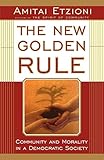
Amitai Etzioni. The New Golden Rule: Community and Morality in a Democratic Society. New York: Basic Books, 1998. Xxii + 314 pp. $16.00 (paper), ISBN 978-0-465-04999-8.
Reviewed by Steven Jones (Coordinator, Political Science Program, The University of Charleston)
Published on H-Teachpol (April, 1999)
What is the proper balance between the protection of individual liberties and the pursuit of the common good? How should one define "the common good?" If individuals are defined in part by their communal attachments, to which communities do those attachments belong? Such questions have been implicit in political philosophy since the ancient Greeks, and explicit since the publication of John Rawls' A Theory of Justice,[1] a book that gives priority to rights-bearing individuals and relates common good to individual choice-making. Both liberal and so-called communitarian philosophers have criticized this position--with the liberal, Robert Nozick, believing that Rawls allows for the violation of inherent liberties;[2] and communitarian philosophers, such as Michael Sandel and Alisdair MacIntyre faulting him for ignoring the social context in which individuals make choices.[3]
In addition to these philosophical questions about the relationship of individual to community, there is a political debate calling for the renewal of core social values and reinvigoration of civic responsibilities.[4] Amitai Etzioni has been a participant and framer in both, and his book, The New Golden Rule, reflects what he has learned so far. Etzioni's purpose is to find a balance between the values of personal autonomy and moral order. He argues that, in making ontological claims about the priority of the individual or of society, both liberal and communitarian philosophers are required to emphasize one value over the other. According to the author, common sense should tell us that both values are important to the functioning of a good society. Unfortunately, philosophical approaches based on ontological ordering cannot recognize this symbiotic relationship. Thus, a philosophical approach is not be very helpful in sorting out the proper balance between autonomy and order. Rather, we should draw upon the functionalist paradigm of sociological theory (Etzioni is, after all, a sociologist), which allows us to approach these issues by identifying what societies need for stability: stable societies need both autonomy and order, not a preponderance of one at the expense of the other. Ultimately, however, Etzioni's rejection of philosophical analysis undermines his thesis, as I will argue below.
Etzioni develops his ideas over eight chapters. Chapter One examines philosophical and moral arguments that tend favor one value over the other. He refers to thinkers who place a priority on autonomy as individualists and those placing a priority on order as conservatives. Although the tactic avoids the liberal-conservative dichotomy and the political connotations associated labeling, this individual-conservative dichotomy is no less confusing. For example, Etzioni places thinkers as diverse as John Locke, John Stuart Mill, Milton Friedman, John Rawls, and Robert Nozick under the 'individualist' category and religious conservatives such as Jerry Falwell and Pat Robertson with secular conservatives like Michael Oakeshott and Alasdair MacIntyre. Of course, Etzioni needs to develop these extreme positions in order to present his version of communitarianism as the only logical middle ground (p. 7).
Chapter Two develops the thesis that stable societies require a balance between the protection of personal autonomy and the protection of social order. It warns of the destabilizing effects that excessive individualism can have on societies as well as the dehumanizing effects that excessively orderly societies can have on individuals. How are societies to find a balance between excessive individualism and excessive order? Etzioni offers four general guidelines (p. 52), examined in greater detail throughout the book. First, order should be based on moral suasion rather than coercion. Second, to the extent that societies take aggressive measures to guarantee social order, those measures should be based on incentives rather than punishments. Third, measures that restrict autonomy should be "minimally intrusive." Fourth, identify the potential autonomy-reducing "side effects" of public policy and seek to limit those negative consequences.
Chapter Three is the weakest link in Etzioni's argument. Here, he rehashes the decline in social values and the rise of excessive individualism in the United States since the 1950s. Etzioni identifies a familiar litany of social ills, (e.g., decrease in voter turnout, decline in public trust in the government, increased divorce rates, increase in single- parent families, etc.) and places the blame on excessive individualism. The second half of the chapter does offer some descriptions of programs and policies that can help communities cope with the economic displacements caused by global capitalism. The book would have had a more positive impact on me had he avoided "the fifties were great but ever since then the U.S. has been in decline" approach, and focused on the consequences of globalilzation for both personal autonomy and social order.
Chapter Four, on the other hand, puts Etzioni's argument back on track. Having identified a decline in shared, core values in American society, however naively, Etzioni explores mechanisms by which Americans can rebuild consensus on social concerns. Building a justification not only for deliberative democracy on policy issues, but on community dialogues as well as society-wide "megalogues" on values, it is this chapter that seems the most well-reasoned. Etzioni also focuses on the need to make such dialogues "dialogues of convictions" rather than procedural dialogues, a distinction upon which he elaborates in Chapter Eight.
Chapter Five describes the importance of society's "moral voice," in balancing between social duty and personal choice. The moral voice enables a person to recognize that there are social consequences to individual choices and that what one "ought" to do is often morally superior to what one "wants" to do (pp. 123-26). How do individuals develop a recognition of the moral voice?: through communities, which Etzioni defines as "social webs in which people are attached to one another by crisscrossing relationships rather than by one-to-one relationships" (p. 123). However vague that definition may be, it becomes clear that Etzioni thinks of communities as being local in scope and pluralistic in membership. At this point, he attempts to defend the role of communities from some of communitarianism's critics, and concludes the chapter by identifying mechanisms by which communities can be strengthened.
Chapter Six shifts the focus of the argument, needlessly in my opinion, to a discussion about human nature. Etzioni rejects the "sanguine" view developed during the Enlightenment, that human nature is essentially rational--and thereby human behavior can be perfected. He also rejects the conservative view that human nature is inherently passionate and sinful. He argues that we are born animals, but teachable ones (as children), and that socialization through strong families, schools and communities allows individuals to develop their nobler selves through the internalization of the moral voice described in Chapter Five. It is in this chapter that Etzioni introduces the concept of a "community of communities," which he defines in greater detail in Chapter Seven.
Chapter Seven presents Etzioni's take on cultural pluralism. Although he acknowledges the strong attachments that individuals hold to their ethnic and religious communities, he argues that is possible and necessary for the United States to develop a "community of communities" to provide for intercommunal values, communication and attachments. He lists seven "core elements" to building a "substantive framework" for a pluralistic community of communities in the U.S.: First, focus on democracy as a value rather than a set of procedures (pp. 199-200); second, use the Constitution and Bill of Rights as the sources of your shared social values (pp. 200-202); third, develop "layered loyalties" involving the "nurturing a split loyalty, divided between commitment to one's immediate community and to the more encompassing community, and according priority to the overarching one on key select matters" (p. 203); fourth, emphasize respect (as opposed to neutrality or tolerance) for cultural differences; fifth, replace identity politics with a an approach in which "group differences [are] seen as differences among members of the same community that can and need to be worked out while maintaining the community" (p. 205); sixth, support intercommunity dialogues (p. 208); and, seventh, reduce intercommunity conflict through reconciliation (pp. 208-10).
In the concluding chapter, Etzioni takes on the issue of moral universalism versus moral particularism. Consistent with his thesis, he argues that we need not evaluate a community's values on the basis of a universal moral doctrine, nor should we accept unmitigated moral relativism. Rather, Etzioni argues that the core values of autonomy and order can provide the basis for evaluating a particular community's values as well as provide the basis for strengthening not only a national community of communities, but building a global community of communities as well (pp. 231-41). The author is not advocating world federalism. Rather, he argues for intercultural dialogues on value-laden topics in which both autonomy and order are viewed as legitimate values. Thus, according the Etzioni, the United States is justified in condemning human rights abuses in China but China is equally justified in criticizing the breakdown of social order it perceives in the United States (p. 240).
There are a number of features that make Etzioni's book an important contribution to the liberal-communitarian debate. First, in spite of the over-simplistic, individualist-conservative dichotomy in Chapter One, Etzioni does provide a balanced, reasonable account of the ongoing moral debates occurring in the United States and based on an overemphasis of either autonomy or order. He is as suspicious of the Religious Right as he is of the ACLU and he calls for a healthy skepticism about the presumed benefits of global capitalism.
Second, Etzioni provides an admirable response to several of the criticisms leveled at communitarians. Contrary to other communitarian thinkers, he does not view communities as good in themselves, but rather as necessary for the internalization of values, the so-called "moral voice." Likewise, he does not limit his definition of community to the scope of local communities. Rather, he calls for cross-community dialogues that will help build a community of communities. Etzioni's communitarianism does not advocate a relativistic or particularistic approach such as that taken by Walzer; instead, he argues that any community's values can be evaluated from the outside, by viewing how that community balances autonomy and order.
Third, Etzioni also attempts to provide the reader with practical policy applications of his version of communitarianism, some of which have been suggested elsewhere. For example, in Chapter Three he considers the effects of the global marketplace on both autonomy and order and calls for more effective economic adjustment policies associated with trade liberalization, greater emphasis on community jobs (as opposed to public works), work-sharing programs (such as shorter work weeks and reduced overtime), and the provision of a minimum social-safety net for all Americans pp. 80-84). In Chapter Five he offers a number of proposals for strengthening local communities and in Chapter Six he discusses programs he believes will strengthen families, schools, and voluntary associations. Although Etzioni's policy recommendations are offered as suggestions, not detailed policy prescriptions, they allow the reader to consider policy alternatives that are not based on partisan and/or ideological agendas.
Fourth, Etzioni provides a reasonable defense of cultural pluralism. Although I disagree with his views on bilingual education (he favors English as a Second Language over bilingual education), his calls for building a community of communities based on mutual respect among diverse religious, ethnic, gender, and preference groups are balanced and well-reasoned, and lack the polemics found in arguments from the opposing sides of the culture wars.
Finally, while I suspect that Etzioni prefers order to autonomy, a theme of his book emphasizes that this order cannot be imposed through the threat of force or the implementation of restrictive rules, laws and regulations. Thus, Etzioni's "moral voice" should not be confused with Rousseau's general will. Furthermore, Etzioni calls for a reawakening of the moral voice are less strident than social conservative calls for a return to traditional values. Therefore, the author is largely successful in developing an alternative to the political and social rhetoric of the day which seem to pose all social choices in zero-sum terms
In spite of its contributions, this work has serious flaws in as well. Those mentioned earlier, although detracting, do not ultimately undermine Etzioni's central arguments. However, there are other, more damaging, flaws. The first involves the relationship between individuals, communities, and values. In seeking to defend communitarianism against the charge that "communities are oppressive, conformist, and authoritarian," Etzioni argues that the critics confuse "old" communities with "new" communities (p. 127). He states that whereas "old communities had monopolistic power over their members ..., new communities are often limited in scope and reach" (p. 128). By this, he means that rather than being members of one overriding community, individuals in contemporary, postmodern societies have overlapping memberships in a variety of communities (Ibid.). For Etzioni, the condition of "multicommunity membership" acts to prevent any one community's need for order to violate individual autonomy. Thus, this social condition allows for a society to develop a balance between autonomy and order so long as the core values of the society are maintained by "the next-level moral community, the community of communities" (Ibid.). It is not clear to me how this can be the case. If individuals' attachments to communities are fluid and temporary, there is no reason to expect that they will form attachments to a less personal community of communities. And if that is the case, there is little reason to expect that individuals in those circumstances will develop a core moral voice. As I see it, either individuals are self-conscious members of a community (be it religious, professional, ethnic, etc.), while intercommunity as well as interpersonal relations are moderated by a core set of national values, or individuals are transitory members of communities and their values change with their circumstances.[5] Etzioni does not provide a convincing set of arguments for his supposition that individuals can be transitory members of multiple communities yet internalize a core set of values. Furthermore, this failure undercuts the concept of layered loyalties, which was presented in Chapter Seven as a means of building the community of communities.
The second major flaw in the work is ontological. As memtioned in the Introduction, Etzioni seeks to avoid making ontological claims by arguing that he is not writing a philosophical work, but a work of normative sociology. However, through this avoidance, Etzioni can give the reader no good reason to place autonomy and order as the values upon which to build moral order and good societies. Why are autonomy and order to be the cornerstones of our moral and social architecture as opposed to liberty and equality of opportunity, or liberty and property, or justice and virtue? Etzioni gives us no good reason. Although one may disagree with Rawls' principles of justice, or MacIntyre's priority on virtue, those authors can give us good reasons for their claims. Etzioni can not give us reasons for his. Indeed, as I read this book, I kept thinking of Rawls' concept of the overlapping consensus, which has much in common with Etzioni's discussions of constitutionalism, democracy and public deliberations as sources of common understandings. I kept hoping that Etzioni would make the comparison himself and explain why his approach is superior. It is this failure to address similar, yet contrasting perspectives that ultimately diminishes the power of Etzioni's work.
In spite of these flaws, The New Golden Rule has a number of pedagogical applications. It would be very useful as a supplemental text for a public policy course. As such it would be used as a basis for developing normative approaches to public policy considerations. I would also include it, or at least sections of the book, in my social and political philosophy class. My previous objections aside, Chapters Four, Five and Seven of the book provide as good an introduction as any to the issues of concern to communitarian philosophers. The book would also be a good companion piece to any course that deals with the issue of deliberative democracy in pluralistic societies. On the other hand, there is little here that can be applied to classes dealing with national government or national politics. Indeed, it seems that Etzioni goes out of his way to avoid discussions of politicians, political parties, political campaigns, interest groups, or the media.
In conclusion, The New Golden Rule, in spite of its weaknesses, has much to recommend it. Etzioni seeks to develop a set of core values that will allow societies to balance their policies between the extremes of excessive individualism and excessive order. It is clear that Etzioni believes that the U.S. has swung to far toward excessive individualism. However, he does not believe that the answer to the excesses of individualism can be found in more laws or more religion. Rather, he provides some well-considered alternatives to social and religious conservative correctives and manages to describe how we can shape and accomplish shared objectives in a culturally diverse society. In the end, The New Golden Rule is a welcome alternative to today's unsatisfying and often depressing moral and political debates.
Notes:
[1]. John Rawls, A Theory of Justice (Cambridge, Mass.: Belknap Press of Harvard University Press, 1971).
[2]. Robert Nozick, Anarchy, State, and Utopia (New York: Basic Books, 1974).
[3]. For a summary of communitarian critiques of Rawls, see Stephen Mulhall and Adam Swift, Liberals and Communitarians (Cambridge, Mass. and Oxford, England: Blackwell Publishers, 1996).
[4]. Benjamin Barber, Strong Democracy: Participatory Politics for a New Age (Berkeley, Calif.: University of California Press, 1984); Robert Bellah et al., Habits of the Heart: Individualism and Commitment in American Life , Updated Edition (Berkeley and Los Angeles, Calif.: University of California Press, 1996); Amitai Etzioni, The Spirit of Community: The Reinvention of American Society (New York: Touchstone Press, 1993); James Q. Wilson, The Moral Sense (New York: Free Press, 1993); Alan Wolfe, Whose Keeper? Social Science and Moral Obligation (Berekeley and Los Angeles, Calif.: University of California Press, 1989).
[5]. The first half of the argument resembles Rawls' overlapping consensus. See John Rawls, "The Idea of the Overlapping Consensus," in Political Liberalism (New York: Columbia University Press, 1996), 133-172. The second half of the argument is explored in Bellah et al., Chapters Three and Five.
Copyright (c) 1999 by H-Net, all rights reserved. This work may be copied for non-profit educational use if proper credit is given to the author and the list. For other permission, please contact H-Net@h-net.msu.edu.
If there is additional discussion of this review, you may access it through the network, at: https://networks.h-net.org/h-teachpol.
Citation:
Steven Jones. Review of Etzioni, Amitai, The New Golden Rule: Community and Morality in a Democratic Society.
H-Teachpol, H-Net Reviews.
April, 1999.
URL: http://www.h-net.org/reviews/showrev.php?id=3005
Copyright © 1999 by H-Net, all rights reserved. H-Net permits the redistribution and reprinting of this work for nonprofit, educational purposes, with full and accurate attribution to the author, web location, date of publication, originating list, and H-Net: Humanities & Social Sciences Online. For any other proposed use, contact the Reviews editorial staff at hbooks@mail.h-net.org.

