



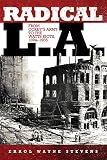
Errol Wayne Stevens. Radical L.A.: From Coxey's Army to the Watts Riots, 1894-1965. Norman: University of Oklahoma Press, 2009. 366 pp. $34.95 (cloth), ISBN 978-0-8061-4002-5.
Reviewed by Jordan Lieser
Published on H-California (August, 2010)
Commissioned by Eileen V. Wallis (Cal Poly Pomona)
Radicalism in the Big Orange
The city of Los Angeles can be a controversial and polarizing topic. In modern times, it has been criticized as a culturally shallow town filled with Hollywood starlets; however, at the same time, others praise the vast metropolis as a home for political, social, and cultural diversity. Errol Wayne Stevens, the former head of the Seaver Center for Western History Research at the Los Angeles County Natural History Museum, peels back the historical layers of Los Angeles in Radical L.A., presenting it as a battleground between staunch left- and right-wing coalitions. The very idea of chronicling radicalism is a difficult and vague task. Stevens should be commended for his research and comprehensive study of all things “radical” in Los Angeles between 1894 and 1965. Scholars interested in this particular topic will recognize that Radical L.A.’s specific period of study chronologically precedes Laura Pulido’s 2006 work, Black, Brown, Yellow, and Left: Radical Activism in Los Angeles, and contains only a limited overlap, since Pulido’s study begins in the 1960s. While Stevens never defines radicalism directly, he describes the political Left and Right effectively by using specific labor and cultural disputes to describe the ideological battles occurring within Los Angeles.
Stevens presents a number of historical observations about the major topics covered in Radical L.A. in his introduction. However, the only true argument formally introduced which spans the entire work points out that “race and ethnicity replaced the class struggle as the organizing principle of progressive Los Angeles,” specifically transitioning with the Watts riot of 1965 (p. xviii). These theses are underwhelming from a specialist’s standpoint. A much deeper analysis into the causes for the shifts--especially the transition from class struggle to race--would have produced a more interesting study for those interested in labor, political, or L.A history.
While the introduction is a bit limited, the first chapter is outstanding and reveals the template for the rest of Radical L.A. The author begins his discussion of radicalism with the economic depression of 1893, or what he deems “the first large-scale crisis of capitalism that modern Los Angeles experienced” (p. xvii). He frames the discussion of the depression, and one may argue the entire book, around the idea that there are two distinct and politically radical groups working in Los Angeles, evident by their two very different solutions to the economic problem carried out by the citizens--one coming from the radical Right and one originating within the radicalized Left. The first solution he discusses is representative of the more conservative Angelenos, including most of the city’s business owners, who believed in limited government, and therefore proposed a primarily private sector solution to the problem. The key organization for this group was the Merchants’ Association, which successfully manufactured a series of celebrations known as La Fiesta de Los Angeles. The idea behind the festival is that it would celebrate Los Angeles through a number of different public events while concurrently stimulating the city’s economy. At the other political extreme was General Fry’s Industrial Army, which Stevens uses as the representation of the left wing in Los Angeles. Fry’s group believed in direct government involvement and was reformist minded. Their solution to the depression was to march all the way to Washington DC with three demands: “1st. Government employment for all her unemployed citizens. 2nd. The prohibition of foreign immigration for ten years. 3rd. That no alien be allowed to own real estate in the United States” (p. 12). Fry’s group would eventually join with other labor groups across the nation to participate in the event best known to historians as Coxey’s Army. By introducing the polarized views of politics within Los Angeles in the first chapter and contextualizing the events of the city to America’s national history, Stevens sets a precedent for the rest of the book with an in-depth discussion of both right- and left-wing Los Angeles radicalism and their relation to the wider American historical narrative.
The author’s discussion of right-wing radicalism is extensive and serves as a nice counterweight to the more animated left-wing activism. The Right is presented as relatively static in comparison to the Left--which is perhaps further evidence of their chokehold on L.A. city politics--and did not stray too much from its small government, open-shop agenda. While the Right’s story may not be as entertaining of a read, Stevens does an excellent job portraying the city’s power players, most notably L.A. Times publisher Harrison Gray Otis. The author also tracks the evolution of the right wing; for instance, in the chapter “The Changing of the Guard,” he discusses the generational shift from people like Otis to his successor and son-in-law Harry Chandler.
While the right wing is aptly covered, the book is pushed forward primarily by the more fractionalized Left, which evolves primarily through organized labor and those affiliated with socialism or communism. The narrative includes a masterful contextualization of well-known (and many lesser-known) historical events and time periods, which include the Pullman Strike of 1894, the bombing of the L.A. Times building in 1910, Eugene Debs’s political career, the Great Depression, World War II, the “Sleepy Lagoon” murder trial, and McCarthyism. While the first chapter is perhaps the high point of the book, these subsequent chapters present interesting, well-researched, and intriguing histories.
Radical L.A. concludes with a discussion of the Watts riot of 1965 and a modest effort to reconnect the book’s content with the arguments presented in the introduction. In essence, Stevens’s last chapter explains the way Los Angeles has changed from Coxey’s Army to the Watts riot. While the author’s conclusions are thought provoking, they are not systematically evidenced throughout the book. This work does not have a specifically delineated argument with closely tied supporting evidence; however, this was likely a premeditated decision. Radical L.A.’s topic may seem narrow based on geography; however, its broad ideological scope, the rich historical time period under scrutiny, and the author’s effective contextualization of America’s national history makes for a much broader subject matter than a typical piece of historical research. In reality, Stevens’s highly accessible book with short chapter’s functions more like an extraordinary detailed textbook on LA. history with subsequent sections marching readers through a timeline. While the books uniqueness is a credit to the sheer volume of research the author completed, the quality can also be viewed as a negative.
The author’s diligent use of historical newspapers, the Huntington Library archives (used in chapter 1), a variety of published government sources, labor records, and an impressive list of secondary literature (some of which is unpublished) gives the book a solidly researched base. Based on the book’s endnotes, newspapers are the most ubiquitous primary sources; however, Stevens does not simple utilize one or two publications. Instead, he encompasses well over a dozen news journals covering both political extremes. For instance, one sample chapter’s references include the L.A. Times, L.A. Express, San Francisco Examiner, San Francisco Chronicle, L.A. Socialist, and the L.A. Record.
One area in which Stevens faltered slightly is objectivity. When discussing a polarizing topic, such as political radicalism, a writer can easily become overly subjective. This is actually to be expected; however, with the limited theses and even handedness of the text, it is apparent that Stevens strived for a certain level of neutrality. Unfortunately the level of objectiveness varies and Radical L.A. strays from impartiality on a few occasions. The most notable example is the vilification of the L.A. Police Department (LAPD) as a tool of the open-shop supporting business owners. While this may be well supported with documentation, the amount of evidence presented in the text to prove this point is unsatisfactory to classify it as simply observational.
The amount of material successfully navigated by Stevens is impressive. While the book is surprisingly limited in its overall analysis and historiography, it is a well-written narrative and contains valuable information. Radical L.A.’s broad sweep and theme make it unique, and its strong research makes it a reference for future scholars interested in furthering L.A. history. There is little doubt that Radical L.A. productively contributes to both the study of American radicalism and the history of Los Angeles.
If there is additional discussion of this review, you may access it through the network, at: https://networks.h-net.org/h-california.
Citation:
Jordan Lieser. Review of Stevens, Errol Wayne, Radical L.A.: From Coxey's Army to the Watts Riots, 1894-1965.
H-California, H-Net Reviews.
August, 2010.
URL: http://www.h-net.org/reviews/showrev.php?id=30022
 | This work is licensed under a Creative Commons Attribution-Noncommercial-No Derivative Works 3.0 United States License. |

