



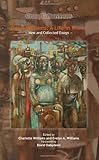
Charlotte Williams, Evelyn A. Williams, eds. Denis Williams: A Life in Works, New and Collected Essays. Amsterdam: Rodopi, 2010. Illustrations. xxi + 238 pp. $75.00 (cloth), ISBN 978-90-420-2791-6.
Reviewed by dele jegede (Department of Art, Miami University)
Published on H-AfrArts (August, 2011)
Commissioned by Jean M. Borgatti (Clark Univeristy)
Art, Scholarship, and Human Agency: Immortalizing Denis Williams
For quite some time, there has been a penchant for particularistic work in the field of academic research and scholarship as well as in the creative arts. Many of us are familiar with the fervor for specialized studies in art history that make it easy to identify an artist with a distinctive style or a favored medium of expression. In academic circles, it is customary for scholars to pursue tightly defined areas of study. So prevalent is this characteristic that we tend to forget that it is possible to successfully profess one’s competence in multiple fields.
It is against this background that we must view the portrait of Denis Williams painted by a group of fifteen contributors with expertise in diverse fields that include visual art, creative writing, art history, cultural engineering, and social justice. It is a portrait that demonstrates the accomplishments of one individual across many creative, scholarly, and scientific divides. It is simply admirable to read the chronicles which demonstrate the capability of the human mind to transcend the narrow confines that specialization often imposes on scholars, creative artists, and culture experts.
Many of us who are contemporaries of the cohort of artists propelled into limelight through their participation in the series of experimental workshops that took place in Osogbo in 1962 and 1963 probably knew Williams as one of their key conductors. Perhaps not many people realize that his intervention in Osogbo was but a small part of an academic and cultural involvement in Nigeria that lasted from 1962 to 1967 during which he taught at the University of Ife (1962-66) and the University of Lagos. Williams’s period in Nigeria, like his involvement in Osogbo, was only a fragment of his life as a sojourner, traversing continents and leaving his footprints in disparate fields until his death in 1998 at the age of seventy-five.
Denis Williams: A Life in Works is a welcome effort to recuperate Williams by bringing together in one volume essays and reminiscences aimed at preserving his laudable achievements as an award-winning painter in London in the early 1950s, a novelist, art historian, curator, archaeologist, teacher, mentor, and catalyst. Ironically, this publication has perhaps the unintended consequence of demonstrating how marginalized and underappreciated Williams has been in scholarly and academic circles.
The introduction by Charlotte and Evelyn A. Williams frames the book by foregrounding the key contexts within which Williams’s life and works are to be analyzed. The introduction is a crisp summation of the essays that follow: essays that speak to, analyze, and reminisce about the many skills and capabilities of Williams in diverse areas. Although five of the fourteen essays have been published previously, they complement rather than vitiate the enormity of his contributions, the singularity of his commitment, and the many competences that he brought to bear on the execution of his chosen tasks. Charlotte and Evelyn Williams make the important point, which a reading of the essays will confirm, that “Williams’s work defies easy compartmentalization” (p. xvi). This introduction also wonders aloud why Williams’s seminal publication, Icon and Image (1974), has been neglected by scholars.
In their contribution, Charles Gore and John Picton focus on Williams in Africa and, in particular, on the significance of Icon and Image. Post-WWII Africa excited Williams, especially during the incipient wave of independence that would eventually envelop the continent. In 1957, driven by his sense of selfdom and energized by the prospects of locating Africa as a potential site of counter-hegemonic activities, Williams left his lectureship at the Central School of Art in London and headed for the Sudan. For the next five years, he would remain at the Technical Institute in Khartoum and teach art and art history. It was during his stay in the Sudan that Williams became exposed to archaeology, which he would use later upon his return to Guyana in 1967. From 1962 to 1967, Williams was in Nigeria where he was a faculty member first at the University of Ife (now Obafemi Awolowo University) and later at the University of Lagos. After a thorough critique of Williams’s work, and in particular, his groundbreaking investigation of metal-working practices in Nigeria that resulted in the publication of Icon and Image, Gore and Picton are unambiguous in their conclusion that the book “remains a neglected masterpiece of art-historical writing that directed our attention away from the established views of Fagg, Dark, and Willet in the 1960s when Williams carried out his research” (p. 167).
Although the editors make no attempt at organizing the essays in any particular chronological order, three distinct phases are discernible. The first deals with the growth of young Williams in British Guiana (now Guyana). We learn of his prodigious talent in art, which earned him a British scholarship to the Camberwell School of Art in London in 1946, his teaching stint at the Central School of Arts and Crafts, and his brilliant exploits as an artist with a string of exhibitions that drew appreciation from notable critics of the time. Phase 2 saw Williams in Africa between 1957 and 1967. The last phase of his life and work coincides with his return to newly independent Guyana in 1967. We see him in his role as a catalyst for the establishment of enduring institutional structures for the pursuit, propagation, and sustenance of research, art, and scholarship.
The publication’s downside lies in poor quality reproductions. Given the epochal nature of Williams’s paintings, the least one expects are reproductions that do justice to their execution rather than reducing their importance. Reproductions of actual pages from Ulli Beier’s work on Osogbo, also included, are so small as to make them unreadable without the use of a magnifying instrument. Their very inclusion seems questionable. Was the point to validate the contact between Beier and Williams? Also, the absence of an index in such a notable publication is regrettable.
Fortunately, contributions by Evelyn Williams, Wilson Harris, and Andrew Jefferson-Miles provide redemption in their luminous critique and analyses of Williams’s art. The last two essays in this volume by Nicholas Laughlin and Anne Walmsley offer appropriate summations of the life and works of Williams. They show Williams as a recurrent figure in the histories, and the intellectual and creative adventures that span three continents: South America, Europe, and Africa.
The reproduction and index issues are, on the whole, not significant enough to offset the excellent quality of the essays and the insights that they offer into the mind of an erudite scholar, a visionary artist, and a truly international figure. It is hoped that the copious references that are contained in the footnotes and the excellent bibliography of primary and secondary sources, which are at the end of the work, will encourage scholars to give Denis Williams another look.
If there is additional discussion of this review, you may access it through the network, at: https://networks.h-net.org/h-afrarts.
Citation:
dele jegede. Review of Williams, Charlotte; Williams, Evelyn A., eds., Denis Williams: A Life in Works, New and Collected Essays.
H-AfrArts, H-Net Reviews.
August, 2011.
URL: http://www.h-net.org/reviews/showrev.php?id=30000
 | This work is licensed under a Creative Commons Attribution-Noncommercial-No Derivative Works 3.0 United States License. |

