



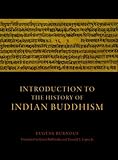
Eugène Burnouf. Introduction to the History of Indian Buddhism. Translated by Katia Buffetrille and Donald S. Lopez Jr. Chicago: University of Chicago Press, 2010. 608 pp. $65.00 (cloth), ISBN 978-0-226-08123-6.
Reviewed by Richard Davis (Bard College)
Published on H-Asia (March, 2011)
Commissioned by Sumit Guha (The University of Texas at Austin)
Davis on Burnouf Indian Buddhism
Eugène Burnouf’s Introduction à l’histoire du Buddhism indien was, as Donald Lopez writes in the introduction to this edition of the Introduction, “the most influential work on Buddhism to be written during the nineteenth century” (p. 1). Published in 1844, this massive work of scholarship superseded in its comprehensiveness and detail all previous European works on Buddhism, and established a groundwork for much that would follow. As a general historical account of Indian Buddhism, it would not be surpassed for over a century, until Étienne Lamotte’s Histoire du Bouddhisme indien of 1958. To a considerable extent, Burnouf was responsible for first articulating the master narrative of Indian Buddhism, which retains a potent hold on our understanding of Buddhism today.
As the translators Katia Buffetrille and Lopez observe, Burnouf’s fundamental work is largely overlooked by modern scholars. In part this is because his renderings of the Buddhist tradition entered so fully into the conventional understandings of the field. But it is also due to the lack of availability of the work, which was reprinted only once in 1876, and has never been previously translated into English. It is also the result of the style of its composition, the “difficult and antiquated” French of the early nineteenth-century academy, which appears “erudite and antiquated,” difficult even for an educated Francophone (p. 29). This translation aims to make this great work available more readily to an English-speaking audience, and it will surely do so. However, the translators have chosen to preserve the formality of Burnouf’s style. While this is a wise and necessary choice, the resulting translation is not easy to read. The primary audience for this translation will be confined to those with an interest in the scholarly study of Buddhism or of early Indian religious history.
In the editor’s introduction, Lopez relates the story of the work’s composition. In 1832, Burnouf became chair of Sanskrit at the Collège de France and the secretary of the Société Asiatique. His initial studies included major contributions to the study of Avestan, and a massive translation of the Bhāgavata Purāna, published in three large volumes in the 1840s. But in the 1830s, Burnouf and the Société began to receive shipments of Sanskrit Buddhist texts from Brian Hodgson, then the British resident in Nepal. Working with the erudite Sanskrit pandit Amritānanda, Hodgson supplied texts to a number of British and French learned institutions in hopes of stimulating the scholarly study of Buddhism. Burnouf in Paris was the scholar who most clearly envisioned the value of these newly available ancient works. He recognized them as a means to establish Indian Buddhism as a religious tradition whose history in the Indian subcontinent could be reconstructed largely on the basis of Sanskrit texts. Burnouf was aware of other scholars working on Buddhism at the time, including George Turnour’s work with Pali texts in Ceylon, but he gave priority to the Sanskrit texts from Nepal over the Pali and all others. After wide reading, Burnouf devoted his first major effort to the translation of the Lotus Sūtra, which he judged to have the most compelling interest. He had completed this translation and its notes by 1841, but he held off from publishing his work. The indefatigable Burnouf realized that this work would not be comprehensible, even with the addition of his copious apparatus, unless the reader had a knowledge of earlier Indian Buddhist tradition. To supply this background, he set about writing an “introduction,” eventually reaching 647 pages, which would include extensive translated extracts from the original sources. Burnouf’s composition involves a dialogue between these primary sources and contemporary Western scholars of Buddhism; his style is to lay out his own considerations and resulting conclusions, in the manner of an ongoing scholarly conversation, rather than a hegemonic summation. The Introduction came out in 1844, while Le Lotus de la bonne loi (all 897 pages of it) appeared in 1852, just after Burnouf’s death.
The master narrative of Burnouf’s Introduction would prove to be a powerful one for subsequent scholarship and popular understandings of Indian Buddhism. As Burnouf presents it, Indian Buddhism should be reconstructed primarily from texts, and especially Sanskrit texts. It is a “textual object,” as Lopez puts it (p. 2). Buddhism is Indian in origin and early development, and it needs to be understood in its Indian historical context, including its lengthy debate with Brahmanism (or Hinduism) and its nuanced encounter with Indic social realities such as caste. The Buddha himself must be seen as a human teacher, whose most essential teachings are ethical in character. Burnouf distinguishes between “simple” and “developed” sutras. The simple sutras, dealing with the human Buddha’s dialogues with his followers and his opponents in the surrounding social world, are the most authentic renderings of the human teachings of the historical Buddha, and Burnouf clearly finds these the most satisfying. Of the opponents of the Buddha, Burnouf disdains the Brahmanic defenders of caste hierarchy and their own privileged status as a corrupt priesthood. But with the development of the Buddhist Order, cloistered Buddhist monks increasingly engage in abstruse metaphysical speculations and create “developed sutras.” “The actors there,” he writes, “are imaginary bodhisattvas, with infinite virtues, with endless names one cannot pronounce, with bizarre and almost ridiculous titles, where the oceans, the rivers, the waves, the rays, the suns are coupled with qualities of unmerited perfection in a manner most puerile and least instructive, because it is without effort there” (p. 16). The painstaking scholar Burnouf cannot abide an effortless Buddhist path. The monastic digressions into imaginary Buddha worlds estrange the Buddhists from ordinary society, according to Burnouf’s narrative. He reserves special disdain for the later Buddhist tantras, which he views as forming an unholy alliance with Śaivism. Finally, he acknowledges the disappearance of Buddhism from the Indian subcontinent with nostalgic regret. Something is inevitably lost when Hindus gain the upper hand in India and Buddhism flourishes only in other regions and loses its home language of original expression.
Anyone who has studied or taught Buddhism or early Indian history will readily recognize many of these now long-standing historical tropes. Some have been effectively challenged in recent decades, but the overall narrative maintains a powerful hold on the way we understand and present Buddhism. The translators deserve our gratitude for providing the occasion for reflecting on the foundations of this narrative, by bringing Burnouf’s great work of early Buddhist scholarship to our attention and making it more broadly accessible.
If there is additional discussion of this review, you may access it through the network, at: https://networks.h-net.org/h-asia.
Citation:
Richard Davis. Review of Burnouf, Eugène, Introduction to the History of Indian Buddhism.
H-Asia, H-Net Reviews.
March, 2011.
URL: http://www.h-net.org/reviews/showrev.php?id=29994
 | This work is licensed under a Creative Commons Attribution-Noncommercial-No Derivative Works 3.0 United States License. |

