



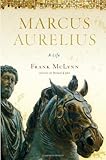
Frank McLynn. Marcus Aurelius: A Life. Cambridge: Da Capo Press, 2009. 720 pp. $30.00 (cloth), ISBN 978-0-306-81830-1.
Reviewed by Joseph Frechette
Published on H-War (February, 2011)
Commissioned by Brian G.H. Ditcham
An Ambitious Biography of a Complex Life and Times
It is perhaps inevitable that a volume of this size and ambition might have corresponding difficulties. Frank McLynn does not restrict himself to a mere biography of Marcus Aurelius. Over the course of nineteen chapters and three appendices, he treats the reader to lengthy discussions not only of Marcus’s immediate life and times, but also his philosophy, attitude toward Christianity, and significance to posterity, as well as the terribly fraught question of the decline and fall of the Roman Empire. All of this is in an assertive and engaging style with a polymath’s facility at drawing historical parallels from the ancient to the modern. Given the presentation of such a large amount of material it might be a bit ungracious to complain about what else might have been included. To his credit, McLynn includes much material that provides useful context for the lay reader and it is clear that he familiarized himself with a great deal of the specialized primary and secondary literature. The result, as the London Times note on the dust jacket proclaims, is a “polished and panoramic” biography.
The very size and complexity of the task, however, do not always lend themselves to such narrative facility. The reader might never guess that much of what McLynn relates so confidently is the subject of ongoing debate. Even worse, Da Capo Press has not done the reader or McLynn any favors in its treatment of his bibliographic materials. The use of endnotes rather than footnotes is especially unwieldy in a tome of this size, as is the frustrating and inexplicable lack of line breaks between notes. The lack of a general bibliography for all but the ancient narrative sources further complicates the reader’s task in pinning down exact citations to secondary materials in one hundred pages of notes. This is a pity, because many of McLynn’s endnotes are fairly substantial and often make clear that, despite the directness of his prose, he is not unacquainted with many of the nuances of the current historiography.
In the end, however, McLynn must bear the burden of his authorial choices. Despite all the hand-wringing over academic historians losing sight of readability in their narratives, in this case, a bit more nuance in the text might have made for a better book. As McLynn freely admits, “the plain truth is that there are vast chunks of Marcus Aurelius’ life about which we know nothing” (p. 86). Given that acknowledged reality, as well as the manifest difficultly in establishing the facts of any of the events eighteen centuries past, a bit more circumspection might have been beneficial for the unwary reader. Instead McLynn is given to aggressive conclusions on topics about which there might be reasonable differences of opinion. For instance, it is not clear to this reviewer that “a more priggish, inhuman, killjoy, and generally repulsive doctrine would be hard to imagine” than ancient Stoicism, particularly given the intellectual history of the nineteenth and twentieth centuries (p. 209).
Perhaps most seriously, McLynn’s text is replete with details drawn from the tendentious collection of late imperial biographies collectively known as the Historia Augusta. McLynn even goes so far as to refer to them as the “official histories” (p. 37). Although it is generally conceded that the earlier biographies in the series, which begin with that of the Emperor Hadrian, tend to be more reliable, they are hardly straightforward contemporary sources. This easygoing attitude toward a problematic source does not always combine well with McLynn’s self-assured style of characterization. To refer in passing to Hadrian as possessed of “psychopathic tendencies” seems a bit strong when McLynn admits that the Historia Augusta’s portrait of Hadrian can only really represent senatorial opinion (pp. 30, 42). Likewise, despite conceding that most historians treat the biography of Avidius Cassius “at arm’s length,” he boldly concludes, based on this source, that Cassius was “more than usually contemptuous of human life, and perhaps driven by sadistic urges” (p. 375). It may well have been that the Emperor Lucius Aurelius Commodus was a monster of the first order, but one wonders if simply retelling the lurid tales of the Historia Augusta as unproblematic is entirely appropriate. It is also a bit jarring to see an off the cuff reference to the Emperor Trajan simply as an “alcoholic homosexual” even after a lengthy digression on his reign (p. 319). More restraint, qualification, and source discussion within the narrative would have been welcome.
McLynn’s discussion of the “decline and fall” of the Roman Empire is also problematic. He relies heavily on such classics as Michael Rostovtzeff’s Social and Economic History of the Roman Empire (first published in 1926), Eric R. Dodds’s Pagan and Christian in an Age of Anxiety (1965), and Arthur E. R. Boak’s Manpower Shortage and the Fall of the Roman Empire in the West (1955). Although justly respected, these works are all at least forty years old. McLynn concludes regarding the empire’s demise that “the writing was on the wall for those who chose to read it” a full two centuries before the Battle of Adrianople and three centuries before the deposition of Romulus Augustus (p. 457). Given the track record of relatively transient modern imperial powers, it is a dubious proposition that the period AD 180-476 was three centuries of constant and inevitable decline. Such a proposition neglects the enormous amount of scholarship on the vitality of Late Antique society over the last forty years and the lively debate currently taking place over whether “decline and fall” or “transformation” are better models for the later Roman Empire.[1]
Perhaps unconsciously, McLynn perpetuates certain anachronisms that more recent scholarship eschews. Terms like “bourgeoisie” (pp. 10, 468, 475, 486) and “proletariat” (pp. 10, 79, 82, 158, 409, 440) echo Rostovtzeff, but are also loaded terms that may mislead as well as enlighten the lay reader.[2] The portions of the work most likely to be of interest to the H-War readership are the discussions of the Parthian campaigns of Trajan and Lucius Verus, Marcus’s wars with the Marcommani, and the revolt of Avidius Cassius which include some discussion of the imperial army. There is not much new here for specialists, although McLynn does provide an engaging resume of events. What does jar a bit are the occasional narrative inconsistencies. McLynn describes Trajan as a “hard driver” who still “lolled” in Babylon with no attempt to reconcile the two comments (p. 135). Likewise, he treats the reader to a lengthy discussion on Lucius Verus’s peccadilloes and foppish behavior (esp. pp. 120-125, 142-143), but then notes that Verus was “no fool” (p. 158) McLynn does note the lack of a powerful officer class and central army command, but still resorts to such anachronistic shorthands as “northern frontier command” and “general staff,” which may confuse the unwary (pp. 141, 143).
To be fair, it is unlikely that McLynn or Da Capo Press intended this volume for a specialist audience or as an undergraduate textbook. Despite the reservations noted above, the dedicated and wary nonspecialist who chooses to peruse the endnotes carefully may read the work with enjoyment and possibly some profit.
Notes
[1]. A good introduction to the debate is Jeanne Rutenburg and Arthur M. Eckstein, “The Return of the Fall of Rome,” International History Review 29 (2007): 109-122.
[2]. For a discussion of Rostovtzeff’s views and the sea-change in the study of ancient economics taking place in the 1960s, see Bryan Ward Perkins, “Jones on the Economy,” in A. H. M. Jones and the Later Roman Empire, ed. David Gwynn (Leiden: Brill, 2008), 193-210.
If there is additional discussion of this review, you may access it through the network, at: https://networks.h-net.org/h-war.
Citation:
Joseph Frechette. Review of McLynn, Frank, Marcus Aurelius: A Life.
H-War, H-Net Reviews.
February, 2011.
URL: http://www.h-net.org/reviews/showrev.php?id=29912
 | This work is licensed under a Creative Commons Attribution-Noncommercial-No Derivative Works 3.0 United States License. |

