



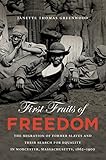
Janette Thomas Greenwood. First Fruits of Freedom: The Migration of Former Slaves and Their Search for Equality in Worcester, Massachusetts, 1862-1900. The John Hope Franklin Series in African American History and Culture. Chapel Hill: University of North Carolina Press, 2010. 256 pp. $55.00 (cloth), ISBN 978-0-8078-3362-9; $22.95 (paper), ISBN 978-0-8078-7104-1.
Reviewed by Nicole Etcheson (Ball State University)
Published on H-CivWar (May, 2010)
Commissioned by Matthew E. Mason (Brigham Young University)
Before the Exodusters
Historians are familiar with waves of African American migration out of the South in the post-Reconstruction period. The Exodusters fled the reestablishment of white supremacy by moving to Kansas and other parts of the Midwest in the late 1870s. The labor shortages of World War I that opened northern industrial jobs to black workers helped inspire the Great Migration of that era. Less attention has been paid to migration during the Civil War. For a generation before the war, northern whites accommodated slavery in part for fear that emancipation would free southern blacks to move northward. That is exactly what happened, as the work of Leslie A. Schwalm on the upper Midwest (Emancipation’s Diaspora: Race and Reconstruction in the Upper Midwest [2009]) and now Janette Thomas Greenwood on Massachusetts makes clear. While Schwalm’s midwestern states of Iowa, Wisconsin, and Minnesota sometimes had legal prohibitions against black migration (which were even more common in lower midwestern states, such as Ohio, Indiana, and Illinois), Massachusetts had a proud abolitionist tradition. This was especially true of Worcester, Massachusetts, Greenwood’s focus.
Worcester had been a locus of antislavery activity, such as providing refuge for runaways and defying the 1850 Fugitive Slave Law. It was home to Thomas Wentworth Higginson, antislavery minister, member of the Secret Six who backed John Brown’s Harpers Ferry conspiracy, and eventually colonel of the Union’s first official all-black regiment. When Isaiah Allen, a Virginia slave, escaped into the lines of the 15th Massachusetts, he was welcomed. A white officer, Thomas Spurr, hired Allen as his body servant. Eventually Allen resettled in Worcester. White regiments from Worcester, many of which operated in the region around New Bern, North Carolina, provided refuge to such fugitives, called contrabands. Horace James, chaplain of the 25th Massachusetts, opened schools for the freedmen, and some Worcester whites went to teach at these schools in the South, expanding the freedmen’s networks of northern contacts. And the efforts of an unsympathetic occupation governor to ban the schools gave impetus to freedmen’s desire to leave North Carolina. While white soldiers and teachers became the conduit for those contrabands to make their way to Massachusetts, the black community welcomed them. Isaac Mason, who had escaped from slavery in the 1850s, rented a home and probably gave a job to the first contraband to arrive in Worcester, William Bryant.
After the war, the Freedmen’s Bureau had a short-lived program to resettle black laborers in the North. Although Greenwood has been able to identify a group of these migrants, lacking personal connections to whites, these Freedmen’s Bureau migrants were less likely to stay in Worcester. After the initial migration, further movement north occurred as family members in the South joined relatives in Worcester.
Many black migrants did well in Worcester. George and Elizabeth Wilson accompanied their white teacher, Sarah Chase, when she returned to Worcester. George Wilson established a successful business, which remained in the family for several generations. The Wilsons’ daughter, named after their former teacher, received a superior education. Sarah Chase took an interest in her namesake, teaching her piano, etiquette, art, and religion. Sarah Wilson graduated from the town’s best high school and then from a teachers’ college, eventually becoming a “beloved” first grade teacher for generations of white as well as black Worcester children (p. 113). Despite the successes of the Wilsons and other black migrant families, as a whole the community remained poor. As industrial jobs became an important avenue of mobility into the middle class, discrimination against African Americans blocked them from gaining those jobs. Black workers remained as servants or day laborers. Despite their desire for autonomy, black institutions, such as the local church, were reliant on white “benevolent sympathizers” (p. 132). And black voters did not muster enough strength to win much patronage or sway the political parties. At the turn of the century, Worcester blacks held heated debates over whether to abandon the party of Lincoln and support the Democrats. On the one hand, local Republicans failed to reward black voters with patronage jobs, such as road work, which often went to Irish Democrats. On the other hand, many Worcester blacks felt that to vote Democratic was to support the party carrying out segregation and disfranchisement of southern African Americans.
Greenwood finds evidence of a split between the black Yankee community and the new immigrants from the South. For example, the two groups experienced residential segregation, although this segregation may have been linked to housing availability. In addition, to preserve their distinctive style of worship, southern migrants formed their own church. Even with some divisions between the two, however, both communities joined in celebrating Emancipation Day holidays. Eventually, the black Yankee tradition of celebrating August 1, the anniversary of West Indian emancipation, triumphed over the January 1 date of the Emancipation Proclamation. The weather was simply better for outdoor fun in August than in January. Furthermore, intermarriage between black Yankees and southern migrants was high, diminishing the idea of any serious internal division in the black community.
Even with the advantages of a sympathetic white community, black migrants to Worcester were limited in the economic, social, and political gains they could make. But as the white Civil War generation in Worcester died out and was replaced by “Gilded Age go-getters,” commitment to aid the black community lessened (p. 133). Memory of the contributions African Americans had made--the local Grand Army of the Republic post had twenty black members--faded. Former slaves, such as Mason, helped preserve some of this memory in their memoirs, and Greenwood has made an important contribution to a previously neglected topic, which is, fortunately, now generating much worthwhile scholarship.
If there is additional discussion of this review, you may access it through the network, at: https://networks.h-net.org/h-civwar.
Citation:
Nicole Etcheson. Review of Greenwood, Janette Thomas, First Fruits of Freedom: The Migration of Former Slaves and Their Search for Equality in Worcester, Massachusetts, 1862-1900.
H-CivWar, H-Net Reviews.
May, 2010.
URL: http://www.h-net.org/reviews/showrev.php?id=29885
 | This work is licensed under a Creative Commons Attribution-Noncommercial-No Derivative Works 3.0 United States License. |

