



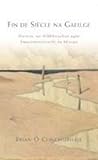
Brian Ó Conchubhair. Fin de Siècle na Gaeilge. Indreabhán, Conamara: Cló Iar-Chonnachta, 2009. x + 346 pp. $50.00 (paper), ISBN 978-1-905560-46-2.
Reviewed by Coilín Owens (George Mason University)
Published on H-Albion (June, 2011)
Commissioned by Nicholas M. Wolf (New York University)
Irish Language Revivalism and Apprehensions about Cultural Decadence
This study of the Gaelic revival--the late nineteenth-century effort to restore the Irish language to daily oral and written use in Ireland--undertakes to refute the charge that the movement was politically reactionary. It surveys several aspects of the movement--linguistic, literary, and, more broadly, cultural--and argues to the contrary: that its leaders were informed by contemporary debates over social Darwinism and cultural decadence.
Brian Ó Conchubhair begins by acknowledging the long-established overview of Irish nationalism in the late nineteenth century. He observes that during the period under study (up to 1901), traditional rural ways of life, the quality of spiritual life, popular religion, and use of the Irish language became identifiable components of the aspiration toward national sovereignty. Of these components, the language was the most distinctively, even essentially, Irish. The discipline of acquiring and using it daily was seen as contributing to the construction of an ideal Irishness. Newspapers promoting the language advertised Irish-language classes along with social, athletic, and recreational events providing direct competition with the vulgar commercial entertainment that inculcated a state of mind subservient to imperial political interests: what came to be known as “West Britonism.”
But Ó Conchubhair also emphasizes the ways in which this nationalism should be understood as something other than a mere continuation of the Gaelic revivalism of the mid-century, particularly that of Thomas Davis. Thus, he argues that the discipline of acquiring and using Irish daily was seen as more than contributing to the construction of an ideal Irishness: it was an antidote to the perceived decadence sweeping through European culture and a response to the widespread concerns about “racial decline” heavily embedded in the discourse of the time. In this sense, the language movement in Ireland was strikingly contemporary, engaging directly with (and feeding on) common anxieties found throughout Europe and the United States.
Within the movement, there were several sites of contention. One was concerned with which iteration of the language should be adopted--the classic style of the best writers of the past, or the oral usage still surviving among the living generation of native speakers. Another focused on the counterclaims of proponents of either the Celtic or the Roman typefaces in books and journals dedicated to the language. A third was engaged in issues surrounding the proper spelling of the language, which up to then had no accepted standard. A fourth strand of debate (one still familiar to teachers of the language) was concerned with which of the three surviving oral dialects would be accepted as the new standard, or whether a new compromised modern dialect would be devised to meet the common challenge of adapting to modern conditions. Finally, there were arguments between the grammarians over syntactic questions provoked by variants in usage from one dialect to the other.
These internal discussions--acerbic at times--spoke not to the weakness but to the earnestness of the movement. Participants in these debates were united in their shared apprehensions about the signs of terminal decadence around them, inflated by fin-de-siècle notions of racial and cultural decline. In sum, Irish revivalists were but partially motivated by an isolationist ideology. They shared their larger concerns with cultural theorists outside Ireland who were alarmed by what they perceived as a tide of defeatism, materialism, relativism, and moral decadence. Ó Conchubhair sees in the appearance of two full-length Irish-language novels published in 1900 a particular benchmark in the movement’s growing self-confidence. He argues that Fr. Patrick Dinneen’s Cormac Ua Conaill and Una Ní Fhaircheallaigh’s Grá agus Crádh in their subtexts exemplified the anxieties about cultural and moral decadence current at the turn of the century, a period of heightened political tensions following the commemorations of the 1798 rebellion and opposition to the Boer War.
This study handsomely complements the recent work of Philip O’Leary (The Prose Literature of the Gaelic Revival, 1881-1921: Ideology and Innovation [1994]) and Timothy G. McMahon (Grand Opportunity: The Gaelic Revival and Irish Society, 1893-1910 [2008]) on the aspect of Irish cultural revivalism that was focused on the native language, its attendant culture, and its literature. In surveying the arguments carried on in the Irish-language journals, Ó Conchubhair complicates the standard reading of the period which tends to reduce the force of the movement to reactionary nationalism. He holds that Gaelic revivalism--at least before the twentieth century--was antiquarian but not necessarily politically nationalist; and that the discipline of a cultural self-fashioning after native linguistic and cultural traditions was an essential insurance on the morally vacuous but increasingly competitive material international stage. He argues, therefore, that an exaggerated emphasis on the politically activist elements within the movement amounts to a caricature of the real intelligence, currency, and vision of the Gaelic revival. We are indebted to this concerted and descriptive study--written in clear academic Irish--for reminding us that in its original phase, the language movement did not necessarily imply either cultural isolation or political revolution. One has only to look across the Irish Sea to see how, in the successful efforts of the Welsh, the history of Irish revivalism might have taken another course.
If there is additional discussion of this review, you may access it through the network, at: https://networks.h-net.org/h-albion.
Citation:
Coilín Owens. Review of Ó Conchubhair, Brian, Fin de Siècle na Gaeilge.
H-Albion, H-Net Reviews.
June, 2011.
URL: http://www.h-net.org/reviews/showrev.php?id=29844
 | This work is licensed under a Creative Commons Attribution-Noncommercial-No Derivative Works 3.0 United States License. |

