

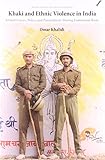
Omar Khalidi. Khaki and the Ethnic Violence in India: Armed Forces, Police, and Paramilitary Forces during Communal Riots. Second Edition. Revised and Enlarged. Gurgaon: Three Essays Collective, 2010. xi + 196 pp. $12.00 (paper), ISBN 978-81-88789-71-9.
Reviewed by Arvind Verma (Indiana University)
Published on H-Asia (April, 2011)
Commissioned by Sumit Guha (The University of Texas at Austin)
Communal Stain on Khaki
Murali Krishnan, learning that Muslims are not selected for intelligence agencies of India, thought he found a great scoop but “everybody in the government seemed to already know” (p. 157). Much like Krishnan’s discovery, Omar Khalidi’s book too establishes what is common knowledge--that Muslims are poorly represented in the uniformed forces of the Republic of India. Khalidi’s earlier book (Muslims in Indian Economy [2006]) found Muslims to be economically backward too. For that matter, except perhaps Bollywood and sports, Muslims have lagged in most fields behind almost every other community. Khalidi asserts that this is a result of bias on the part of the establishment that suspects the loyalty of community and denies them equal opportunities. While the book under review presents compelling evidence about scarce Muslim presence in the uniformed forces, the insinuation that this is due to official discrimination is weakly supported.
Initially published in 2003, the book has gone into a second edition and continues to provoke readers. However, there is little change from the first edition with the exception of two chapters on the composition and role of the army and the police and a short chapter about intelligence agencies and paramilitary forces. Chapter 1 examines the Muslim presence in the army through diverse sources, as the religious affiliations of military personnel are not made public by the government. In contrast, in chapter 2, proportions of Muslims in the police forces by state are cited from the National Crime Records Bureau but the data is not analyzed because “these figures do not have a base for comparison historically since independence for each state,” whatever that may mean (p. 126). The discussion about the role of these uniformed forces is also perfunctory. Their performance cannot be assessed without an examination of their command, control, and resource mechanisms and has to be grounded in the wider politics of the country. None of these factors are part of the discourse.
Nevertheless, there is little doubt that Khalidi has raised an important question. Can a plural democratic society exist if the largest minority community is excluded from participation in nation building? He rightly observes that “an unrepresentative force makes the state a lot less legitimate for those unrepresented in its most obvious instrument of coercion” (p. 84). However, the government has stoutly refused to provide this information on various grounds. Khalidi states that on “9 January 2006, [the army] informed the Defense Ministry that there were 29,093 Muslims in the army in 2004” and that “an anonymous source leaked the data to newspapers despite the army’s wish,” without citing any reference (pp. 49, 50). Clearly, this statistic embarrassed the establishment with many dubbing the count of Muslims in the army “anti-national” (p. 50). Khalidi asserts that while the Sikhs, Gurkhas, and the Scheduled Tribes and Castes have been favored in terms of recruitment, Muslims have been ignored. Using a variety of documents, ranging from materials obtained from the British Association for Cemeteries in South Asia to personal interviews conducted across several countries, he has laboriously culled information from magazine articles, official correspondence, memos, letters, and a host of archival material to support his contention.
Unfortunately, accumulated information is selectively cited and sometimes misleading. It is surprising that many reviews of the first edition of this book listed discrepancies and yet these have not been addressed in the second edition. For example, Anil Bhat pointed out that certain army regiments, such as Rajputana Rifles, Rajput Regiment, Grenadiers, Brigade of Guards, Parachute Regiment, Madras Regiment, 16th Cavalry, 18th Cavalry, 71 and 73 Armoured Regiments, and the Corps of Artillery and Engineers, do have a quota for Muslims with Jammu & Kashmir Light Infantry having 50 percent Kashmiri Muslims.[1] Similarly, the allegation that Muslims are not allowed to have beards in the army while Sikhs have that right is a distortion of the policy (p. 58). Mohbil Ahmad noted that Hindus too are forbidden to have beards while it is permitted for everyone in the navy.[2] Many other charges are equally outlandish. That Gurkha forces cannot be deployed against Hindus is baseless (p. 63).
One could also question the research, as he seems unaware of many official practices governing recruitment, deployment, and cadre allotment. The charge of discrimination in view of the small numbers of Muslim Indian Police Service (IPS) officers is unfounded (see p. 104 about Uttar Pradesh, p. 107 about Bihar, p. 114 about Karnataka, and p. 118 about Maharashtra). IPS cadre allotment is a “lottery” system based on vacancies, rank, and reserved categories of different states. Official policy or administrative bias does not determine the number of Muslim officers serving in a state. Similarly, there is misunderstanding about the recruitment process in the police (and army), which is largely based on physical fitness tests conducted openly. It is difficult to discriminate anyone qualifying in these physical tests though nepotism and corruption do play a part at the final stage. Moreover, officers of the rank of superintendents or higher do the selection and not every officer can be influenced all across the country. The percentage of Muslims successfully qualifying in these tests is small. But this has more to do with their inability to compete with other communities than with official prejudice.
Strangely, even those who qualify also seem to be tainted in Khalidi’s view. He devotes half a page of citation to a bizarre aspersion against one of the finest officers of Maharashtra, alleging Javed Ahmad to be “the consummate insider, a man ... --whose instincts and hopes--whose entire being are governed by the system he serves” (p. 119). It is unclear what Khalidi means by saying that Ahmad “is an exception in Maharashtra and elsewhere” (p. 119). Does he mean that a Muslim officer cannot reach the pinnacle of power by meritorious service? This is clearly uncharitable against Ahmad and all other Muslim officers who have attained high ranks (including that of Director-General of the police) in various states.
Notwithstanding the title, the book does not cover other ethnic groups in the country (except in comparison to the Muslim community) and the role of uniformed forces in communal violence also gets little attention. The book is largely about the lack of Muslim representation in the army and the police and some of its consequences. Nevertheless, one cannot escape the feeling that the cause would have been better served by tempering the tone and presentation.
His contention about unfairness in promotions was refuted by many senior Muslim army officers who “uniformly denied discrimination as a factor” (p. 77). An innocuous statement like “the Allahabad High Court objected indicating deep-rooted opposition to the recruitment of Muslims” also raises question about the objectivity of his arguments (my emphasis, p. 103). As one reviewer of the earlier edition has stated, “the trouble with the author is that he sometimes trivializes the very important central argument of the book by making assertions that cannot stand scrutiny.”[3]
The taint on khaki is also alleged by the use of specific cultural practices in official functions and within the government establishment. There are repeated allegations of “Hinduization,” citing examples of public funded military schools imparting “an exclusively Hindu notion of India”; and of Hanuman temples sprouting in army cantonments and “modern military arsenals being christened with names that resonate with Hindu religious overtones” (pp. 57, 58). Even physical training based on Yoga is criticized for “in a secular state how can the practices of one religion be imposed on a religiously diverse population,” as if Yoga and Hindu religion are synonymous (p. 145). One begins to agree with Keki N. Daruwala who has argued that “much of Mr Khalidi’s argument loses its authority and gravitas with such amateurish statements.”[4] This is also a problem with most “secular” and non-Hindu critics of Indian government who equate many cultural practices with Hindu religion. Lighting of a lamp before a function, greeting with joined palms, garlanding visitors, putting a “tika” on the forehead, and tying “rakhi” are all construed as “Hindu religious practices” rather than cultural traditions of India. Hinduism is difficult to define and many of its practices vary across the country. As Amartya Sen points out, “Hindu religious beliefs and practices have been substantially influenced by contact with Islamic ideas and values” and to label some traditions as exclusively Hindu practices is a misunderstanding.[5]
For that matter, participating in Iftar parties during Ramadan, wearing a “sherwani” coat, and covering the head when entering a mosque (as also a Gurudwara) could similarly be construed as non-Hindu religious practices that nevertheless continue in official business. Many have questioned a “secular” government’s subsidy for Haj pilgrimage and official patronage for Christians to go to Bethlehem.[6] The author forgets that India defines secularism as respect for all religions rather than their sharp division from state affairs. Many of these cultural practices transcend religious boundaries and reflect Indian civilization rather than Hinduism. While it is true that many police stations and government establishments have Hindu temples within their premises, mosques and holy Islamic sepulchres (mazars) too can be found. Many old police stations function in Mughal buildings adorned with Islamic artifacts and mosques. Hindu police officers pray at these shrines and show reverence to Islamic symbols. Many Hindu officials celebrate Muslim festivals, fast in Ramadan, and make offerings at special occasions. Muslim officers too follow Hindu traditions. One Muslim Director-General of Policeto to my personal knowledge regularly offered sweets at the local Hanuman temple every Tuesday. These personal actions of administrators should not be construed as imposition of Hinduism by the state. India remains a deeply religious society and members of the armed forces do not shed their beliefs after donning their uniform.
However, if prejudice influences official responsibility then clearly it is a matter of concern. Unfortunately, the role of the police in handling social conflict shows evidence of bias against Muslims. Episodes of interreligious violence in Meerut, Gujarat, Mumbai, Bhagalpur, Ranchi, and Hyderabad have not only brought shame to the nation but also revealed partisan conduct of police forces. But as asserted by many officers, the police role is politically determined and controlled. Many of these riots occurred because politicians played a major role in preventing police action against the miscreants. Sadly, politicization has affected many personnel who actively support political objectives by omission or even direct action against the Muslim community. Yet, as Khalidi acknowledges, under a different political regime the same officers do act to prevent communal violence.
Ultimately, the book fails to present a complete picture by restricting the debate to minority representation in uniformed forces even when Khalidi does concede that proportionate representation is “not a necessary condition for fair performance” (p. 151). In the democratic polity of India, Muslims constitute a sizeable minority and have the votes to influence electoral politics. The community has largely been letting different political parties use its numbers without addressing its backwardness. No community can be ignored in a democracy where voting is generally fair and participation is high. As Ahmad suggests, “it is the responsibility of all Indians to ensure it stays secular and Indian Muslims need to do their bit as equal stakeholders in the future of the country.”[7]
Notes
[1]. Anil Bhat, letter to the editor, “Muslims in Armed Forces,” Frontline 20, no. 25 (December 6-19, 2003), http://www.flonnet.com/fl2025/stories/20031219008312100.htm (accessed November 21, 2010).
[2]. Mohib Ahmad, “India, Secularism, Whatever,” Indian Muslim (February 4, 2009), http://indianmuslims.in/india-secularism/ (accessed November 21, 2010).
[3]. Keki N. Daruwala, review of Khaki and Ethnic Violence in India, by Omar Khalidi, Strategic Analysis 28, no.1 (2004): 205-210, quotation on 207.
[4]. Ibid.
[5]. Amartya Sen, “The Threats to Secular India,” Social Scientist 21, nos. 3-4 (1993): 5-23, esp. 16.
[6]. See, for example, Ahmad, “India, Secularism, Whatever.”
[7]. Ibid.
If there is additional discussion of this review, you may access it through the network, at: https://networks.h-net.org/h-asia.
Citation:
Arvind Verma. Review of Khalidi, Omar, Khaki and the Ethnic Violence in India: Armed Forces, Police, and Paramilitary Forces during Communal Riots.
H-Asia, H-Net Reviews.
April, 2011.
URL: http://www.h-net.org/reviews/showrev.php?id=29836
 | This work is licensed under a Creative Commons Attribution-Noncommercial-No Derivative Works 3.0 United States License. |

