



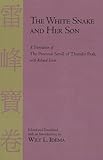
W. L. Idema. The White Snake and Her Son: A Translation of the Precious Scroll of Thunder Peak, With Related Texts. Indianapolis: Hackett Pub. Co., 2009. xxiv + 171 pp. $14.95 (paper), ISBN 978-0-87220-995-4; $44.00 (cloth), ISBN 978-0-87220-996-1.
Reviewed by Philip Clart (University of Leipzig)
Published on H-Buddhism (October, 2011)
Commissioned by Dan Lusthaus (Harvard University)
Clart on Idema
The present volume is part of a flurry of new translations of premodern popular Chinese literature by Wilt Idema of Harvard University. Five of these volumes (two of them co-authored) were published in 2009 and 2010 by Indiana-based Hackett Publishing Company, while three others appeared in 2008 and 2010 with other publishers (University of Hawai‘i Press, University of Washington Press, World Scientific). Most of these publications follow a common pattern in offering the reader translations not of one authoritative text, but of multiple versions of the same story as well as of other texts genetically related to it--a procedure uniquely suited to traditional popular literature in which narrative themes move around fairly freely, both geographically and in terms of literary genres, and are constantly being reshaped and transformed.
Most of the stories translated by Idema in this series of publications are part and parcel of the general Chinese cultural repertoire, being widely known and even today still being reworked into new versions and new genres. Stories like the legends of the White Snake, Meng Jiangnü, Mulan, Weaving Maiden, and Herding Boy have a status in the Chinese cultural sphere similar to the Grimm brothers’ fairy tales in the West. Their motifs have become archetypes that each generation uses to reflect on its values and worldview. Just like the tales of, say, Snow White and Little Red Riding Hood, they are seemingly inexhaustible subjects of retelling, reinterpretation, and commercialization. The last-named aspect now even works to merge Chinese and Western repertoires by, for example, extending Disneyfication to the legend of Mulan (cf. the Disney Studios’ 1998 animated film by the same title).
In his introduction, Idema gives a fine overview of the historical development of the White Snake narrative, including its modern adaptations in twentieth-century literature, drama, film, and cultural criticism. However, his focus is firmly placed on the premodern period, none of the translated texts dating later than the nineteenth century. In a nutshell, the story told is that of a White Snake demon, taking the shape of a beautiful woman, who falls in love with a young man. She showers him with gifts, which, being stolen, create no end of legal trouble for him. Still, they marry, but eventually the husband discovers the demonic identity of his wife and has her exorcized by a Buddhist monk. Her spirit is then imprisoned under the Thunder Peak Pagoda on the banks of West Lake in the city of Hangzhou. Later versions extend the plot by having White Snake give birth to a son, who passes the civil service examinations and eventually fulfills a vow to free his mother from her imprisonment. The abiding interest of the story is largely due to the ambiguities in the character of the protagonist, White Snake. Is she an evil demon driven by lust, who deserves to be exorcized? Is she a victim of the patriarchal system, a symbol of womanhood quashed beneath the phallic pagoda? Can she be redeemed or is she even in need of redemption? What are the psycho-analytical implications of her imprisonment by her husband and her release at the hands of her son?
The story is set in the Southern Song dynasty capital, Hangzhou, but the earliest known version only appears at the end of the Ming dynasty, in Feng Menglong’s (1574-1646) Stories to Caution the World (Jingshi tongyan) of 1624. Feng’s version emphasizes the threatening demonic nature of White Snake and does not yet contain the filial-piety themed extension involving a son of the mismatched couple. Fully elaborated versions, complete with filial son and a more sympathetic White Snake, may have already been present in the form of a Ming-period play, which unfortunately is lost. It is only in the Qing period that various permutations of the more complex story version appear.
The centerpiece of the present work, covering pages 7 to 84, is a complete translation of a late nineteenth-century prosimetric work, the “Precious Scroll of Thunder Peak” (Leifeng baojuan). Its faithful and highly readable rendition is supplemented by four nineteenth-century “youth books” (zidishu), rhymed narratives then popular in the Beijing area, and an opening piece (kaipian) of an early nineteenth-century Suzhou-region chantefable (tanci). The youth books in particular present a revaluation of White Snake, with the men opposing her cast in the roles of villain (the Buddhist monk) or weakling (the husband). An appendix contains a selection of earlier sources that may have foreshadowed the White Snake motif or at least represent similar concerns and value conflicts.
Thus, this slim volume actually contains a microcosm of premodern Chinese literature in which we see the growth and transformations of a core theme through several genres. We thereby learn much about the story of White Snake, of course, but this approach also has much to teach us about the nature and dynamics of Chinese popular literature in general--and about the methodology of its study.
If there is additional discussion of this review, you may access it through the network, at: https://networks.h-net.org/h-buddhism.
Citation:
Philip Clart. Review of Idema, W. L., The White Snake and Her Son: A Translation of the Precious Scroll of Thunder Peak, With Related Texts.
H-Buddhism, H-Net Reviews.
October, 2011.
URL: http://www.h-net.org/reviews/showrev.php?id=29763
 | This work is licensed under a Creative Commons Attribution-Noncommercial-No Derivative Works 3.0 United States License. |

