



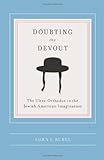
Nora L. Rubel. Doubting the Devout: The Ultra-Orthodox in the Jewish American Imagination. New York: Columbia University Press, 2010. xi + 207 pp. $79.50 (cloth), ISBN 978-0-231-14186-4; $24.50 (paper), ISBN 978-0-231-14187-1.
Reviewed by Wendy Zierler (Hebrew Union College - Jewish institute of Religion)
Published on H-Judaic (January, 2011)
Commissioned by Jason Kalman (Hebrew Union College - Jewish Institute of Religion)
Doubting the Doubt
In 2005, conservative author Wendy Shalit published a controversial review essay called “The Observant Reader” that targeted the representation of (ultra-)Orthodox Jews in contemporary American Jewish literature.[1] A former Reform Jew turned ba’alat teshuvah, Shalit harshly criticized a number of new novels for portraying “deeply observant Jews in an unflattering or ridiculous light.” Much of her essay hinged on the idea of literary outsiders versus insiders, arguing that a whole host of writers--Tova Mirvis, Allegra Goodman, Jonathan Rosen, Nathan Englander, and Tova Reich--were outsiders (or at best “outsider insiders,” having once lived within the fold, but having left), hence their unsympathetic portrayals. She contrasted what she deemed an unfair focus on religious hypocrisy in the works of these outsiders, with “insider insider” fiction by such writers as Risa Miller or Ruchama King, adherent Orthodox Jews, whose fiction “captures the subtlety and magic of [Orthodox] traditions,” according to Shalit.
Nora L. Rubel quotes from Shalit’s essay only at the very end of her book, but in many respects the book reads like a measured expansion of Shalit’s essay. To be sure, Rubel’s position on this subject is less strident, more focused on analyzing liberal anxiety about ultra-Orthodox Jews than condemning it. Unlike Shalit’s piece, her book is neither an outright defense of ultra-Orthodoxy nor an argument in favor of books about Orthodox Jews written by Orthodox Jews. That said, a good chunk of the book is dedicated to exposing the harsh representations of this community in novels and films created by nonmembers of this community. And nowhere in the book does Rubel attempt to balance the picture by examining ultra-Orthodox attitudes or writings about non-Orthodox Jews. Rubel even refers in one chapter to defector or apostate literature, casting into doubt, for example, Naomi Ragen’s credibility in her depictions of the haredi world, by saying that although she once lived as a haredi Jew, “she was not raised in the community, and she also chose to leave” (p. 107).
Like Shalit’s essay, which was provoked by a number of recent books by non-ultra-Orthodox Jews who depicted ultra-Orthodoxy, Rubel’s study responds to the rise, since 1985, of works of literature and film by non-ultra-Orthodox Jews who purport to describe the inner world of ultra-Orthodox Jewish communities. According to Rubel, prior to the mid-1980s, ultra-Orthodox characters were few and far between in Jewish literature and film. This is both true and untrue. During the 40s, 50s, and 60s, mainstream novels on this subject were relatively rare. During the early decades of the century, however, when immigrant Jews were busy acclimating to American life, portraits of Orthodox Jews were rather standard, most famously in the fiction of Abraham Cahan, Anzia Yezierska, Mary Antin, Henry Roth, and Sydney Nyburg. And even in the 1950s and 1960s, American readers were exposed to the Orthodox, through the fiction of Isaac Bashevis Singer and Chaim Grade, and through translations of the Hebrew fiction of Nobel Laureate S. Y. Agnon. In fact, a major part of modern Jewish literature since the Haskalah has been dedicated to the conflict between the traditionalists and the liberals or the secularists.
According to Rubel, the critical mass of recent works that address this sector of the Jewish community, by such authors as Pearl Abraham, Michael Chabon, Englander, Goodman, Rebecca Goldstein, Dara Horn, Mirvis, Eileen Pollack, Naomi Ragen, Reich, Anne Roiphe, and Philip Roth points to “increased anxiety about the direction of American Jewry and Orthodoxy’s visibility in American culture” (p. 17). Comparing the representations of the ultra-Orthodox in more recent fiction to that seen in such earlier works as Chaim Potok’s The Chosen (1967) and the stage version of Fiddler on the Roof, Rubel detects a shift from nostalgic to antagonist portrayals of Orthodoxy, and from anxiety about children marrying non-Jews to a countervailing anxiety about children becoming “too Jewish,” and embracing right-wing Orthodox values.
Rubel demonstrates this trend first through an analysis of two works that portray Rebbe’s daughters who choose to leave the fold because of the patriarchal strictures of the community, Erich Segal’s Acts of Faith (1992) and Abraham’s The Romance Reader (1995). The next works she examines, Ragen’s Sotah (1992) and Boaz Yakin’s A Price Above Rubies (1998), employ the gothic captivity genre, in which the female protagonists are held captive by dark, sinister, would-be pious villains who threaten the very values their community claims to uphold. By rescuing these women from their captivity in the ultra-Orthodox community, these novels imagine the rescue of the very soul of Judaism. Rubel explores the captivity theme even further through an examination of Roiphe’s Lovingkindness (1987)and Mirvis’s The Outside World (2004), novels that depict young adults who travel to Israel and become caught up in ultra-Orthodoxy through the world of the Israeli yeshiva. Israel emerges from these novels as a seductive and threatening location for conversion to ultra-Orthodoxy. The anxiety displayed in these works comes not just from secularists or liberal Jews but from modern Orthodoxy as well. The central points in these chapters--that the rift between liberal and Orthodox Jews is seen most clearly in attitudes about the place of women in Judaism and that American Jews are famously liberal and tolerant, except when it comes to ultra-Orthodox Jews--are fair and well taken. Rubel astutely identifies the search for Jewish authenticity as a core issue, noting liberal Jews’ fear that more and more the mantle of authenticity is being claimed exclusively by the Orthodox. She also correctly notes the irony inherent in modern Orthodox and liberal frustration over the rightward trend in Judaism, when so many liberal Jews choose to fund Orthodox institutions and so many modern Orthodox day schools employ teachers with ultra-Orthodox leanings.
Overall this is a lucid, well-written, and clearly argued book, one that is blissfully free of the critical jargon of so many works of literary criticism. In large measure, however, this is because it is not a work of literary criticism. The scholarly methodology at work here comes from the fields of comparative American religious studies, sociology, and history. Rubels draws on such works as Samuel Heilman’s study of ultra-Orthodoxy (Defenders of the Faith: Inside Ultra-Orthodox Jewry [2000]); Katheen Brown’s study of gender in the American colonial period (Nasty Wenches and Anxious Patriarchs: Gender, Race and Power in Colonial Virginia [1996]); and Bertram Wyatt Brown’s book Southern Honor (1982), which talks about the uses of honor in the Old South. These are interesting and valuable sources. That said, as a study of literary representation, this book would have been considerably enriched by a deeper grounding in (Jewish) literary studies. Rubel writes about Ragen and Yakin in terms of the gothic captivity narrative, but offers little to no literary or feminist critical background on the female gothic genre despite the plethora of available material.[2] When she deals with American Jewish literary representations of Israel, she makes no reference to extant critical studies of the representation of Israel in American Jewish literature.[3]
Perhaps most significant, the book lacks a certain sensitivity to the multifarious meanings of literary texts. In general, Rubel reads these novels and stories in a univalent way, mining them for quotations that capture antagonism toward Orthodox Jews, without noting the many ambivalences in the text, the sense of mystery, shifting identity, and the opening up of possibility that characterize good fiction. The best writers allow us an encounter with the ideas of the “other,” even as they dramatize conflict.
For example, in her examination of Goodman’s short story “Long Distance Client” (2005), Rubel quotes from the story to demonstrate the protagonist Mel’s marked disdain for the Orthodox--his wife has become enamored of the teachings of the Bialystocker Hasidim who have recently moved into their town of Canaan, Connecticut--and the limits of his liberalism: “When he saw the little Zylberfenig boys running across the slushy front yard, and screaming in Yiddish, their hair long and curling under black velvet yarmulkes, as big as soup bowls, their white shirts untucked and fringes flying, he felt only revulsion and embarrassment, mounting anxiety for his neighborhood, his home, and especially his wife. When it came to the fringe members of his own faith, Mel could remain calm and rational; he could not respect differences, but sped past, silently screaming.”[4]
What she does not do is situate this quotation within the context of the entire story, of which Mel’s anti-Orthodoxy is only one part. Mel is suffering not just from his wife’s attractions to religion, but also from job insecurity, chronic back pain that has him continually listing to the left (a symbolic detail, to be sure), and narcissism. He is so self-obsessed that he is completely oblivious to the fact that the wife of Bobby, the Alexander teacher who has been treating his back pain, is dying. At the end of the story, Mel eavesdrops on his Alexander teacher’s session with a “long distance client,” a mysterious moment with intimations of transcendence, communication with the dead, even God-encounter. A close reading of this story, then, and in fact, many of the texts that Rubel treats in her book, shows that they are much more slippery, ambiguous, and open to the ideas of the “other” than Rubel’s interpretations admit. Even her reading of Roth’s “Eli the Fanatic” (1959), which she quickly describes as a satirical piece “concerned with the artifice of 1950s Jewish suburbia,” that nevertheless “asserts that Orthodoxy is a remnant of the past,” is far too cursory and one-sided (p. 32). Roth’s story remains so relevant precisely because it is hard to pin down. In this story, Roth anticipated not just the anxiety about the Orthodoxy that Rubel detects in much more recent fiction, but also the attraction of Holocaust memory and Orthodox Judaism as transmitters of Jewish identity. Eli seems like a fanatic in the eyes of his suburban community, just like Barbara/Basha does in Goodman’s story, because they are both willing to assume Orthodox ways and to consider the possibility that religious observance is not merely a “remnant of the past.” And it is Eli’s perspective, that we, the readers, are invited to share, not that of the Ortho-phobic denizens of Woodenton.
Notes
[1]. Wendy Shalit, “The Observant Reader,” New York Times Book Review, January 30, 2005.
[2]. See, for example, Ellen Moers’s classic chapter on the female gothic in her Literary Women (Oxford: Oxford University Press, 1977), 90-98. For a more recent work, see Helene Meyers, Femicidal Fears: Narratives of the Female Gothic Experience (Albany: SUNY Press, 2001).
[3]. See Andrea Furman, Israel through the Jewish-American Imagination (Albany: SUNY Press, 1997); and Naomi Sokoloff, ed., “Israel and America: Cross-Cultural Encounters and the Literary Imagination,” special issue, Shofar 16, no. 2 (Winter 1998).
[4]. Allegra Goodman, “Long Distance Client,” The New Yorker, July 11, 2005.
If there is additional discussion of this review, you may access it through the network, at: https://networks.h-net.org/h-judaic.
Citation:
Wendy Zierler. Review of Rubel, Nora L., Doubting the Devout: The Ultra-Orthodox in the Jewish American Imagination.
H-Judaic, H-Net Reviews.
January, 2011.
URL: http://www.h-net.org/reviews/showrev.php?id=29713
 | This work is licensed under a Creative Commons Attribution-Noncommercial-No Derivative Works 3.0 United States License. |

