



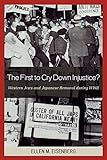
Ellen Eisenberg. The First to Cry Down Injustice?: Western Jews and Japanese Removal During WWII. Lanham: Lexington Books, 2008. xxi + 181 pp. $65.00 (cloth), ISBN 978-0-7391-1381-3; $24.95 (paper), ISBN 978-0-7391-1382-0.
Reviewed by Gina Petonito (Miami University of Ohio)
Published on H-Judaic (May, 2012)
Commissioned by Jason Kalman (Hebrew Union College - Jewish Institute of Religion)
A Fresh Take on a Well-Worn Topic
Volumes have been written about Japanese internment, yet Ellen M. Eisenberg’s book, The First to Down Cry Injustice? Western Jews and Japanese Removal during WWII, provides fresh perspective. She boldly poses a question: given that western Jews championed other minority causes, why did they not collectively oppose the removal and eventual internment of 110,000 American Japanese (Nikkei) during World War II? Answering a question that attempts to explain why something did not happen enables the author to offer new information about the relationship between Jews and the Nikkei during this period. Utilizing historical materials gathered from major West Coast centers, such as Los Angeles, San Francisco, Seattle, and Portland, Eisenberg sheds light on how western Jews negotiated Jewish identity as people of the West. In so doing, she skillfully interweaves the history of western Nikkei with that of Western Jews.
As Eisenberg notes, Jewish groups denounced prejudice and discrimination against U.S. minority groups, but their action on behalf of the western Nikkei in the face of mass removal and internment was noticeably absent. Eisenberg’s nuanced analysis explains why strong alliances between Jewish and Nikkei groups were never forged. Jews, as European immigrants, were afforded the opportunity to identify themselves as white, distancing themselves from the Asian “other.” This identity work took place against a backdrop of anti-Semitism, which they linked to the rise of fascism. Eisenberg mentions several Jewish people who publicly argued against Nikkei removal and internment, and posits that there were undoubtedly numerous additional, but undocumented, Jewish people who supported their Nikkei neighbors. Nevertheless, these individual acts did not lead to any widespread, organized Jewish opposition to internment.
In chapter 4, Eisenberg’s most startling revelation is that the Los Angeles Jewish Community Committee (LAJCC) was not just silent but complicit in the national campaign to intern the Japanese. Eisenberg documents how the LAJCC executive secretary Leon Lewis worked hand in hand with Martin Dies, the chair of the House Committee on un-American Activities (the Dies Committee), which produced the notorious Yellow Paper that provided key justifications for the internment program. One of Dies’s major sources was the News Research Service’s (NRS) News Letter that activists fighting against internment, such as Congressman Vito Marcantonio, as well as later internment scholars such as historian Peter Irons, assumed was an obscure anti-Asian group outlet. However, Eisenberg reveals that the NRS was the public dissemination arm of the LAJCC.
While the LAJCC never openly promoted internment, it never spoke against it either, ostensibly giving the order tacit approval. To understand this position, Eisenberg traces the committee’s history beginning in 1934 as a coalition of Los Angeles Jewish organizations. It aimed to combat un-Americanism by fighting anti-Semitism. Publicizing the anti-Semitic and fascist activities it uncovered in the News Letter was one of several strategies the committee employed. Its relationship with the Dies Committee, Eisenberg writes, was long-standing and a natural outgrowth of its fight against anti-Semitism. In fact, early NRS reporting exposed Dies’s supposed allies as virulent anti-Semites, leading him to expand his campaign against un-Americanism to include both communists and fascists. This expansion worked in the LAJCC’s, favor allowing anti-Semitism to be linked with anti-Americanism more broadly. So, the LAJCC and Dies became allies in the fight against fascism, which led to their investigations into the Nikkei community.
Eisenberg’s careful reading of multiple editions of the News Letter reveals that LAJCC’s commitment to combating fascism began prior to the Pearl Harbor attack and the Nikkei was but one group that attracted its attention. However, after Pearl Harbor, the News Letter published a comprehensive summary of the pro-Japanese activity of Nikkei institutions, such as the language schools and newspapers, along with allegations of their ties to pro-Nazi groups and their ability to conceal their “true” sentiments from “Occidental” observers. While the News Letter was distributed to other Jewish groups during that period, Eisenberg claims that its impact in that community remains unclear. However, she argues that the News Letter reports had a broad influence. The information provided for the Dies Yellow Paper released during the Tolan Committee hearings shaped the discourse regarding Nikkei loyalty to the U.S. during the critical months after Pearl Harbor. The Yellow Paper also influenced General DeWitt’s 1943 Final Report, as well as the Supreme Court’s 1943 opinions upholding restrictions on the Nikkei in the Hirabayashi case.
The LAJCC’s active involvement in the internment debate was a unique example, since the more common stance among Jewish organizations was silence. However, Eisenberg distinguishes the LAJCC’s motivations from nativist anti-Japanese groups, such as the Native Sons of the Golden West. The LAJCC did not harbor long-standing hostility towards the Nikkei community per se, but was focused on identifying and eliminating any fascist activities within that community.
Eisenberg analysis of Jewish groups’ silence or tacit support for Nikkei internment is compelling. Yet, some may contend she bases her arguments more on supposition than fact. For example, she claims that the LAJCC members were motivated to act against fascism because of their “anxieties” about the rise of domestic and global fascism and their feelings of “insecurity” in this new world (p. 136). An alternative argument could be that the LAJCC members took a hard, but principled stance against fascism, even if it meant targeting a minority group. A more structural analysis might note the absence of social movement organizational structures among the silent Jewish groups, such as funding or a past history of working alliances with the Japanese, for example. However, this is a minor concern and perhaps a research direction for other scholars to pursue. Eisenberg’s well-documented analysis reveals a heretofore hidden chapter in the history of minority relations in the U.S. The book provides insight into the unique position western Jews held in the U.S. prior to and during World War II as well as documenting their relationship with the western Nikkei during a dark moment in U.S. history.
If there is additional discussion of this review, you may access it through the network, at: https://networks.h-net.org/h-judaic.
Citation:
Gina Petonito. Review of Eisenberg, Ellen, The First to Cry Down Injustice?: Western Jews and Japanese Removal During WWII.
H-Judaic, H-Net Reviews.
May, 2012.
URL: http://www.h-net.org/reviews/showrev.php?id=29552
 | This work is licensed under a Creative Commons Attribution-Noncommercial-No Derivative Works 3.0 United States License. |

