



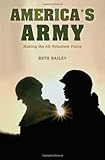
Beth L. Bailey. America's Army: Making the All-Volunteer Force. Cambridge: Belknap Press of Harvard University Press, 2009. Illustrations. xi + 319 pp. $29.95 (cloth), ISBN 978-0-674-03536-2.
Reviewed by J. Garry Clifford
Published on H-War (February, 2011)
Commissioned by Janet G. Valentine (U.S. Army Command and General Staff College - Dept of Mil Hist)
This superb study demonstrates why social and cultural historians should pay more attention to military history. The author of previous books on the history of dating and on the sexual revolution in Kansas, Beth L. Bailey recounts the checkered history of the all-volunteer army from President Richard M. Nixon’s opportunistic promise to end the draft during the divisive Vietnam War to the current travails of fighting simultaneous wars in Iraq and Afghanistan with an overstretched mix of enlistees, reservists, and civilian mercenaries. She shows in vivid detail how the army adapted to new conditions, how it overcame its reliance on draftees and entered the consumer and labor marketplace to attract volunteers by selling service as opportunity rather than obligation, how it relied increasingly on women and African Americans to fill the ranks, how key innovators such as General Max Thurman successfully rejuvenated the “all-recruited army” of the Reagan era, and how after 9/11 the army refurbished its “Warrior ethos” in order to fight “for the first time in its modern history ... an extended war with a volunteer force” (p. 244).
Throughout her study Bailey emphasizes that the military has been a principal arena in which America’s struggles over race, gender, and social justice have played out in the past half century. For example, recruiting commercials, such as “Today’s Army Wants to Join You,” “Be All That You Can Be,” “Some of Our Best Men Are Women,” and an “Army of One,” stressed the language of opportunity and equality, even as the military pondered how best to integrate more women into new roles and stood firm on a “Don’t Ask, Don’t Tell” policy toward gays. In the mid-1990s, writes Bailey, the army was marketing itself as “the embodiment of the American dream of full inclusion and equal opportunity ... a force for good in civilian society ... a creator of good citizens, of good employees, and of good leaders” (p. 206). By 2007, statistics indicated that the war in Iraq was not being fought “on the backs of the poor and black” but that the army’s rank and file were “fairly solidly middle class” with a quarter of enlistees coming from families with incomes in the highest 20 percent and with only 11 percent drawn from “the bottom quintile” (p. 258). When the Supreme Court considered the legitimacy of affirmative action for admission to the University of Michigan in 2003, retired army generals “weighed in heavily” in support of racial diversity (p. 215). In short, despite recurrent calls for a return to the draft, an institution that “once seemed mired in crisis has achieved remarkable successes, both as purveyor of military force and provider of social good” (p. 260).
Perhaps Bailey’s most significant discussion involves the ideological rationale for the all-volunteer force wherein a group of libertarian economists, headed by Martin Anderson, persuaded President Nixon to end the draft with two major arguments, namely, that “individual liberty is the most essential American value, and the free market is the best means to preserve it” (p. 33). Nixon added his own rhetorical flourish by claiming that “upholding the cause of freedom without conscription” would demonstrate “the superiority of a society based upon the dignity of man over a society based on the supremacy of the State” (p. 32). Antiwar activists also condemned the draft because of its alleged unfair deferment practices and because they believed that readily available manpower through conscription made it easier for presidents to wage misguided wars like Vietnam. Some observers worried that an all-volunteer force would refute the maxim that military service was on obligation of citizenship and ignored issues of fairness and shared sacrifice. With only 6 percent of Americans under the age of sixty-five having any experience in the military by the new century, it was not surprising that the unpopular war in Iraq sparked far fewer protests than when the draft touched, at least potentially, nearly every American family. Even though young American males still register for a standby selective service system (an ironic legacy of President Jimmy Carter’s response to the Soviet invasion of Afghanistan), nothing short of a large-scale protracted war will suffice to reinstitute the draft. Nonetheless, as Bailey notes, “there is something lost when individual liberty is valued over all and the rights and benefits of citizenship become less closely linked to its duties and obligations” (p. 260). As more and more Americans prefer to “bowl alone,” in political scientist Robert Putnam’s famous phrase, so too does America’s army mirror our increasingly individualistic society.
If there is additional discussion of this review, you may access it through the network, at: https://networks.h-net.org/h-war.
Citation:
J. Garry Clifford. Review of Bailey, Beth L., America's Army: Making the All-Volunteer Force.
H-War, H-Net Reviews.
February, 2011.
URL: http://www.h-net.org/reviews/showrev.php?id=29511
 | This work is licensed under a Creative Commons Attribution-Noncommercial-No Derivative Works 3.0 United States License. |

