



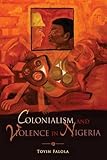
Toyin Falola. Colonialism and Violence in Nigeria. Bloomington: Indiana University Press, 2009. xxii + 231 pp. $65.00 (cloth), ISBN 978-0-253-35356-6; $24.95 (paper), ISBN 978-0-253-22119-3.
Reviewed by Steven Pierce (University of Manchester)
Published on H-Africa (July, 2010)
Commissioned by Brett L. Shadle (Virginia Tech)
Colonial Antecedents to Nigerian Violence
Anyone following the news is aware of political violence in Nigeria. From the recurrent ethnic violence in Jos to continuing conflict in the Niger Delta, violence has become a near-constant feature of public life--a “political instrument,” as Patrick Chabal and Jean-Pascal Deloz suggested for disorder in African politics more generally.[1] In his book Colonialism and Violence in Nigeria, Toyin Falola argues the roots of this violence lie in those of the Nigerian state itself. Nigeria was created through colonial conflict: myriad wars and battles brought the region’s peoples under British rule. Continued violence and the threat of violence enforced the new rulers’ demands. Colonial rule was challenged through violence, and ultimately the threat of violence drove late colonial political change and eventual independence. The cost of this history is high. The colonial state had no intrinsic legitimacy, and it ruled through fear rather than consent. Falola suggests colonialism was tutelary, but only perversely: Nigeria’s public culture was constituted through, in response to, and naturally inclining to commit, violence. The consequences have been deadly.
This is an important topic, and it would take a scholar of Falola’s prodigious range to do it justice. Indeed, the volume he has produced provides a useful and readable overview to the problem. The chapters are thematic, though they progress roughly chronologically. The first three examine colonial conquest, strategies of resisting British advances, and the role of terror in establishing political control. Falola’s narrative (and, to some extent his analytic) strategy is anecdotal, moving from one instance of violence to another, though he intersperses this event history with general commentary about overarching trends. Thus for example, Falola develops a vivid account of the Ekumeku wars of guerrilla resistance to the British occupation of western Igboland. In only a few pages (pp. 35-38) he sketches a compelling history of a concerted military effort coordinated by a loose collection of male associations that bedeviled the last years of Royal Niger Company administration and the first several of direct British rule. While the narrative is largely anecdotal--and is based two secondary works[2]--Falola also develops a rather deeper point: while British violence in this period was largely ad hoc and patterned by Victorian scientific racism, the new result was a quite systematic drive for colonial control. The Colonial Office and the British public insisted on a humanitarian face for the empire’s African endeavors, but this did little to prevent a practical brutality that systematically terrorized the Nigerian countryside. Collectively these opening chapters develop a useful and accessible portrait of the violence of early colonialism, as well as the ways in which authorities in the metropole both fostered and remained aloof from the atrocities committed on their behalf.
Subsequent chapters examine the role of violence in tax collection, gendered violence, the rhetoric of nationalism, and trade unionism. Again, while the narrative approach is anecdotal, Falola does make important claims. In outlining how very violent the imposition of systematic taxation was, Falola suggests Nigerian colonialism attempted a radical restructuring of Nigerian societies, one which was vociferously resisted. In doing so, colonial officials also learned the limits of their power, which ultimately forced a greater degree of accommodation and consultation--a point given added force through the extended account of the Aba women’s war, which makes up the entire chapter on gender. The chapters on nationalism and trade unionism are less ambitious and in the end demonstrate primarily that Nnamdi Azikiwe’s “Zikist” followers employed violent rhetoric and that strikes were often put down rather violently.
The book is filled with powerful reminders of colonialism’s brutality, and its accessible narrative will make attractive course readings. However, its main analytic conclusions about the colonial roots of today’s violence in Nigerian political culture demand further development. The narrative choice to structure the book around case studies of violence is useful, and it certainly aids accessibility. But too little is done to justify the choice of cases or to deal systematically with violence as a phenomenon. Colonialism and Violence takes little account of recent work on violence or even recent developments in Nigerian historiography. This is troublesome to the extent that it precludes a more complex appreciation of the phenomena the book attempts to engage. Given that the book is largely based on secondary literature, Falola’s failure to take recent work into accounts detracts from its ability to represent the field. The chapter on gender demonstrates these problems most clearly. The chapter is necessary: colonialism was shot through with gendered violence, from the exploitation of women displaced by colonial warfare to the structural violence targeting women in British-driven social change. The Aba women’s war is a fascinating instance of gendered resistance (one with an exciting historiography Falola largely ignores), but it is at best an atypical example of how violence was gendered in colonial Nigeria. I would have been very grateful to see Falola apply the insights of, for example, Nwando Achebe, Oyeronke Oyewumi, and Ifi Amadiume to the general problematic of colonial violence.
Too often, Falola’s analysis descends to statements of the obvious (“the wars involved tactics, strategies, and impacts” [p. 19]). And the provocative claim that contemporary violence has emerged directly from colonial statecraft is never directly demonstrated. In the end, Falola has produced a compelling and troubling compendium of instances of colonial violence. He has also made a provocative, potentially useful suggestion about its present-day consequences. But for the moment, there the analysis rests.
Notes
[1]. Patrick Chabal and Jean-Pascal Deloz, Africa Works: Disorder as Political Instrument (Bloomington: Indiana University Press, 1999).
[2]. Don C. Ohadike, The Ekumeku Movement: Western Igbo Resistance to the British Conquest of Nigeria, 1883-1914 (Athens: Ohio University Press, 1991); and Philip Igbafe, “Western Igbo Society and Its Resistance to British Rule: The Ekumeku Movement, 1898-1911,” Journal of African History 12, no. 3 (1973): 441-459.
If there is additional discussion of this review, you may access it through the network, at: https://networks.h-net.org/h-africa.
Citation:
Steven Pierce. Review of Falola, Toyin, Colonialism and Violence in Nigeria.
H-Africa, H-Net Reviews.
July, 2010.
URL: http://www.h-net.org/reviews/showrev.php?id=29504
 | This work is licensed under a Creative Commons Attribution-Noncommercial-No Derivative Works 3.0 United States License. |

