



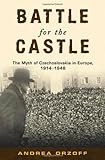
Andrea Orzoff. Battle for the Castle: The Myth of Czechoslovakia in Europe 1914-1948. New York: Oxford University Press, 2009. xi + 286 pp. $74.00 (cloth), ISBN 978-0-19-536781-2.
Reviewed by Tara Zahra (University of Chicago)
Published on HABSBURG (March, 2010)
Commissioned by Jonathan Kwan (University of Nottingham)
The Propaganda Revolution: Nation-building as Public Relations in Interwar Europe
The break-up of the Austrian Empire in 1918 was described by contemporaries and has since been described by historians as a revolution: a moment of triumph for the Wilsonian principles of democracy and national-self determination. In Battle for the Castle, Andrea Orzoff makes a compelling case that this was no ordinary revolution, however. Czechoslovakia, she argues, was not made on the barricades, the battlefield, or in the halls of parliament. It was above all a product of myth and propaganda.
Orzoff’s Czechoslovakia was constructed, defined, and sustained in the newspapers and universities of London and Paris as well as in Prague. It was bought and paid for through Czech government support of foreign academics and journalists: no less than twenty-six newspapers, press agencies, and radio stations in France alone were on the government’s payroll. Its meaning was debated in literary salons and international writers' congresses. And its ideals were disseminated in books produced by Czechoslovakia’s government-subsidized publishing house and in the genteel quarters of the state’s elite social club. “Admiring works of history were kept in print; concerts of music by national composers were given, and social occasions were carefully arranged, both in Great Power and East Central European capitals. The propagandistic stakes were high; the very existence of these states seemed predicated on it,” Orzoff argues (p. 8).
Battle for the Castle is a stimulating and imaginative history of statecraft in interwar Czechoslovakia, focused on the role of propaganda and myth in the First Czechoslovak Republic. But the importance of this study extends far beyond Czechoslovakia’s contested borders. First, this is a story about the struggle to define the meaning of “Europe” between the wars, as every Habsburg successor state “cited its adherence to European cultural norms as proof of its moral worthiness, and thus its defense by the Great Powers” (p. 9). Second, as Orzoff argues, the fate of Czechoslovakia was inextricably linked to the fate of the post-Versailles settlement itself. “East-Central European revisionists understood that if Czechoslovakia fell, the entire system of postwar treaties and the post-Versailles order in Europe might be called into question; the Czechs worked from the same assumption” (p. 173).
The central protaganist in Orzoff’s study is not an individual, a political party, or a movement, but “the Castle,” named after Prague Castle. The Castle was more than the seat of government: it was a unique set of institutions and alliances crafted by Czechoslovak president Thomas Garrigue Masaryk and the foreign minister Edward Beneš. It included formal government institutions, like the Third Section of Beneš’s Foreign Ministry, which was charged with gathering intelligence and producing propaganda. But it also included a publishing house, the Spoločenský club, and a group of intellectuals, writers (for example Karel Čapek), publishers, and journalists who disseminated the Castle’s vision of Czechoslovakia at home and abroad.
Every nation has its myths, but the Czechoslovak myth was particular in its insistence on the essentially democratic nature of the Czech nation and people. Orzoff describes the myth succintly: “Czechs were as Western in their values and in their political inclinations as the Westerners themselves: they were Enlightenment rationalists yearning to be free from Austrian repression. They ought to be joined with their fellow Slavs, the Slovaks, to lead an East European state that was dedicated to tolerance, egalitarianism, and human rights, and was capable of joining with the West. Not coincidentally, this same state, with Western support, might help withstand German aggression and contain Bolshevik social radicalism” (p. 24).
National myths and cultural politics have been a central theme of nationalism studies ever since Eugen Weber, Benedict Anderson, Eric Hobsbawm, and Terence Ranger began to dissect the notion of the nation as a primordial entity. But Orzoff takes us beyond the “imagined community” in several refreshing ways. First, she attends as much to the institutional dynamics of myth-production as to the ideological contents of the Czechoslovak myth. This perspective enables us to better understand how Czechoslovak propaganda was financed, produced, and disseminated, why it succeeded or failed. She dissects the Castle myth through a nuanced reading of feuilletons, history books, photos, and biographies of Masaryk. But she also analyzes the words and ideas of those who opposed the Castle domestically and abroad--the party bosses who formed the so-called Pětka; the right-wing politicians in the National Democratic Party, Agrarian Party, and Czech fascist movement; and Czechoslovakia’s opponents abroad.
Battle for the Castle is particularly original in its treatment of the international dimensions of nation-building. Orzoff convincingly demonstrates how domestic and international struggles for legitimacy were intertwined in interwar Europe. Her understanding of cultural diplomacy extends beyond a bilateral analysis of relations between Czechoslovakia and the Great Powers. A fascinating section of the book looks at the Castle’s battle with Lord Rothermere (Harold Harmsworth), a former British minister of aviation, anticommunist, and media tycoon who launched a vociferous propaganda campaign against Czechoslovakia (on behalf of the Hungarians) on the pages of the Daily Mail in 1927. Another section describes a six-year struggle between the Prague and Budapest sections of the international P. E. N. club, waged over the issue of censorship of the Hungarian press in Slovakia. Embedded in this history of cultural diplomacy and conflict is the story of western Europe's gradual disengagement from east-central Europe. Ultimately, she concludes, “Castle rhetoric met with West European suspicion or indifference” (p. 172). Among elites in Britain in particular, sympathy for Sudeten German and Hungarian revisionism grew in the 1930s.
Given Orzoff’s attention to the international dimensions of Czechoslovak myth-making, it is somewhat surprising that the propaganda efforts of the German minority community (or of Weimar and Nazi Germany) are not more central to her story. Czechoslovakia was rhetorically defined in opposition to the Austro-Hungarian empire, and Czech nationalists defined themselves in opposition to their German neighbors. Czechoslovak propaganda and cultural diplomacy evolved in a heated conversation with the tracts, petitions, and press disseminated by German nationalist movements between the wars. Moreover Czechoslovak-German nationalists also claimed the mantle of democracy, national self-determination, and cultural superiority as they lobbied the Great Powers, the League of Nations, and their own domestic allies and foes.
Czech and German propagandists were in fact engaged in a struggle to define democracy itself, and Battle for the Castle is an important contribution to the history of interwar democracy. A number of works have begun to historicize the concept of democracy in Czechoslovakia (and in Europe more broadly) between the wars.[1] Rather than passing judgment on whether Czechoslovak national myths were true or false, Orzoff dissects what the term democracy meant to the architects of Czechoslovak political culture. Masaryk, she argues, “used the term imprecisely, referring to an idealized state and society, rather than to legal or formal characteristics such as universal suffrage and free elections” (p. 30). “My goal was religious and moral: politics was just an instrument,” Masaryk affirmed at the end of his life.
Indeed, Czechoslovak democracy was overwhelmingly embodied in the figure of Masaryk himself, Orzoff suggests. It is therefore fitting that she devotes substantial attention to what she calls the “Masaryk myth,” a leader cult that ironically elevated Masaryk to king-like status. Images of Masaryk, Orzoff demonstrates, consciously or unconsciously channeled Franz-Joseph; in spite of the fact that the Castle officially disavowed similarities between Austria-Hungary and Czechoslovakia. Orzoff provocatively suggests that leadership cults are characteristic of democracies as well as dictatorships. But while the Masaryk cult was not enforced through censorship or repression, as in neighboring fascist states, she speculates that “the kingly emphases in the cult might have legitimated the speedy dismantling not just of Masaryk’s republic but of its democratic structure in 1938-39” (p. 131).
Significantly, the Masaryk cult may have been the most enduring and successful element of the Castle myth. George Bernard Shaw even remarked in 1935 that Masaryk would be the ideal president of a hypothetical United States of Europe. And even as Czechoslovakia itself was dismembered, along with Czech faith in the West, the cult of Masaryk survived. Following the Second World War, it was appropriated across the political spectrum during the short-lived Third Republic (1945-48). Even Communist officials such as Václav Kopecký argued that Masaryk had “a beautiful relationship with the workers” (p. 209). After 1948, the cult of Masaryk survived in exile, cultivated by émigrés in American universities. It was easily revived in the post-Communist Czech Republic, as Václav Havel and his colleagues sought a usable past in the First Republic.
The question of whether and how Czechoslovak cultural diplomacy and propaganda “mattered” is more difficult to answer. It was clearly successful in shaping enduring images of the Czech nation at home and abroad, although understanding how deeply the Castle myth penetrated Czech society would require a different kind of study. As Holly Case has argued, Hungarian and Romanian diplomats were also convinced that Czechoslovak propaganda was a slam-dunk success: they spent the interwar years and the Second World War attempting to mimic the Castle’s public relations efforts in a bitter contest to win the prize of Transylvania.[2]
But following the money tells a less triumphant story, one in which Great Power status, military might, and financial resources mattered more than so-called soft power. In 1933, for example, Germany spent 256 million francs on international propaganda, France 74 million francs, Poland 26 million, and Czechoslovakia only 18 million. And in the ten years between 1938 and 1948, east European populations were transferred, borders shifted, and states violently made and unmade through the executive decisions of Adolf Hitler, Josef Stalin, Winston Churchhill, Franklin Roosevelt, and Harry Truman. Orzoff ultimately concludes that east-central European propaganda may not have mattered much in the realm of Realpolitik, given the extent to which the international cards were stacked against Czechoslovakia. One question that Orzoff’s book therefore raises is the extent to which the interwar era was the heyday of a particular kind of cultural diplomacy, an art of statecraft that died with the League of Nations and the Versailles settlement itself.
Whatever the legacies of interwar mythmaking in the realm of international politics, the Castle myth was and remains central to the self-understanding of Czech elites and to images of Czech culture abroad. Battle for the Castle is an important, engaging, and lucid study of Czechoslovakia’s political culture, and of its struggle for legitimacy. It offers convincing answers to the question of how eastern Europe’s new democracies were made and unmade between the wars, and will be essential reading for anyone who hopes to understand the vexed history of democracy and nation-making in twentieth-century Europe.
Notes
[1]. See especially Melissa Feinberg, Elusive Equality: Gender, Citizenship, and the Limits of Democracy in Czechoslovakia, 1918-1950 (Pittsburgh: University of Pittsburgh Press, 2006); Peter Bugge, “Czech Democracy 1918-38: Paragon or Parody?” Bohemia 47, no. 1 (2006-2007): 3-28.
[2]. Holly Case, Between States: The Transylvanian Question and the European Idea during WWII (Stanford: Stanford University Press, 2009).
If there is additional discussion of this review, you may access it through the network, at: https://networks.h-net.org/habsburg.
Citation:
Tara Zahra. Review of Orzoff, Andrea, Battle for the Castle: The Myth of Czechoslovakia in Europe 1914-1948.
HABSBURG, H-Net Reviews.
March, 2010.
URL: http://www.h-net.org/reviews/showrev.php?id=29493
 | This work is licensed under a Creative Commons Attribution-Noncommercial-No Derivative Works 3.0 United States License. |

