



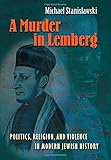
Michael Stanislawski. A Murder in Lemberg: Politics, Religion, and Violence in Modern Jewish History. Princeton: Princeton University Press, 2007. 152 pp. $21.95 (cloth), ISBN 978-0-691-12843-6.
Reviewed by Sam Johnson (Manchester Metropolitan University)
Published on HABSBURG (May, 2010)
Commissioned by Jonathan Kwan (University of Nottingham)
Reform, Conflict and Violence in the Jewish Community of Lemberg
On May 3, 1847, the Austrian government appointed Bohemian-born Abraham Kohn Kreisrabbiner (chief rabbi) of Lemberg, Galicia (today L'viv, in Ukraine). At this moment, the tang of rebellion hung in the air throughout the lands of the Habsburg Empire and, before long, it was engulfed in the drama of the so-called Springtime of the Peoples. At first glance, these events appear to have little in common by way of historical significance. The first was of passing importance to perhaps a handful of Jews in the most impoverished part of the Austrian Empire. The second, in contrast, bore international and domestic ramifications for many decades to come. Yet each was undoubtedly revolutionary, reflective of the inroads made by modernity into both Jewish and non-Jewish Austrian society. Kohn was a modernizer and a reformist, whose installation in Lemberg, a city with a large and fractured Jewish community, immediately caused controversy and outrage among its traditionalist sections. In little over a year, Kohn was dead, murdered, along with his infant daughter, by arsenic poisoning. His assassin, it was alleged, was a member of the traditional Lemberg community, one Abraham Ber Pilpel, who apparently tipped the poison into the family soup pot.
Michael Stanislawski, a distinguished historian of the Jewish experience in tsarist Russia, has examined this murder mystery not simply to allocate guilt but also to try and understand the complexities of Jewish life in the Austria of the 1840s, and to "break the stereotype of East European Jewry and underscore its religious diversity" (p. 2). In this aim, Stanislawski reveals one of the key problems in teaching Jewish history to a non-Jewish audience, for whom the word "orthodox" apparently serves as an all-embracing descriptor, especially when dealing with nineteenth-century Eastern Europe. But, as Stanislawski shows, in 1840s Lemberg the Jewish community was wracked with internal dissension and rivalries, preoccupied with a myriad of halakhic matters, and for a sizeable proportion, whose vernacular language was often German, "orthodox" represented backwardness, mysticism, and the retention of anachronistic rituals. This part of the community was responsible for inviting, in 1843, Kohn to take up the post of preacher and teacher at the soon-to-be built reform synagogue. Four years later, following the synagogue's consecration, Kohn's inaugurating sermon, delivered wearing garb more akin to that of a Catholic priest than an Eastern European rabbi, and subsequent appointment as Kreisrabbiner, led the traditionalists among Lemberg's community to be thrown into a "frenzy" of indignation and despair (p. 60).
For the next year, Kohn was the target of a range of attacks from traditionalist Jews, who accused him of being "totally ignorant of the Talmud and its laws" (p. 71). Pamphlets were distributed; various malicious rumors abounded, including that, among other things, Kohn ate nonkosher food; and in January 1848, a small gang of traditionally attired Jews physically attacked him, though he refused to press charges. By this stage, the 1848 revolution had spread to Lemberg, and Kohn, alongside other Jews, participated in the clamor for political and civil rights. Given the heightening general atmosphere, it comes as no surprise that Kohn's opponents also stepped their animosity up a gear and in April a mob attacked his residence. In September, placards were pasted onto the walls of the city's Orthodox synagogue, which berated Kohn as poshea yisreal--a renegade, a sinful Jew (p. 74). Then, just a few days later, a stranger entered the Kohn kitchen and poured arsenic into the soup. A reformist speaker at the rabbi's funeral passionately indicted the "wild cannibal lust of a poisoner in a Jewish caftan" (p. 75).
For the Austrian authorities, the shade of suspicion was immediately cast on Pilpel, a goldsmith, who had brought attention to himself by entering a barbershop and asking for his sidelocks and beard to be shaved (a remarkable request for an Orthodox Jew). He was arrested, alongside two other figures, who were indicted as coconspirators--Hirsch Orenstein and Jacob Herz Bernstein, two prominent and wealthy Orthodox community members. Initially, Pilpel was found guilty and sentenced to twenty years hard labor by the Lemberg Criminal Court, but following the case's transference to the District Appellate Court, the specially appointed judge deemed that there was insufficient evidence in the case. Pilpel was released, as were Orenstein and Bernstein. Subsequently, Rabbi Kohn's widow, Magdalena, attempted to appeal against the judgment at the Imperial Supreme and Cassation Court in Vienna, but it was rejected.
Notwithstanding the dearth of decisive evidence, Stanislawski concludes that while Pilpel was Kohn's assassin, he was merely the hired hit man in a conspiracy launched and paid for by Bernstein and Orenstein, who were impelled in committing their crime by "a combination of financial self-interest and religious zealotry" (p. 113). In this aspect, it is the motivations behind the murder that fascinate Stanislawski most of all, since, in his view, Kohn's assassination represents "a radical new departure in Jewish history" (p. 114). Hitherto, the only instances that witnessed the communal sanction of murder concerned informers, but in Kohn's case, he was condemned to death because he was a heretic: "for the first, but alas not the last, time [since antiquity] we encounter the murder of a Jewish leader by another Jew on the basis of political-cum-religious motivations" (p. 118).
A Murder in Lemberg is a comparatively short tome, yet, for the most part, it packs a powerful punch. And it is a testament to Stanislawski's skill that what might initially appear to be a parochial, if somewhat shocking, event, relevant only to its own time and place, is rendered of broader and potent meaning. However, the challenge here was the Habsburg context and Stanislawski's foray into unfamiliar territory. As a consequence, there are some factual errors in the opening two chapters, devoted to the history of Galician Jewry and the city of Lemberg. Nevertheless, this is a first-rate microstudy that deserves attention beyond the academy.
If there is additional discussion of this review, you may access it through the network, at: https://networks.h-net.org/habsburg.
Citation:
Sam Johnson. Review of Stanislawski, Michael, A Murder in Lemberg: Politics, Religion, and Violence in Modern Jewish History.
HABSBURG, H-Net Reviews.
May, 2010.
URL: http://www.h-net.org/reviews/showrev.php?id=29369
 | This work is licensed under a Creative Commons Attribution-Noncommercial-No Derivative Works 3.0 United States License. |

