



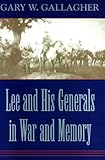
Gary W. Gallagher. Lee and His Generals in War and Memory. Baton Rouge: Louisiana State University Press, 1998. xvi + 298 pp. $27.95 (cloth), ISBN 978-0-8071-2286-0.
Reviewed by Phyllis F. Field (Department of History, Ohio University)
Published on H-CivWar (March, 1999)
Lee and His Generals
Gary Gallagher is well known as one of the most prolific and productive military historians of the Confederate military experience. In this, his sixteenth book either authored or edited, he brings together thirteen of his essays, eleven of which have been previously published. While such collections often lack thematic unity, this is not the case here. Nearly all of these essays in one way or another are a tempered response to the breakup of the Lost Cause interpretation of Confederate military history.
As Gallagher recounts in "Jubal A. Early, the Lost Cause, and Civil War History: A Persistent Legacy," the thoroughly unreconstructed Early took a great interest in how future generations would view the Confederacy. Over the remainder of his lifetime he interpreted his experiences in the Army of Northern Virginia, praising Robert E. Lee and Stonewall Jackson above all generals, emphasizing the importance of the eastern theatre, and tracing southern defeat to overwhelming odds not the superiority of Yankee generals. He promoted the publication of other similar memoirs in the Southern Historical Society Papers. While Thomas L. Connelly's exposure of Early's questionable motivations in The Marble Man: Robert E. Lee and His Image in American Society (1977) has led to a spate of revisionist writing reevaluating Lee, the primacy of the eastern theatre, and southern generalship generally, Gallagher attributes the long persistence of Lost Cause views to key truths within the mythology. In his words, "Robert E. Lee was a gifted soldier who inspired his army to accomplish prodigious feats on the battlefield. The army of Northern Virginia and other Confederate forces consistently fought at a disadvantage in numbers and of materiel... Many people at the time--northern, southern, and European--looked to Virginia as the crucial arena of the war," (pp. 211-12).
The thrust of Gallagher's argument is that the truth lies between the extremes of the Lost Cause and revisionist interpretations. Most of these essays consist of efforts to reconstruct for individual campaigns or generals a happy medium by comparing the Lost Cause memories of participants to primary sources from the war itself. Gallagher's essays are models of clear exposition, and it is easy to follow the reasoning to leads to his judgments, even if at times the primary sources are a bit more ambiguous than he allows.
Gallagher begins the collection with an original essay on Robert E. Lee, countering some of the recent criticisms of Lee's manpower-depleting preference for the offensive. In Gallagher's view Lee's popularity kept the Confederates going long after the military situation was hopeless, but his popularity was in turn connected to his aggressiveness. Lee did not become a southern hero until after his aggressive attacks on McClellan in 1862. The succeeding three essays evaluate Lee at Antietam, Gettysburg, and in the Grant campaign in May 1864. The Antietam essay, a heavily revised version of two previous essays, is a particularly fine assessment of that battle and Lee's successes and failures there. The Gettysburg piece admits that Lee's aggressiveness turned out to be mistaken but in Gallagher's view was still reasonable. The final essay in this section attributes Lee's problems in the spring of 1864 to the depletion of the high command of Confederate officers.
Gallagher devotes seven essays to Lee's subordinates. He sees Stonewall Jackson's legendary status deriving from his perceived personality and tragic death as much as his military record which contained some nonstellar performances. This contrasts to John B. Magruder whose intemperance and other sins made him a likely scapegoat for Confederate disappointments in the Seven Days. Longstreet's postwar unpopularity likewise led to unfair efforts to downgrade his performance at Second Manassas. Jackson's death at Chancellorsville made A. P. Hill and Richard S. Ewell likely victims of unfair comparisons to Jackson at Gettysburg; Gallagher suggests Lee bears some of the blame for Confederate indecision on the first day of the battle. Jubal Early faced the same problem of comparison to Jackson in the Valley campaign of 1864. The Lost Cause gave Early a way to salvage his honor, however. LaSalle Corbell Pickett, the widow of the general, found another way to reinvent the past, plagiarizing other soldiers' memoirs to write the fictitious letters in Heart of a Soldier (1913), supposedly written by her husband.
In the final two essays Gallagher looks at the longer shadow of the Lost Cause. He finds Ken Burns in the PBS series on the Civil War guilty of succumbing to it in part. But he is most shocked by the willingness of some professional historians to dismiss battlefield preservation because of the association of so many eastern battlefields threatened with nearby economic development with Lost Cause imagery. Gallagher argues passionately that battlefields can be used not just to talk about the battles and generals but issues such as the war's causation, emancipation, women's work, homefront morale, foreign diplomacy, etc. Ironically, these issues rarely surface in his own essays. Gallagher suggests in his preface a need to bring together the interested layperson and professional scholar, the social historian and military historian. This is easier said than done, however. Excellent writer though he is, most of Gallagher's essays are suited to a professional audience of traditional military historians. Perhaps only an aggressive frontal assault on the issues of race, class, and party division hidden behind romantic visions of the war can break the deadlock. Perhaps not.
Copyright (c) 1999 by H-Net, all rights reserved. This work may be copied for non-profit educational use if proper credit is given to the author and the list. For other permission, please contact <h-net@h-net.msu.edu>. [The book review editor for H-CivWar is Robert F. Pace <rpace@longwood.lwc.edu>].
If there is additional discussion of this review, you may access it through the network, at: https://networks.h-net.org/h-civwar.
Citation:
Phyllis F. Field. Review of Gallagher, Gary W., Lee and His Generals in War and Memory.
H-CivWar, H-Net Reviews.
March, 1999.
URL: http://www.h-net.org/reviews/showrev.php?id=2917
Copyright © 1999 by H-Net, all rights reserved. H-Net permits the redistribution and reprinting of this work for nonprofit, educational purposes, with full and accurate attribution to the author, web location, date of publication, originating list, and H-Net: Humanities & Social Sciences Online. For any other proposed use, contact the Reviews editorial staff at hbooks@mail.h-net.org.

