



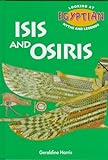
Geraldine Harris. Isis and Osiris. Lincolnwood, Ill.: NTC Publishing Group, 1997. 48 pp. $12.95 (cloth), ISBN 978-0-8442-4763-2.
Reviewed by Alexandra O'Brien (University of Chicago)
Published on H-AfrTeach (March, 1999)
This is a new U.S. edition of a book previously published in the UK in 1996. Harris has produced several books on ancient Egypt for younger readers, all of which are competent, useful and to be recommended. She has also retold Egyptian myths for the same audience, in Gods and Pharaohs from Egyptian Mythology, a lavishly illustrated book with paintings by David O'Connor (New York: Peter Bedrick Books, 1992, and worth looking up).
This book retells the legends surrounding Isis, her brother-husband Osiris and their son, Horus, all of whom had great troubles from another Egyptian deity, Seth due to his rival claim to the (primeval) throne of Egypt. The stories associated with Isis and her husband-brother Osiris have largely been preserved for us in the writings of Plutarch (De Iside et Osiride), while the Contendings of Horus and Seth are better known from Egyptian texts. Both the cult of Isis and that of the Apis bull became extremely popular under the Ptolemies, the period in which the present book is set.
Instead of a straightforward retelling of these tales, the author has chosen to use a frame story of two girls hired to play the parts of Isis and Nephthys during the rituals associated with the funeral of the Apis bull. The two girls are poor and uneducated, and so the priest who wants to hire them (they're twins and so would be perfect for the roles of Isis and Nephthys) has to tell them the stories of Isis and Osiris and of the struggles between their son, Horus and his rival, Seth. Using the priest to do the retelling is a useful device as it provides an audience for the tales in the two girls which facilitates an adaptation of the stories that is accessible to younger readers (9-12 years). Harris has managed to retell the stories without over-simplifying or modernizing them.
The author has broken down the tales into thirteen short chapters, each of which addresses a distinct part of the legend, and this--along with the inclusion of a "cast list" on p. 4, and the "note" on p. 47 which explains who the two little girls actually were (they are based on real individuals known from Memphite texts of the Ptolemaic period) along with other information on the setting's time and place--all facilitate the reading of the story. The decision to use photographs of actual artifacts to illustrate the book is a good and appropriate one. Colour photographs appear throughout, accompanied by explanatory labels which provide contemporary cultural setting and relevance for the tales recounted in the book.
Harris' book is a great introduction to Egyptian religion and mythology for younger readers and I recommend it (it's certainly good value too).
Copyright (c) 1999 by H-Net, all rights reserved. This work may be copied for non-profit educational use if proper credit is given to the author and the list. For other permission, please contact H-Net@h-net.msu.edu.
If there is additional discussion of this review, you may access it through the network, at: https://networks.h-net.org/h-afrteach.
Citation:
Alexandra O'Brien. Review of Harris, Geraldine, Isis and Osiris.
H-AfrTeach, H-Net Reviews.
March, 1999.
URL: http://www.h-net.org/reviews/showrev.php?id=2878
Copyright © 1999 by H-Net, all rights reserved. H-Net permits the redistribution and reprinting of this work for nonprofit, educational purposes, with full and accurate attribution to the author, web location, date of publication, originating list, and H-Net: Humanities & Social Sciences Online. For any other proposed use, contact the Reviews editorial staff at hbooks@mail.h-net.org.

