



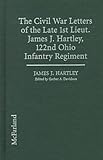
James J. Hartley Davidson, Garber A., ed. The Civil War Letters of the Late 1st Lieutenant James J. Hartley 122nd Ohio Infantry Regiment. Jefferson, N.C.: McFarland, 1998. 160 pp. $39.95 (cloth), ISBN 978-0-7864-0543-5.
Reviewed by Shannon Morris (Department of Foreign Languages, Marion Harding High School, Marion, OH)
Published on H-Ohio (February, 1999)
A Different Perspective on the Civil War
Readers will enjoy this book because it presents a personal account of the life of a soldier in the American Civil War, his day-to-day struggles, defeats, and triumphs in the attempt to stay alive and one day return to his loved ones back home. In a smaller, but no less important, sense, the book gives many insights into the life of the family the soldier left behind back in Ohio.
This book contains the personal letters home written by First Lieutenant James Jasper Hartley, One Hundred Twenty-Second Ohio Infantry Regiment to his wife, Mrs. Melissa J. Hartley between September 10, 1862, and June 1, 1864, when Mr. Hartley was killed by cannon fire at the battle of Cold Harbor, Virginia. Lieutenant Hartley is given the by-line of the book, with his great grandson, Garber A. Davidson, listed as editor. Mr. Davidson passed away in January of 1998 soon after the completion of the book. His wife, Madelyn Davidson, is acknowledged as having seen the book of her late husband through to publication. The eighty-nine letters which comprise this book are arranged in chronological order and excerpted. Mr. Davidson, through exhaustive research and family archives, fleshes out each letter and gives explanations for various comments mentioned within. Through the letters, then, troop movements and activities are traced and historical references are given. The editor thus frames the letters with descriptions of what the Northern Army was doing at each point of time over the two-year period represented by the letters.
Many of the letters (and thus corresponding parts of the book) become somewhat tedious in the reporting of the various aspects of life in the army that made the soldiers' day-to-day existence monotonous. For example, Lieutenant Hartley, was responsible for his company's provision and supply reports, and the letters explaining his daily routine often become somewhat less than interesting to the average reader removed from the action by one hundred thirty-five years and a lack of military experience.
But the vast majority of the book is filled with interesting, often humorous, accounts of how it felt to be a soldier in the mid-nineteenth century, descriptions ranging from the repetitiveness of camp food (p. 18) to the use of pine boughs (called "Virginia Feathers" in the soldiers' vernacular) cut and used as beds (p.60). Other passages give the reader a sense of what it was like to march long hours, often through mud, snow, and torrential downpours, toward an often unseen enemy, anticipating at any time being shot from the woods, only to find that at the end of the march your enemy was not where you expected him to be.
In editing the letters of his ancestor, Mr. Davidson points out that the era in which they were written was quite different from today's, especially in the area of language. While Lieutenant Hartley was a man of average education and perhaps above-average intelligence for his time, the letters demonstrate a much more formal style than would be seen in the correspondence of modern letter writers. In almost all of the letters, Mr. Hartley addresses his wife as "My Dear Wife" and frequently signs them with his full name, rank, and the location from which the letter is being written. At the same time, however, Lieutenant Hartley's letters contain many colloquialisms, misspellings, and grammatical errors, all of which are maintained in this book as they were written.
The letters often remind the reader that their author was a flesh-and-blood individual with hopes, desires, and opinions about the issues of the day. At several points in the letters, Lieutenant Hartley expresses his displeasure with the fact that Ohio Democrats had nominated as their candidate for the office of governor Mr. Clement Vallandigham, an anti-war Copperhead who vociferously opposed Abraham Lincoln's prosecution of the war. Many soldiers, including Hartley, considered Vallandigham a traitor and vigorously objected to his candidacy (Vallandigham was soundly defeated in the election by Republican John Brough). In other passages, Hartley makes comments of a more personal nature to his wife, such as occasionally gossiping about things and people that his wife has mentioned in her letters to him. (We are unfortunately deprived of the "other side of the story," as none of Mrs. Hartley's correspondence to her husband has survived.) Apparently, at one point that correspondence took on the form of a mild disagreement between husband and wife, because Lieutenant Hartley in one letter seems to take issue with something his wife had said in a previous letter because he felt that she had been making fun of him (p. 26).
Lieutenant Hartley apparently never lost sight of the fact that, even though he was engaged in the most horrible war that the nation had suffered up to that time, he was still a family man with a farm to take care of. In many cases Hartley conducts his farm business through the letters with the help of his wife, instructing her to sell a calf, get the sheep sheared, or how best to spend the pay he was sending home to her. Such letters lend a sense of reality and poignancy to the story.
Much of the appeal of this book rests on just such poignant moments and often revolves around situations that are never mentioned in regular history texts. For example, in one letter Hartley mentions that his company was caring for a small child that had been found en route during one of their many marches through the Virginia countryside. Unfortunately, no further mention was made of this child in later letters and the reader is left with the mystery of who this child was and what became of him or her. In another section of the book , the modern reader is reminded that the American Civil War was a conflict unlike any other in our history: on more than one occasion Lieutenant Hartley asks his wife to come to the area where he is encamped to visit him. This was apparently a fairly common occurrence, as Hartley mentions that the wives of several of the men had come to see their husbands at the site of battle. We are thus reminded that this was a war that "came home" to American citizens, unlike foreign wars in which we have engaged in years since. One of the most poignant moments in the entire book occurs in just such a venue. Hartley mentions that on one occasion, one of the members of the Southern Army, upon realizing that he was passing close by his own home, broke ranks to cross his backyard and greet his wife, who had come out the back door to see him. While the couple was engaged in a tender embrace on the porch of the family home, an enemy bullet struck the young soldier and he died in his wife's arms.
The book ends with four appendices that provide background information on the war in general and Hartley's company in particular: The first, "From Cold Harbor to Appomattox," relates the activities of Hartley's company after his death; the second, "A Note on Hartley's Language," discusses differences in language usage from then to now; the third, "Union Leadership," provides short treatises on Generals Grant and Meade; and the fourth, "Selected Letters," contains copies of Hartley's letters reproduced in the book. Overall, unlike traditional fictional accounts of the Civil War, in which the characters are the products of the imagination of the author, this book presents the true point of the Civil War: that this was a war fought by ordinary individuals, with real concerns and fears, not a conflict for some abstract ideal or concept, a war that deeply affected the participants' lives, and in many ways still affects our lives to this day.
Copyright (c) 1999 by H-Net, all rights reserved. This work may be copied for non-profit educational use if proper credit is given to the author and the list. For other permission, please contact H-Net@h-net.msu.edu.
If there is additional discussion of this review, you may access it through the network, at: https://networks.h-net.org/h-ohio.
Citation:
Shannon Morris. Review of Davidson, James J. Hartley; A., Garber, ed., The Civil War Letters of the Late 1st Lieutenant James J. Hartley 122nd Ohio Infantry Regiment.
H-Ohio, H-Net Reviews.
February, 1999.
URL: http://www.h-net.org/reviews/showrev.php?id=2741
Copyright © 1999 by H-Net, all rights reserved. H-Net permits the redistribution and reprinting of this work for nonprofit, educational purposes, with full and accurate attribution to the author, web location, date of publication, originating list, and H-Net: Humanities & Social Sciences Online. For any other proposed use, contact the Reviews editorial staff at hbooks@mail.h-net.org.

