



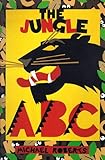
Michael Roberts. The Jungle ABC. New York: Callaway Hyperion, 1998. 64 pp. $19.95 (cloth), ISBN 978-0-7868-0398-9.
Reviewed by Donnarae MacCann (University of Iowa)
Published on H-AfrTeach (January, 1999)
Skillful graphic designers can sometimes do more damage than those who are less skilled. Michael Roberts is a case in point, as he buys into the popular culture that makes Africans fair game for stereotyping and ridicule. In Roberts' The Jungle ABC, the intended beauty and humor have been overwhelmed by a direct attack against Africanness--by distortions that have many antecedents in Western, imperialist books and artifacts.
Depictions of protruding, oversized mouths and other bodily features have been a typical means by which European perspectives vis-a-vis Africa have expressed themselves in the mass culture. In book illustrations, toys, advertisements, and home decorations, such distorted shapes have been the way of suggesting an African's alleged inferiority and subordinate position in the world. The text includes letters of the alphabet, paper cutouts, a fifteen-line poem, and a foreword by Iman, a fashion model in the United States who was raised in Somalia. The page headed "About Michael Roberts" contains a self-portrait and an account of the artist's many assignments in Europe and the USA. This collage indicates that Roberts is himself of African descent, a fact that has not made him immune to the Western habit of misrepresenting Africa. His exaggerated figures are more alienating than engaging. There is no hint of African self-definition in the forms, no self-authenticating statement. In a few cutouts we see references to traditional African art objects (e.g., textiles and sculptures), but most pictorial references are to nineteenth century cartoons and their counterpart in "blackface" minstrel performances. On the letter "X" page, for example, the xylophone player's mouth takes half the space on his face, as was typical of "stage Negro" facial make-up. The point was and is to mock Africanness rather than suggest an array of human differences. On the G, F, Q, R, T, and Z pages, there are additional symbols of African underdevelopment, primitiveness, childishness, extremism, and animality. As the poem states explicitly, the "Zulus prance" in "exotic" and "snake-like dance." This work is a throwback to a benighted, colonialist era that lacked even a touch of subtlety in presenting its biases. It points to the way the West is still using its power to control the African image--to degrade and express contempt for it.
"Ridicule," says sociologist Hugh Duncan, "makes us inferiors ... The social essence of comedy is ... shared joy ..." (Communication and Social Order, 1962, p. 390). This principle serves as a good test for well-intentioned efforts to amuse Western audiences. If comedy has no social meaning unless there is "shared joy," how can The Jungle ABC qualify as humor? Chinua Achebe has explained why even good intentions can badly misfire. He comments that "white racism against Africa is such a normal way of thinking that its manifestations go completely unremarked" (Hopes and Impediments, 1989, p. 12).
One way to verify this "normal way of thinking" is to examine its many manifestations in Kenneth W. Goings's Mammy and Uncle Mose: Black Collectibles and American Stereotyping (1994) and in the works cited in his bibliography. The Jungle ABC fits right in with these deplorable antecedents. It reinforces a negative perspective that remains, as Goings notes, remarkably "seductive" even as the twentieth century winds down (p. xxiv).
Copyright (c) 1999 by H-Net, all rights reserved. This work may be copied for non-profit educational use if proper credit is given to the author and the list. For other permission, please contact H-Net@h-net.msu.edu.
If there is additional discussion of this review, you may access it through the network, at: https://networks.h-net.org/h-afrteach.
Citation:
Donnarae MacCann. Review of Roberts, Michael, The Jungle ABC.
H-AfrTeach, H-Net Reviews.
January, 1999.
URL: http://www.h-net.org/reviews/showrev.php?id=2711
Copyright © 1999 by H-Net, all rights reserved. H-Net permits the redistribution and reprinting of this work for nonprofit, educational purposes, with full and accurate attribution to the author, web location, date of publication, originating list, and H-Net: Humanities & Social Sciences Online. For any other proposed use, contact the Reviews editorial staff at hbooks@mail.h-net.org.

