



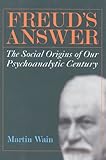
Martin Wain. Freud's Answer: The Social Origins of Our Psychoanalytic Century. Chicago: Ivan R. Dee Publisher, 1998. xv + 366 pp. $28.95 (cloth), ISBN 978-1-56663-216-4.
Reviewed by Richard W. Bloom (Department of Humanities and Social Sciences, Embry-Riddle Aeronautical University)
Published on H-Review (January, 1999)
An Answer without a Question?
Wain's point of departure is that the writings of Sigmund Freud have had tremendous effects--psychological, social, cultural, political, etc.--for over one hundred years. And for over one hundred years many readers and nonreaders alike have sought to discover, infer, construct, and deconstruct meaning from the Freudian corpus and/or Neo-Freudian spawnings as well. But after a very close reading of Wain's text, I am not sure--referring to the text's title--to what question and to what meaning Freud is answering. Is Wain giving us his take on Freud's take on Freud's purpose in writing? Wain's take on Freud's purpose in writing regardless of whether this purpose was Freud's take or whether Freud was aware of his (Freud's) purpose? Wain's take on the meaning of Freud's writings or the consequences of these writings for various population segments at various times? Wain's take on the consequences of Freud's writings--beyond meaning--for various population segments at various times? Or Wain's take on various causal and epiphenomenal factors affecting Freud's writings and their consequences? Other readers of this text may field additional candidates.
Wain's argument seems to run as follows. If Freudian psychoanalysis is not a science or therapy, what is it? A scientific or therapeutic failure? A hoax--from outright fraud to a self-deluded mimesis of science and therapy? A scientific, therapeutic, or other failure induced through the effects of cocaine on Freud's cognitive, emotional, motivational, and behavioral functioning? An aggressive attack or means of revenge by a Jew against a largely Christian Europe? An attack against Victorianism or political authoritarianism--or even support for the latter? An expression of Viennese decadence, his own sexual and aggressive strivings concerning his mother and father, or psychopathology? An unwitting contribution to aiding and abetting false consciousness? An attempt at social reform? All are alluded to, as are fragments of intellectual, social, cultural, and political histories leading up to Freud's psychoanalytic writings, but Wain's answer--billed as Freud's answer--is that psychoanalysis is a belief system that supports liberal democracy. Wain's (Freud's) answer may be correct, if one assumes that these days it is not too politically incorrect to be correct in intellectual circles--save for being correct in one's political correctness about what is politically correct and incorrect. However, there is still the problem of the question and meaning to which Wain (Freud) is answering.
Does Wain mean to imply that Freud set out to be an applied political scientist as savior of liberal democracy--a line of thought that contends with the more usual Freudian progression from neurologist to psychologist to social commentator? Or that Freud's writings have been most significantly valid, effective, or consequential in support of liberal democracy? The former conclusion does not seem to bear up to biographical and psychobiographical data on Freud.[1] And the latter conclusion, when taken seriously as the origin of an analogy, might lead to a text entitled Nietzsche's Answer and the conclusion that his answer was and is support for the social nationalism of Naziism--a serious misreading of Nietzsche's writings unless clearly explicated as these writings' misuse.[2] Less contentious are conclusions that psychoanalysis can or has supported liberal democracy as viewed by various population segments at various times.[3]
The reader of Wain's text also must be forewarned about three other issues--the scientific and therapeutic status of psychoanalysis, discussions of psychoanalytic theory, and descriptions of historical trends. As to the first, the reader would be excused for wondering what all the fuss is about. This is because the contemporary vitality of psychoanalysis as science and therapy is not conveyed. There are many scientific and therapy journal articles and books on psychoanalysis, a very large number of behavioral scientists interested in psychoanalysis as exemplified by membership in professional organizations, and many psychoanalytic concepts that are integral to contemporary behavioral science.[4] Yet Wain's whole argument stems from the premise that psychoanalysis is neither a science nor a therapy. One might strongly support this premise, but Wain doesn't attempt to provide an exposition let alone persuade us.
As to Wain's discussion of psychoanalytic theory, advocates and opponents of psychoanalysis--pace, psychoanalyses--could strongly support the position that these discussions are simplistic and outright misleading. For example, consider "Freud's two-part scheme of conscious ego and unconscious libido, the ego is the hero and the libido is the villain, his [Freud's] later three-part scheme of id, ego, superego, the villain is the childish id (libido, unconscious), the hero is again the ego" (p. 213). Wain's take on Freudian "scheme(s)" is actually a misshapen and misbegotten creation of apples, oranges, and, perhaps, a few pineapple grenades--specifically dynamic (conflictual), topographical (conscious-preconscious-unconscious), economic (psychological energy), genetic (developmental), and structural (elements of the mind) aspects of Freud's model of the mind.[5] Libido is not inevitably the villain. Instead--depending on the continuous interactions of the five main aspects of Freudian model--the libido or any other constituent can be parts of problems or of solutions.[6] I must stress that the two Freudian schemes cited by Wain are similar to discussions in many secondary sources on psychoanalysis that, unfortunately, misrepresent its strengths, weaknesses, and very substance.
As to Wain's descriptions of historical trends, the reader must be careful not to be--as certain academics are wont to assert in this day and age--victims of subjugating discourse. For example, consider the very first sentence in the text--"There was once a time emotionally more comfortable--in retrospect--than our own" (p. 5). It is more likely that save for some nihilists, deracinated existentialists, and incorrigible Wobblies there always is a time that seems more emotionally comfortable regardless of one's temporal reference point. Or consider "By lifting the ban of medieval anti-Semitism, modernity had performed a great work for Freud and his co-religionists" (p. 75). This would surely be news to Freud and his co-religionists who experienced anti-Semitism throughout their lives. As a third example, Wain's uncritical acceptance of Cushman's social/nonsocial distinction between neopsychoanalysts Harry Stack Sullivan and Melanie Klein (p. 302) can be severely challenged by noting the significant body of work that applies Kleinian concepts to group and organizational psychology.[7]
Today there is still a vibrant controversy about much that can be ascribed to be or not to be Freudian--as can be attested to by the events leading up to the current Library of Congress display of Freudian artifacts.[8] This controversy reinforces Wain's point of departure on the significance of psychoanalysis as does a recent reviewer of a text on the Library of Congress display who opines that "Eighteen contributors agree on Freud's paramount importance, but differ on everything else."[9] Wain appears to have read widely, and his bibliography is a valuable reference for those readers new to the area. However, if Wain posed a clearer question and quest for meaning about psychoanalytic discourse, the experienced and the neophyte might both more profitably benefit from Wain's (Freud's) answer.
Notes
[1]. See, for example, Ernest Jones, The Life and Work of Sigmund Freud (New York: Basic Book, 1995) and Peter Gay,Freud: A Life for Our Time (New York, W.W. Norton, 1998).
[2]. See Walter Kaufmann, Nietzsche: Philosopher, Psychologist, Antichrist (Princeton, Princeton University Press, 1974).
[3]. For further discussion, see Erich Fromm, Escape from Freedom (New York: Henry Holt, 1955).
[4]. See, for example, American Psychological Association, available on line at http://www.apa.org, and the 1997 Annual Report published in the August 1998 edition of American Psychologist, 53(8).
[5]. See Calvin S. Hall, Gardner Lindzey, & John B. Campbell, "Sigmund Freud's Classical Psychoanalytic Theory," in Theories of Personality (4th ed.) (New York: John Wiley & Sons, Inc, 1998) pp. 30-77.
[6]. See Ruben Fine, History of Psychoanalysis (NY: Jason Aronson, 1990).
[7]. See Wilfred Bion, Experiences in Groups and Other Papers (Tavistock, 1991).
[8]. See Michael S. Roth, Freud: Conflict and Culture, (Alfred A. Knopf, 1990).
[9]. Paul Robinson. "Symbols at an Exhibition," The New York Times Book Review (November 22, 1998) p. 12.
Copyright (c) 1999 by H-Net, all rights reserved. This work may be copied for non-profit educational use if proper credit is given to the author and the list. For other permission, please contact H-Net@H-Net.MSU.EDU.
If there is additional discussion of this review, you may access it through the network, at: /reviews.
Citation:
Richard W. Bloom. Review of Wain, Martin, Freud's Answer: The Social Origins of Our Psychoanalytic Century.
H-Review, H-Net Reviews.
January, 1999.
URL: http://www.h-net.org/reviews/showrev.php?id=2682
Copyright © 1999 by H-Net, all rights reserved. H-Net permits the redistribution and reprinting of this work for nonprofit, educational purposes, with full and accurate attribution to the author, web location, date of publication, originating list, and H-Net: Humanities & Social Sciences Online. For any other proposed use, contact the Reviews editorial staff at hbooks@mail.h-net.org.

