



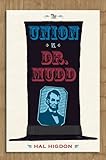
Hal Higdon. The Union vs. Dr. Mudd. Gainesville: University Press of Florida, 2008. xvi + 241 pp. $24.95 (paper), ISBN 978-0-8130-3267-2.
Reviewed by Michael W. Kauffman
Published on H-CivWar (April, 2010)
Commissioned by Martin P. Johnson (Miami University Hamilton)
Dr. Samuel Mudd and the Dispute That Never Ends
For complexity, drama, and human interest, few episodes in American history can rival the assassination of Abraham Lincoln. This stunning incident, coming at the end of the Civil War, gave rise to a wealth of conspiracy theories and continues to provide fodder for speculation about the who, how, and why of a seemingly senseless act of political violence.
The body of literature on the assassination is large and varied, and it should come as no surprise that most of it seeks to blame one group or another for inspiring (and perhaps ordering) John Wilkes Booth to commit the fatal deed. Perhaps more surprising is the attention given in the past century to the case of Samuel Alexander Mudd, the Maryland physician whose house Booth visited in the early morning hours after the shooting in search of treatment for a broken leg. In recent years, Mudd has been the focus of more books and articles than even the assassin himself. Each publication sparks another round of debate and an escalation in rhetoric.
In its basic form, the story of Dr. Mudd sounds simple enough: the actor John Wilkes Booth shot and killed President Lincoln at Ford’s Theatre in Washington on the night of Good Friday, April 14, 1865. At four o’clock the following morning, Booth and a companion named David Herold appeared at the Mudd farm, thirty miles south of the capital, seeking treatment for a leg fracture that Booth had suffered in his escape. When detectives learned that the assassin had stayed at Mudd’s home on a previous occasion, they began to wonder whether the doctor had been an active member of Booth’s plot from the beginning.
Mudd stood trial before a military commission as one of the so-called Lincoln conspirators. He was convicted and sentenced to life at hard labor in the Dry Tortugas, a small cluster of islands in the Gulf of Mexico, and home to Fort Jefferson, dubbed “America’s version of Devil’s Island.” When yellow fever swept through the fort, Mudd could easily have escaped, but he chose to stay and administer medical aid to his captors. In gratitude, more than two hundred members of the garrison petitioned President Andrew Johnson to pardon the doctor, and Johnson did so in the final month of his administration. Mudd had served less than four years of his sentence, returning to Maryland a bitter and broken man.
Dr. Mudd might have faded into obscurity, but for the publication of Osborn H. Oldroyd’s The Assassination of Abraham Lincoln (1901), which relied heavily on information supplied by Louis J. Weichmann, the principal witness against Mudd at the conspiracy trial. Weichmann was a lightning rod in his own right, and his trial testimony was challenged vigorously only hours after he left the witness stand. His contribution to the Oldroyd book has only recently come to light.
When Oldroyd stated flatly that Dr. Mudd had been guilty as charged, the doctor’s family felt compelled to present their own side of the story. In The Life of Samuel A. Mudd (1906), Nettie Mudd Monroe published a wealth of letters her father had written from prison, supplementing them with additional papers and photographs passed down in the family. This book has become a valuable source of information on the case, and its graphic scenes of mistreatment and suffering add a sympathetic dimension to the story.
The book was favorably received, and before long the public came to believe that Dr. Samuel Mudd had been a scapegoat of the government. Director John Ford even made a film about the case. The Prisoner of Shark Island (1937) starred Warner Baxter and Gloria Stuart, with Nettie Mudd Monroe as a consultant.
With a sympathetic image of Dr. Mudd building in the background, Nettie’s nephew, Dr. Richard D. Mudd, began an eighty-year campaign to clear his family name. The second Dr. Mudd insisted that, in setting Booth’s leg, his grandfather had done nothing more than his duty as a physician. He was a simple country doctor, torn from his home and family to serve as an example for slaveowners and southern sympathizers who had gone unpunished throughout the war.
This picture was largely accepted by the time Hal Higdon’s book, The Union vs. Dr. Mudd was published in 1964. This dramatic narrative, written for a popular audience, was the first of many books written by Higdon, a journalist and world-class distance runner.
Higdon was the first author to make the point that there were two sides to the story of Dr. Mudd. He pointed out that prosecutors in 1865 were not merely casting a net for scapegoats. They had learned that Mudd and Booth had known one another before the assassination, and that Mudd had introduced Booth to John Surratt, another conspirator, at a meeting in Washington. They charged the doctor with conspiracy, not merely helping Booth escape, and their initial suspicions were perfectly understandable. After an examination of the trial testimony, Higdon concluded that the government did not prove its case.
In truth, the evidence is contradictory and often quite confusing. Perhaps that is what accounts for the public’s continuing interest in the case. Higdon recognized this, and was careful not to step too far into one camp or the other. Although The Union vs. Dr. Mudd is sympathetic to the doctor’s defense, it does not gloss over the awkward facts. It highlights Booth’s overnight visit to the Mudd farm in late 1864, as well as an encounter between Booth, Mudd, and Surratt just before Christmas of that year.
Higdon accepted two points that the prosecution regarded as crucial to their case, and which historians have found especially damning. He repeated the claim, put forth in trial testimony, that Mudd was less than candid about whether he had recognized Booth during his early-morning visit of April 15. Booth was still resting at the Mudd farm when the doctor went to the nearby village of Bryantown, and he might easily have alerted authorities to the assassin’s whereabouts while Booth was still within reach.
Higdon also contends that Mudd deceived authorities when he told them that he and Booth had only met once before the night of Lincoln’s assassination--a claim they found easy to refute. For many, these points were hard to explain away; if Mudd were innocent, the reasoning goes, why would he need to lie?
To his credit, Higdon recognized that in a criminal trial, inference is not enough for a conviction. He argued, as many others have, that the military commission was organized specifically to convict, and that they sometimes bent the law to achieve that result. He noted that prosecution witnesses had been discredited, and one even died later in prison.
Moreover, Higdon went no farther than the facts warranted. Though Louis Weichmann, mentioned above, testified in detail about a meeting between Mudd and Booth in January of 1865, Higdon concedes that the only serious flaw in his testimony was the date of the occurrence. Like Dr. Mudd himself, he did not try to destroy Weichmann, but only to correct some of his errors. To have done otherwise would have seemed strident and less believable. In all, he approached the subject as a journalist, seeking balance and impartiality in a field that had already drawn its share of partisans.
Higdon’s book was followed by The Riddle of Dr. Mudd (1974) by Samuel Carter III, His Name Was Mudd (1991) by Elden Weckesser, Dr. Mudd and the Lincoln Assassination: The Case Reopened (1995), edited by John Paul Jones, and Dr. Samuel A. Mudd and the Lincoln Assassination (1995) by John E. McHale, Jr., all of which were relatively friendly to the Mudd version, or at least, hostile to the military commission that tried him. (McHale, it should be noted, was a son-in-law of Dr. Richard Mudd).
Though the tide was still moving in Mudd’s favor, the undercurrents were pulling in a different direction. In 1992 the doctor’s grandson appealed to the Army Board for the Correction of Military Records to overturn his grandfather’s conviction. This board acted, essentially, as an appeals court for cases prosecuted under military law, and the Mudds scored an important victory when it decided in their ancestor’s favor. The board members, however, allowed the Mudd family to address them. This was intended as a courtesy, as only legal points (and not historical ones) were to be considered, but it angered those who wanted to argue for the other side.
Under intense lobbying, the Secretary of the Army decided not to reverse Mudd’s conviction as the board recommended. Writer James O. Hall distributed a series of memoranda outlining the case against Dr. Mudd, and shortly afterward Edward Steers Jr. published an anti-Mudd book that repeated and even amplified the claims then being circulated. Enthusiastically endorsed by Hall and others, His Name is Still Mudd (1997) was treated as the new gold standard on Mudd books, in spite of its obvious drawbacks. It repeated the accusations made by the prosecution in 1865 but ignored the testimony offered in rebuttal. As the subtitle conceded, this was “The Case Against Dr. Samuel Alexander Mudd.” It made no pretense of balance.
Encouraged by the favorable reception, Steers continued to write articles and speeches about the case. In a subsequent book, Lincoln Legends (2007), he devoted a full chapter to the man he had grown accustomed to calling “the deceptive doctor.” Though this book provided source notes, they often referred the reader back to Steers’s own earlier work, which was not annotated.
By and large, the public has found the Steers version of the Mudd case convincing. But like those of his counterparts on the other side, his appeal is more emotional than reasonable. He put far too much emphasis on the trial testimony. Normally, this would seem a safe bet to guarantee accuracy. But the Lincoln conspiracy trial was no ordinary proceeding, and the record it produced is extraordinarily unreliable. A survey of the War Department’s own records (such as those of the Army’s Continental Commands, which show the day-to-day movements of troops and detectives) would show that some of their own witnesses were swearing falsely on the stand. The Mudds have long maintained that this was the case, but as yet, no writer or historian has undertaken a detailed study to prove or disprove the point. If the aim is to determine whether Dr. Mudd was falsely accused, it seems to me that a close scrutiny of all the records is absolutely necessary.
Had he delved a little deeper, Hal Higdon might have noticed that a pivotal claim against Mudd--that he had falsely denied seeing Booth after their initial meeting in Maryland the year before--actually originated with a prosecution witness, and not with the doctor himself. Clearly, Mudd had seen Booth on at least two more occasions, and at the earliest opportunity he spoke freely about those incidents. But that would come later. By the prevailing laws of the day only government witnesses could testify on the matter, and it was this, more than anything else, that tipped the balance against Mudd in that sweltering courtroom. It is ironic that modern historians put their faith in the testimony produced and influenced by such an archaic rule. Mudd eventually issued a heated challenge to that testimony, but by that time he was in prison, and his words were not widely read.
With arguments raging on all sides, Robert K. Summers stepped quietly into the fray with the publication of The Fall and Redemption of Dr. Samuel A. Mudd (2007), followed by two book-length monographs: Dr. Samuel A. Mudd at Fort Jefferson (2008) and The Slaves of Dr. Samuel A. Mudd (2008). Summers, a great-grandson of Dr. Mudd, is less preoccupied with exonerating his famous ancestor than with building on the historical record. His archival research has turned up surprising new information on Mudd--not all of it flattering--and he shares it without hesitation. He is a firm believer in the doctor’s innocence, but he is also a scholar, and aims to make his points in a calm and professional manner.
A missed court deadline eventually ended the Mudd family’s legal battle, and their opponents have steadily gained strength in subsequent years. It is in this light that Hal Higdon resurrected his 1964 book. His “Final Word” briefly summarizes the events of recent years and the current trend of thought on the case. He allows that perhaps Dr. Mudd “was guiltier than as currently portrayed” (p. 223). Nevertheless, his first impression still stands: the doctor “was no simple martyr,” but “was guilty only of being an accessory after the fact” (p. 210).
To his credit, Higdon did not merely regurgitate his earlier work in order to supplement his income. He looked at the case again and decided that his opinion had not changed much in the intervening years. He remains convinced that the trial was indeed one-sided, the testimony was tainted, and the circumstances of Mudd’s incarceration are a blot on our history. It is a lesson tailored to more recent times, as military commission trials are being revived in the wake of the 2001 terrorist attacks.
These trials may indeed be unfair, the treatment of prisoners may be brutal, and Americans perhaps ought to insist on remaining above such things. But those questions are quite separate from the issue of an individual’s guilt or innocence. Writers have argued about Dr. Mudd for more than a century, but until they look more closely at the laws and evidence that were brought to bear against him, they will continue to generate more heat than light. In The Union vs. Dr. Mudd, Hal Higdon took a small step in the right direction, and for that he is to be commended.
If there is additional discussion of this review, you may access it through the network, at: https://networks.h-net.org/h-civwar.
Citation:
Michael W. Kauffman. Review of Higdon, Hal, The Union vs. Dr. Mudd.
H-CivWar, H-Net Reviews.
April, 2010.
URL: http://www.h-net.org/reviews/showrev.php?id=26379
 | This work is licensed under a Creative Commons Attribution-Noncommercial-No Derivative Works 3.0 United States License. |

