



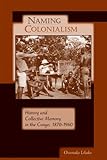
Osumaka Likaka. Naming Colonialism: History and Collective Memory in the Congo, 1870-1960. Madison: University of Wisconsin Press, 2009. 211 S. $26.95 (paper), ISBN 978-0-299-23364-8.
Reviewed by Curtis Keim (Moravian College)
Published on H-Africa (July, 2010)
Commissioned by Brett L. Shadle (Virginia Tech)
Names as Sources of Colonial History
In this book, Osumaka Likaka proposes and demonstrates a method for exploring the ideas and actions of Congolese villagers during the colonial era. Historians have explored texts left by colonizers, but villagers did not leave texts. They did, however, leave mnemonics of their experiences in the names they gave to individual colonists. When analyzed carefully, such names as Mundele Nioka (White Man Who Is a Snake), Pole-Pole (Go Slow), and Sikoti (Whip) become commentaries on individual colonizers and on the colonial experience. Likaka has collected hundreds of Central African names for Europeans and has investigated their meanings through dictionaries, interviews, and texts. His book explores the meanings of names in three periods: the precolonial, early colonial, and high colonial eras.
In the precolonial period, names were more than simple markers of individuality. Rather, Congolese names usually derived from specific contexts, such as a family’s situation at the time of a birth (e.g., “there is a God”), the circumstances of birth and qualities of a baby (e.g., “unripe” for a premature birth, a name signifying birth order, or a name to chase evil spirits), and historic names and events (e.g., the name of a powerful ancestor, family, or king). Not only did these names signify social individuality, but they also situated an individual within the social world. Thus names could also be used to help integrate foreigners into village life, often following an incorporation ritual, such as blood exchange. The violence of the colonial conquest and Free State period (to 1908) is reflected in the fact that names of this era tend to emphasize violent acts: Whip, Gun, Push, Push the Beasts, Defecator, and, of course, Breaker of Rocks (Bulla Matari) for Henry Stanley. A few names show respect, such as those for some Catholic missionaries, for hard workers, or fair administrators, but the majority signify extreme disruption and force.
Under Belgian rule after 1908, more administrators came to Congo and more Africans were in contact with Europeans. High taxes and fines forced Africans to participate in the colonial system while low and fluctuating prices for agricultural products bred economic insecurity. Names, says Likaka, provide better insight than scholarly analysis into both the resulting disruption of village life and the rural contestation of the colonial system. Names such as Rush-Rush, Big Troublemaker, Arbitrary Arrest, Witch, Cannibal, Red Pepper, and Venomous Snake are comments on the colonial situation and on how colonial administrators were understood. The meaning of names could change as circumstances changed so that a name could be interpreted in one way at first and come to mean something entirely different as a colonial career progressed. Moreover, names could carry purposefully ambiguous meanings. Likaka illustrates this possibility with Monganga na Mabele, a Lingala name given to a prospector. Taken one way the name would be Earth Doctor or Earth Healer, but taken another, it would be Earth Sorcerer or Earth Polluter. Thus the violence implied in names is sometimes revealed only by village-level investigation.
One particularly revealing section of the book deals with the treatment of women by government officials, including the practice of having a ménagère, a young African woman who ran the household and provided “services ... beyond the call of such duties,” and that of chiefs providing women to agents who were traveling (p. 114). These types of customs promoted abuse of African women by agents and chiefs, and some names (e.g., Womanizer, Chaser of Women, and He Who Loves Mother) reflect such “predatory sexual conduct” (p. 118).
Likaka frequently emphasizes that names represent “surreptitious forms of protest” (e.g., p. 160). He notes that through naming “Congolese kept some measure of cultural autonomy that accurately identified and gave face to their oppressors and exploiters” (p. 159). Yet names themselves were not always surreptitious; often villagers gave two names to Europeans, one surreptitious and one public. The public name, usually a praise name, often served as a tool of negotiation between villagers and individual administrators. It could, for example, show that villagers were willing to comply with colonial policies deemed to be fair and thus signal to an administrator that he ought to treat villagers well. For his part, an administrator might “mediate paternalistic dominance” (through appropriation of his praise name (p. 161). By trying to live up to his name he could emphasize the benefits of colonialism and cooperation. Thus investigation of praise names shows how villagers participated in the construction of the colonial world and explains “how colonial officials negotiated the boundaries of the colonial world at the village level rather than unilaterally imposing them” (p. 145).
Other administrators used terror in their negotiations with villagers. They therefore embraced violent names in their efforts to collect taxes, recruit labor, expand cash crop farming, and destroy traditional religious symbols. Likaka gives the example of Tshoma-Tshoma (He Who Burns People), a tax collector of the 1930s whose name and reputation were coercive weapons that substituted for actual corporal punishment. Yet as time passed threats of violence and actual violence could not maintain the colonial order. Thus, Likaka concludes, “the expression of accusations of suffering through cultural forms not only sapped the authority and prestige of tax collectors, agricultural officers, and territorial administrators but also tormented their consciences” (p. 156).
Likaka’s work goes significantly beyond what we already know--that Africans were not passive victims of colonial exploitation--by providing many concrete examples of ways in which Congolese villagers negotiated the colonial experience. This book will be most helpful to those scholars who want deeper insight into the Central African colonial world and those who plan to explore naming practices as a research method. Undergraduate students and general readers will find the book challenging, but I especially recommend to them chapter 2, “Colonialism and the Village World,” which provides an excellent overview of the impact of colonialism on Central African village life.
If there is additional discussion of this review, you may access it through the network, at: https://networks.h-net.org/h-africa.
Citation:
Curtis Keim. Review of Likaka, Osumaka, Naming Colonialism: History and Collective Memory in the Congo, 1870-1960.
H-Africa, H-Net Reviews.
July, 2010.
URL: http://www.h-net.org/reviews/showrev.php?id=26350
 | This work is licensed under a Creative Commons Attribution-Noncommercial-No Derivative Works 3.0 United States License. |

