

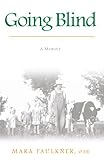
Mara Faulkner. Going Blind: A Memoir. Albany: SUNY Press, 2009. xi + 227 pp. $60.00 (cloth), ISBN 978-1-4384-2667-9; $19.95 (paper), ISBN 978-1-4384-2668-6.
Reviewed by Edward (Ed) T. Morman (National Federation of the Blind Jernigan Institute)
Published on H-Disability (February, 2010)
Commissioned by Iain C. Hutchison (University of Glasgow)
Of Disability and Dispossession: Blindness, Literal and Metaphoric
Mara Faulkner is a Benedictine sister who teaches English at the College of St. Benedict in Minnesota. On her department’s Web site, among her scholarly interests, Faulkner lists working-class literature and contemporary Irish literature; she describes her PhD work as centered on women’s literature, feminist criticism, U.S. literature, and creative writing. She is the author of Protest and Possibility in the Work of Tillie Olsen (1993) and a book on Benedictine women. In a paper on feminist pedagogy, she urges teachers to show greater emotion in talk about peace. In all, Faulkner comes across as a person who regards the examination of life as important and who wishes the earth and its inhabitants well.
Faulkner’s interest in disability studies derives from the retinitis pigmentosa that afflicts her paternal family, a condition that is slowly causing her to lose her vision and that blinded her father almost totally by the time she had reached adulthood. She calls Going Blind a “memoir,” but I am inclined to agree with the blurb writer at SUNY Press who refers to it not only as a memoir but also as a “meditation on blindness” (http://www.sunypress.edu/p-4822-going-blind.aspx). Faulkner meditates to better understand blindness both as a real bodily disability and as a convenient word on which to hang a wide range of metaphorical meanings. She smoothly moves back and forth between what her father’s disability meant to her own family, and what “blindness” to suffering and injustice mean to the world at large.
Dennis Faulkner never accepted his vision loss, choosing instead to pretend that he could see. Mara understands this and retrospectively accepts his decision, even as his bitterness and refusal to learn how to function as a blind person contributed to the poverty and hard life she, her mother, and her siblings experienced. She contrasts her father’s experience with those of blind people of accomplishment, including such writers as Stephen Kuusisto, John Howard Griffin, and Sally Wagner. The lesson she draws from looking at literal blindness--the inability to see well enough to get along by depending on vision--is that it is okay to be blind. While she regrets her father’s inability to understand this, she also grants him the right to live as he saw fit. She celebrates the lives of everyday blind people who lead normal lives using alternative techniques for getting around. And she celebrates blind people like Erik Weihenmeyer, who reached the summit of Mount Everest in a 2001 expedition, while she objects to setting such feats as a criterion for success in life.
The memoir aspects of the book center on her family’s life in North Dakota of the 1940s and 50s, where her parents eked out a living from a small store. Faulkner effortlessly leaps from her parents’ circumstances to the lives of the people around them and uses the nonliteral meanings of blindness to explore the suffering of others. The others about whom she comments are all defined by ethnic categories, ethnic groups that, in common, have been dispossessed. The first she discusses are her own Irish ancestors, whose suffering in the years of famine continued to resonate in her father’s attitudes. After discussing this group, near to her by blood ancestry, she moves on to others who lived in geographic proximity to her North Dakota home. The Germans from Russia (a term Faulkner notes is preferred over “Russian Germans”), who had moved east in the eighteenth and early nineteenth centuries, only to find their culture devalued by the last czars and the Bolsheviks, and who then crossed the Atlantic to reestablish themselves as agriculturalists in the northern plains. Faulkner also remembers the Japanese Americans who were relocated from their West Coast homes, and the occasional black man who appeared in her parent’s store. Most poignant, not surprisingly, is her discussion of the Mandan, Arikara, and Hidatsa Indians, whose repeated attempts to reestablish themselves in a world dominated by European Americans ultimately left them with virtually nothing. Faulkner recruits the sometimes offensive figurative uses of the term “blind” to forge a bond between different subaltern groups--and between the broader categories of “ethnicities” and “disabilities.” In doing so, she provides scholars and teachers the opportunity to explore--among themselves or with students at any level--how we create and define “disadvantage.”
The book at hand is not a scholarly work; if it were, Faulkner would be vulnerable to faultfinding for more than one error of fact. Most evident was the consistent misspelling of the name of the president of the organization for which I work. I started noting other mistakes, but abandoned doing so when I saw that such gaffes scarcely diminished the value of this beautiful book. I heartily recommend it as a good read and as a thought-provoking undergraduate selection.
If there is additional discussion of this review, you may access it through the network, at: https://networks.h-net.org/h-disability.
Citation:
Edward (Ed) T. Morman. Review of Faulkner, Mara, Going Blind: A Memoir.
H-Disability, H-Net Reviews.
February, 2010.
URL: http://www.h-net.org/reviews/showrev.php?id=26327
 | This work is licensed under a Creative Commons Attribution-Noncommercial-No Derivative Works 3.0 United States License. |

